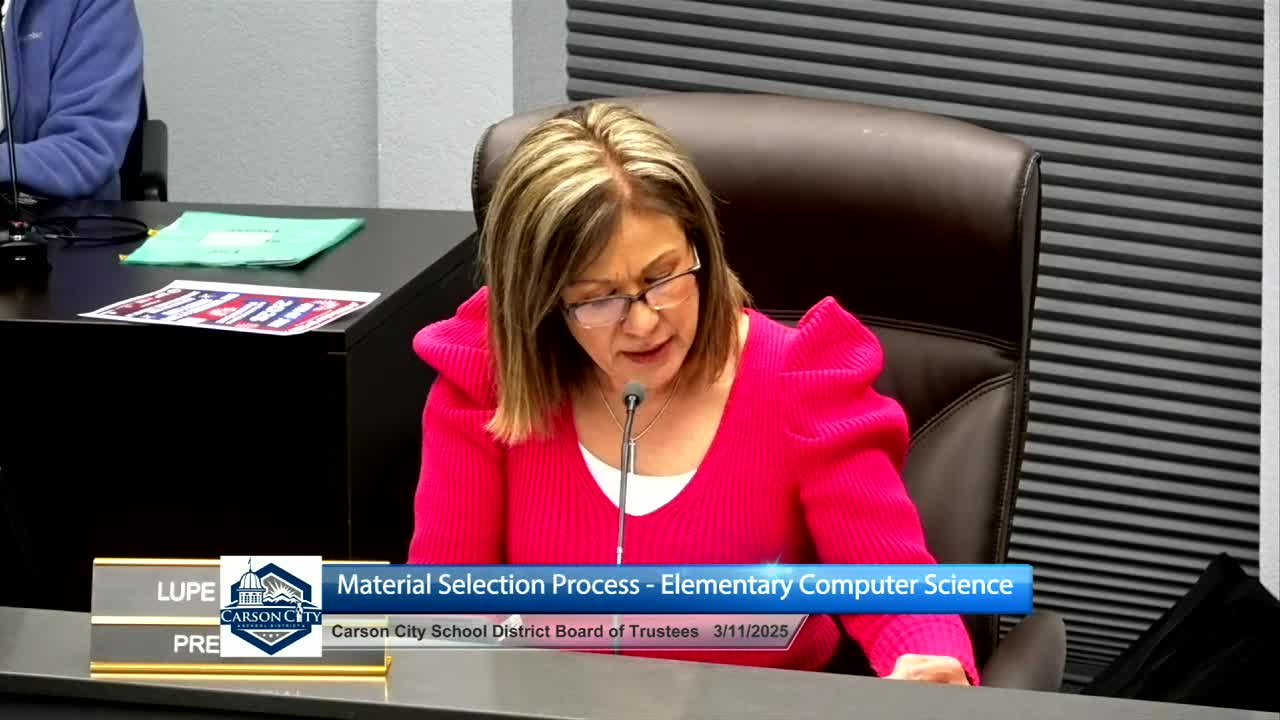
Carson City schools present Skillstruck Launchpad as recommended elementary computer-science curriculum
Loading...
Summary
The Carson City School District instructional team presented its recommendation to adopt Skillstruck Launchpad as the district’s core K–5 computer‑science curriculum following a district review process.
The Carson City School District instructional team presented its recommendation to adopt Skillstruck Launchpad as the district’s core K–5 computer‑science curriculum following a district review process. The presentation at the board meeting summarized the selection rubric, public review, expected costs and an implementation timeline.
The review team, led by Rhonda Wallace, K–12 electives and computer‑science curriculum coordinator, told the board it evaluated the three Nevada Department of Education–approved elementary computer‑science options and scored them on teacher accessibility, equity and content alignment. “A well‑designed computer‑science curriculum must address accessibility for teachers,” Wallace said, and must align to state standards while providing vertical progression from kindergarten through fifth grade.
Tara Babula, a K–5 computer‑science teacher at Mark Twain Elementary, described the team’s needs assessment and said many elementary teachers currently rely on self‑created or externally purchased materials. “Many of our individual teachers are paying out of pocket or using classroom resources,” Babula said, arguing that a district‑selected core would create consistency when students transfer between schools.
Irene Waltz, a district computer‑science teacher who participated in the product demonstrations, outlined why Skillstruck was the team’s top choice. The district team cited in‑person vendor demonstrations, accessibility features for students with diverse needs, an auto‑grader and teacher dashboard, COPPA and FERPA compliance, and built‑in formative/summative assessments and rubrics. Waltz said the vendor had offered to support a districtwide community engagement event and provided a teacher help line and professional‑learning supports.
Adrienne Wiggins reviewed an impact study the vendor supplied showing gains on MAP assessments for a targeted group: an average MAP score that began at about 175 rose to about 206 after a year of using the product, with a corresponding projected increase on SBAC performance bands. Wiggins emphasized the curriculum’s connections to mathematical practices and language arts, and described how lessons pair reading with hands‑on coding activities so students both read about concepts and immediately try them.
The team described planned next steps: the district would issue a purchase order if the district moves forward (staff said materials are budgeted in the Education Services budget), the vendor and district would pursue technical integration (single sign‑on and Infinite Campus) in July, and elementary teachers would receive professional learning in August so instruction could begin with the school year. The typical vendor pricing cited by staff was about $7,000 per school per year, with a group discount of about $30,000 for all six elementary schools or a multi‑year option at roughly $27,000 per year; staff said they were recommending a three‑year contract to align with the state review cycle and to limit long commitments in a fast‑changing technology market.
Rhonda Wallace told the board the district had satisfied the public‑review requirement: the demo was available for two weeks; it was posted in the district office and in local notices, and no public comments were submitted during that period. The presentation was informational only — staff asked for feedback as they enter negotiations with the vendor and decide on contract length.
Board members asked about frequency and equity. Tara Babula said every elementary student (K–5) receives computer‑science instruction through the district’s rotation model, typically 45 minutes once a week and in some cases twice. Teachers on the panel said accessibility features (multi‑language supports, assistive tech and customizable hints) made the product more usable for English learners and students with special needs. “This is something that all of our kids can benefit from, from the struggling to the high achievers,” said Adrienne Wiggins.
Superintendent Fealing (as listed in the meeting materials) confirmed the cost is already included in the district curriculum budget and that staff would proceed to negotiations with the vendor if trustees had no objections. No formal board action was taken; the item was listed on the agenda as discussion only.
The board did not vote on adoption during the meeting. Staff said they would return with contract details or adjustments after negotiations and asked trustees for feedback on contract length and district support plans.
Community and classroom leaders said they plan to monitor implementation progress through teacher collaborative meetings and the district’s Curriculum and Instruction teams.