Get Full Government Meeting Transcripts, Videos, & Alerts Forever!
Get email alerts on the Policing topic
No spam. Unsubscribe anytime.
Chief Smith: Violent crime down 35% in 2024; MPD cites technology, task forces and partnerships while staffing and transparency remain concerns
Summary
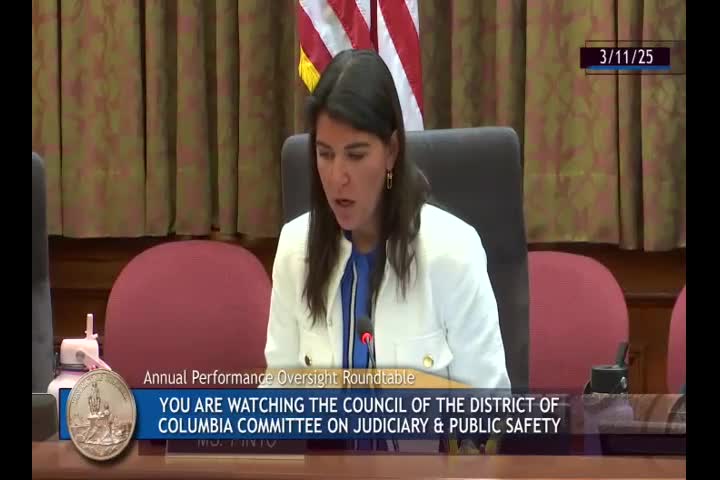
Metropolitan Police Department Chief Pamela A. Smith told the Committee on the Judiciary and Public Safety on March 11 that 2024 produced a 35% decline in violent crime compared with 2023 and credited targeted task forces, a real‑time crime center and technology — even as the department reports a multiyear staffing shortfall and faces public scrutiny over reinstated officers and transparency.
Metropolitan Police Department Chief Pamela A. Smith briefed the Committee on the Judiciary and Public Safety on March 11, saying 2024 produced a historic decline in violent crime even as the department struggles to refill sworn ranks and answer public demands for accountability and transparency.
Why it matters: The department reported significant year‑over‑year drops in violent crime categories, but hearing witnesses and committee members pressed for answers on staffing, overtime use, the handling of sensitive evidence and public access to body‑worn camera video. Several public witnesses raised the high‑profile issue of two officers who were convicted, later pardoned, and then reinstated to MPD — a reinstatement that committee members said has eroded public trust.
Chief Smith told the committee that 2024 ended with a 35% reduction in violent crime overall compared with 2023, including a 32% drop in homicides, a 39% decline in robberies and nearly a 50% reduction in carjackings. Smith credited a mix of data‑driven operations and partnerships: Operation Thrive (a focused homicide reduction effort in neighborhoods such as Rosedale and Anacostia), a Robbery Suppression Initiative that recovered hundreds of firearms and generated arrests, a Carjacking Task Force, and an “Operation Atlas” quality‑of‑life effort that has removed stolen vehicles, recovered guns and issued citations.
Smith highlighted the department’s Real Time Crime Center (RTCC), expanded surveillance camera deployments and new aerial resources as force multipliers. The chief told the committee the RTCC helped investigators to produce suspect images and surveillance leads rapidly, and cited a case in which RTCC video helped recover a murder weapon and arrest a homicide suspect.
Staffing and overtime:
- Chief Smith said MPD’s sworn strength was approximately 3,236 officers; she described the force as the lowest sworn level in decades and said recruitment and retention remain a top priority. The department reported an increase in recruit hires in 2024 and a larger cadet pipeline (132 cadets, with roughly 100 candidates in background checks). - Union testimony from Gregory Pemberton, chairman of the DC Police Union, said membership has fallen to 2,953 and described sustained, very high overtime use. Pemberton told the committee that MPD used about 1,800,000 overtime hours in FY24 at an estimated cost exceeding $133 million and that hiring has lagged separations.
Community concerns, transparency and discipline:
Public witnesses across the ideological spectrum praised officers while also pressing for greater transparency and accountability. Multiple witnesses — including Kanithia Alston, who urged more transparency after her son’s 2018 death — criticized policies that allow officers to review body‑worn camera footage before writing reports and asked the committee to preserve exceptions for serious use‑of‑force incidents. Robert Becker of the D.C. Open Government Coalition charged that MPD resisted statutory disclosure requirements and that the department has been slow to produce full, unredacted video and disciplinary documents in some high‑profile cases. Melissa Millar from ZEDEC DC told the committee that MPD inconsistently accepts identity‑theft reports, which can harm victims seeking recovery; she cited D.C. law that she said creates a mandatory duty to take an identity‑theft report.
Reinstated officers and internal review: Several witnesses and council members pressed Smith over two officers who had been convicted in federal court of obstruction‑related charges tied to a 2020 incident, were later pardoned, and were subsequently reinstated to MPD. Smith said the criminal convictions were vacated or dismissed with prejudice after pardons and that MPD completed an internal policy review. She told the committee the department found administrative policy violations and is applying discipline consistent with MPD’s table of penalties; she said the two officers are not assigned to front‑line patrol and that they must complete required training and other conditions before returning to full duty.
Mental‑health and co‑response: Smith described MPD’s co‑response (CORE) teams — officers paired with behavioral health clinicians — and said the units have been deployed to crisis calls and, by her account, reduced arrests in those incidents.
Ending: Chief Smith asked for continued council support during the budget cycle to sustain expanded cameras, staffing priorities and technology investments. Committee members said they would follow up on staffing, overtime, transparency and the reinstatement discipline process during budget deliberations and further oversight hearings.