Get Full Government Meeting Transcripts, Videos, & Alerts Forever!
Get email alerts on the Education School Construction topic
No spam. Unsubscribe anytime.
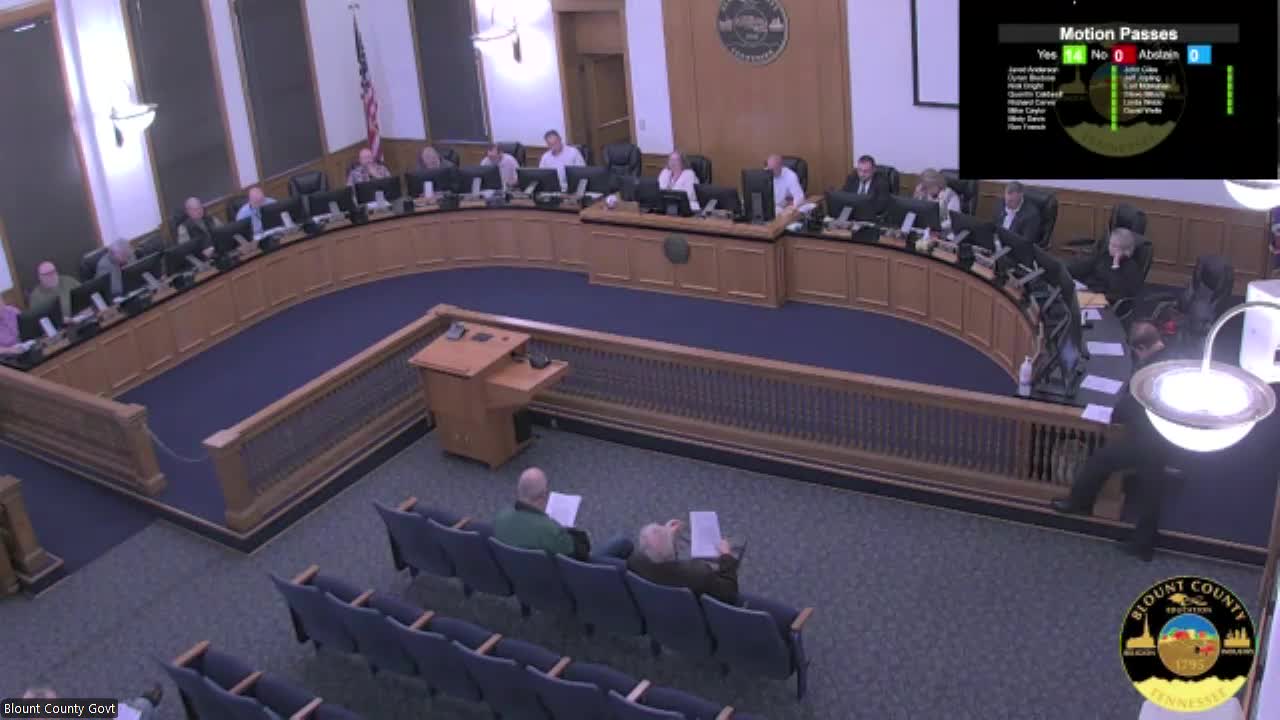
Commissioners advance school capital contingency after questions about change orders; moves to full commission 13-1
Summary
At a March 11 Blount County workshop the commission moved Resolution 25-030006, a request tied to school capital projects originally described as $300,000 in contingency funds (as amended by the budget committee to $1,000), to the full commission after questioning about project overages and oversight. The workshop vote was 13-1.
Blount County commissioners at a March 11 workshop voted 13-1 to move Resolution 25-030006 — a request tied to school capital contingency funds — to the full commission for final action. The budget committee had referred the item with a favorable recommendation and noted the item was amended by the budget committee, which reduced the contingency amount to $1,000.
The measure was described on the call as “budget increase, school capital $300,000 appropriate contingency funds to support FY25 capital projects,” and was introduced with a motion from Commissioner Anderson and a second from Commissioner Webb. During discussion commissioners asked for detail on why projects required the additional contingency and whether overages had been presented to the commission when incurred.
Mister Dukes, who came forward to answer technical questions, summarized the primary causes driving the overages as change orders and site discrepancies. He listed the largest items, saying, “Just the top 5 that are above 20,000,” and then identified (1) a fire‑road extension requested by the fire marshal behind the CTE building; (2) a relocation of a domestic water/fire line where the culinary/Workforce Development Center was planned because the lines were not at the location shown on site plans; (3) owner‑requested furniture changes that required electrical realignment; (4) a culinary arts teacher’s request to extend a fire lane to the rear for deliveries; and (5) cladding vertical I‑beam portico columns to match the building’s exterior. Dukes also said the project team pursued value engineering and identified about $70,000 in credits from ceiling tile changes.
Commissioner Wells asked whether the contingency expenditures had been reported back to the commission as they were used, citing an earlier practice he recalled that required the commission to see overages. The mayor and Commissioner Michaels each said the $300,000 figure had been established as an annual contingency for school capital projects in prior years, and commissioners discussed whether the original intent required separate reporting of each overage or brought items to the commission for approval. Commissioner Michaels said the education committee previously implemented the contingency process and suggested the commission should revisit the originating resolution to confirm reporting requirements.
The motion to move the resolution forward passed on a 13‑yes, 1‑no voice tally at the workshop. The resolution text as read to the workshop identified the contingency amount as $300,000; the budget committee report attached to the item noted the committee had amended the request and reduced the figure to $1,000 before forwarding with a 5‑0 favorable recommendation.