Get Full Government Meeting Transcripts, Videos, & Alerts Forever!
Get email alerts on the Police Oversight topic
No spam. Unsubscribe anytime.
Office of Police Complaints records all‑time high complaints in FY24; director urges funding, expanded authority
Summary
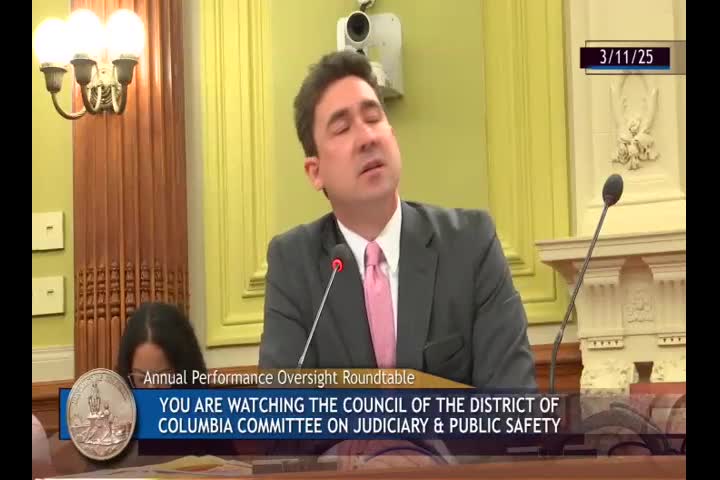
The Office of Police Complaints received a record 942 complaints in fiscal 2024, Executive Director Michael Tobin told the Committee on the Judiciary and Public Safety at a March 11 oversight hearing, stressing that the agency is operating with historically high caseloads and limited staff.
The Office of Police Complaints received a record 942 complaints in fiscal 2024, Executive Director Michael Tobin told the Committee on the Judiciary and Public Safety at a March 11 oversight hearing, stressing that the agency is operating with historically high caseloads and limited staff.
Why it matters: City oversight of police misconduct is both a check on department behavior and a public‑trust mechanism. Tobin and public witnesses told the committee that OPC needs additional funding and statutory authority to publish officer disciplinary records, make binding disciplinary recommendations, and expand proactive policy review. Without those changes, witnesses and OPC officials said the system leaves residents feeling unheard and limits civilian oversight.
Tobin, the agency’s executive director, told the committee that OPC recorded “an all time record high” of 942 complaints in fiscal 2024. He said OPC opened 423 new investigations on top of a backlog and conducted roughly 492 interviews last year, including compelled interviews of officers. Tobin said OPC resolved 83% of its investigations in fewer than 180 days and that the average case in 2024 took about 85 days from open to close; he attributed timelier work to staff effort and technology such as Axon body‑worn camera transcription tools that speed reviews.
Tobin laid out three priorities he said would improve oversight: (1) funding and publishing a public misconduct database so residents can see an officer’s complaint history; (2) statutory authority to make recommendations about the appropriate level of discipline when OPC finds misconduct; and (3) a funded role for the Police Complaints Board to review draft department policies before they take effect so the community can weigh in. He said two of those items have statutory language that was not funded.
Public witnesses backed Tobin’s plea for greater authority and funding. Kathy Henderson, an advisory neighborhood commissioner and 5D Court Watch coordinator, urged greater public use of OPC and stronger accountability, saying, “When it works, it works very well. And when it doesn't work, it doesn't work in a way that leaves residents feeling heard, seen, or that the issue that brought them to the complaint process was actually resolved.” Sheila Thomas, a former MPD officer, described delays she experienced when her arbitration and court steps stretched out and were affected by statutory changes. Brent Sullivan, a public witness, pressed the committee on why OPC has not investigated particular cases he and others raised; Tobin and committee members noted the office's statutory jurisdiction limits some investigations to Internal Affairs or the U.S. Attorney’s Office.
On funding and implementation, OPC fiscal officer Dan Proudfoot told the committee that three positions tied to statute changes were budgeted but not created in the payroll system; Tobin added that there were additional non‑personnel costs — notably software for a disciplinary database — and that some MPD budget commitments affect how quickly a fully functional public database and disciplinary‑recommendation process could be implemented. Tobin estimated modest non‑personnel development costs and said the department could implement the database in a fiscally responsible way if the council and executive act.
Tobin also reviewed OPC’s outreach and policy work: OPC reported more than 25 outreach events in 2024, five published reports last year (including guidance on involuntary emergency hospitalizations and protective pat‑down searches), and tracking of body‑worn camera compliance — which he said still shows a substantial minority of cases with some noncompliance (officers not notifying subjects, turning cameras on late or off early, or equipment problems).
What the committee asked for and next steps: Council members signaled they will review OPC’s funding requests as part of the budget process and asked staff for more detail about the costs and MPD’s role in implementing a disciplinary database. Tobin told the committee he is available to work on statutory changes, and Proudfoot said the budget for personnel exists in layers but the positions themselves have not been created.
Ending: The committee recessed OPC testimony after community witnesses and agency leaders spoke at length; members said they would take witness concerns into account in the coming budget deliberations and during continued oversight of how OPC and MPD implement complaint‑resolution and policy‑review reforms.