Get Full Government Meeting Transcripts, Videos, & Alerts Forever!
Get email alerts on the Environmental Trust Fund Allocation topic
No spam. Unsubscribe anytime.
Ways and Means adopts A4 amendment reallocating ENRTF 1.5% pot; bill sent to general register
Summary
The Minnesota House Ways and Means Committee on March 11 adopted an A4 amendment to House File 1218 that reallocates the 1.5 percentage-point funding stream created last year from the Environment and Natural Resources Trust Fund into four named buckets and specific projects, then sent the bill as amended to the general register.
The Minnesota House Ways and Means Committee on March 11 adopted an A4 amendment to House File 1218 that reallocates the 1.5 percentage-point funding stream created last year from the Environment and Natural Resources Trust Fund (ENRTF) into four named buckets and specific projects, then sent the bill as amended to the general register.
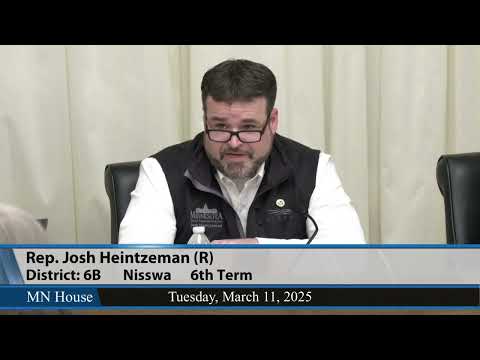
The A4 amendment, moved by Representative Sam Heintzeman, divides the 1.5% pot into four shares — 40% for water-quality grants, 40% for trail improvements (split 50/50 between state and local trail projects), 15% for an “outdoor school for all youth” program, and 5% for the original community grants program — and includes a list of named project grants. Representative Heintzeman described the package as a way “to give some meat on the bones” of the newly authorized funding stream, and said, “The A4 amendment modifies a new grant program that was created last year.”
Why it matters
Committee fiscal staff told lawmakers the 1.5% funding stream is worth about $28.18 million in the current biennium. Under the A4 distribution that fiscal estimate produces approximate amounts of $11.2 million for each 40% bucket, $4.2 million for the 15% outdoor school bucket and $1.4 million for the 5% community grants bucket. Brad Hagemeyer of the House Fiscal Analysis Department summarized the total: “In total, there's 28,180,000.00.”
What the amendment does
The amendment specifies how DNR-administered grants drawn from the 1.5% will be allocated and lists several individual grants and projects with amounts, including: - $3,500,000 to the city of Carver for improvement and restoration of the Carver Le Sueur (Lehi) site; - $1,950,000 to the Minnesota Forest Zone Trappers Association for land acquisition, design and site preparation in Hibbing for a sportsmen/women outdoor development learning center; - $2,000,000 for feasibility, engineering and construction on three segments of the Camp Ripley Veterans State Trail; - $2,500,000 to Sherburne County for phase 2 development of Inlets Regional Park; - $3,150,000 to DNR to reconstruct two segments of the Casey Jones Trail; - $1,000,000 for improvements to the Blue Ox Trail in Cook County; - $3,000,000 for predesign, design, engineering and construction of the Mesabi Trail, including a pedestrian bridge; - $7,300,000 to Scott County for land acquisition, design and construction of 4.3 miles of the Lewisville segment of the Junction Regional Trail; and - $3,930,000 to the Rice Creek Watershed District for flood-hazard mitigation projects in the Highway 35W corridor to alleviate flooding in New Brighton, St. Anthony Village and Roseville.
The amendment also requires the Department of Natural Resources (DNR) to report to the Legislature by Jan. 15, 2026, on implementation plans including draft RFPs, prioritization criteria, grant management and suggested legislative changes before funds are appropriated for the second year of the biennium.
Process and objections
Several committee members objected to the timing and process for the change. Members who serve on the Legislative-Citizen Commission on Minnesota Resources (LCCMR) and members of the Environment Committee said the package bypassed the LCCMR’s multistage evaluation and, they said, the committee of jurisdiction’s deliberations. Representative Ekom (also recorded in the transcript as Representative Ekholm) said the amendment “takes what is and has been a very bipartisan process and blown it up,” and said she would vote against it; she requested a roll call. Representative Cagle pressed on language that removed or relocated statutory language intended to prioritize adversely impacted communities and to bar awards to for-profit entities; House Research staff (Janelle Taylor) told the committee that some language had been moved elsewhere in the bill (recodified to subdivision 1d on page 4).
Becca Nash, director of the LCCMR, summarized the commission’s typical process and said the underlying LCCMR recommendations before the committee were the result of a competitive review; she confirmed the specific changes contained in the A4 did not go through the LCCMR process. Nash said the LCCMR package before the committee contained 124 recommended projects selected after presentations and scoring and was approved by the commission in December; she told the committee that the commission’s process is intended to produce vetted recommendations.
Roll-call and floor actions
The A4 amendment was adopted on a roll-call vote of 14 ayes to 13 nays. A subsequent motion by Representative Bacombe to re-refer the bill to the Environment Committee for additional vetting was defeated in a roll-call vote (14 nays, 13 ayes). After those actions the committee voted by voice to send House File 1218, as amended, to the general register.
What was not decided here
Committee members and witnesses repeatedly noted that the A4 lays out how DNR would spend the 1.5% only in outline and that DNR must still produce implementation documents. Several legislators said that if the amendment remains, the bill’s prospects on the House floor could change; Representative Stevenson warned that the amendment could produce a party-line vote on final passage in the House.
Speakers and attribution
Quotes and paraphrases in this account are attributed only to persons who spoke on the record in the committee: Chair Torkelson; Representative Sam Heintzeman (amendment author and chair of the Environment Committee); Representatives Akbate, Ekom/Ekholm, Cagle, Pinto, Lilly, Stevenson, Bacombe and others who participated in the debate; Becca Nash and Mike Campana of the LCCMR; Janelle Taylor of House Research; and Brad Hagemeyer of House Fiscal Analysis. Representative Heintzeman and fiscal staff provided the funding breakdowns cited above.
Next steps
House File 1218, as amended, now goes to the general register. The A4 requires a DNR implementation report by Jan. 15, 2026, before appropriations for the second biennial year are released. Further committee or floor action could alter the allocation or the list of named projects before final passage.
Ending
The committee record shows sharp disagreement about procedural fairness and about how to balance targeted projects with the LCCMR’s established competitive process. The committee adopted the A4 amendment and advanced the bill to the general register; the DNR report and any subsequent floor deliberation will determine how the new 1.5% stream is ultimately administered.