Get Full Government Meeting Transcripts, Videos, & Alerts Forever!
Get email alerts on the Homelessness Services topic
No spam. Unsubscribe anytime.
Council hears presentation on Urban Street Angels transitional‑age youth housing at city‑owned property; City previously purchased site
Summary
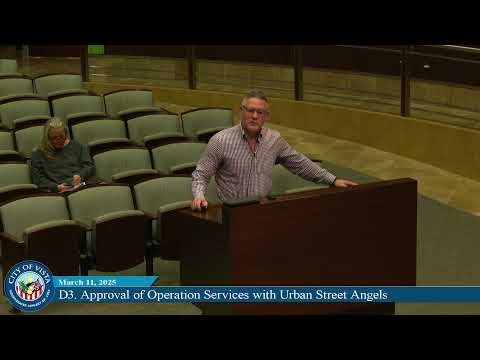
City staff and Urban Street Angels presented a plan to operate a transitional‑age youth housing program at a city‑owned property the council purchased in October 2024; staff showed a multi‑year budget and proposed a July 1, 2025 intake date.
City staff and representatives of Urban Street Angels presented details Tuesday on a proposed transitional‑age youth (TAY) housing program that would operate at a city‑owned parcel the council purchased last year.
The city acquired the three‑quarter‑acre parcel — improved with a 12‑bed residential care facility — for $2,100,000; escrow closed Oct. 15, 2024. At the Oct. 27 meeting, staff summarized the procurement and an RFP process the city ran seeking an operator to provide transitional housing and services for youth ages 18–25.
Why it matters: The program, if implemented, would provide interim and transitional housing and wraparound services for young adults experiencing homelessness in North County. Staff highlighted connections to vocational training and health services and noted private and county partnerships already in place.
RFP and proposer: The city issued an RFP that closed Jan. 30, 2025; Urban Street Angels was the sole respondent, documenting 13 years of experience with outreach and housing programs for TAY and partnerships with county behavioral health, the YMCA, San Diego Housing Commission and other local organizations. Staff said Urban Street Angels plans to begin accepting TAY clients July 1, 2025, and that the operator intends to fund the program using private donations and county funds; the agreement presented includes progressive lease payments to the city in later years.
Program costs and funding: Staff summarized the draft operating budget: about $710,000 in program costs identified for the first year with increases to approximately $834,000 in year two and $878,000 in year three. Staff said the first year’s expenses are anticipated to be covered by secured private donations and county funds, with monthly lease payments to the city beginning in year two and projected annual lease revenue of $77,250 in year two and $79,568 in year three.
Urban Street Angels overview: Founder and CEO Eric Lovett Myers described the organization’s history, its existing housing locations and its emphasis on case management, vocational training, and healthcare access for youth who have experienced homelessness and trauma. He said Urban Street Angels has existing trade‑school partnerships and private donations and noted the organization’s experience operating shelter and transitional programs.
Public comment and context: Earlier public comments at the meeting included multiple speakers representing Green Oak Ranch Ministries, an addiction‑recovery nonprofit that said it houses about 60 people across several programs and described recent legal and funding threats after losing a major lease and revenue source. Green Oak Ranch’s executive director, Hannah Gailey, said the organization needs city and community support to keep residents housed and gave program cost context (residents pay $750 per month, which covers about half of program costs).
Status and council action: During the provided transcript segment staff presented the draft operator agreement and Urban Street Angels’ program plan; a final council vote on the operator services agreement was not recorded in the excerpt provided. Staff indicated the program intends to use secured funding for initial implementation and then begin lease payments to the city in later years per the proposed agreement.
Next steps and clarifications requested: Staff and council will need to finalize the operator services agreement terms, confirm funding sources and performance expectations, and set an implementation timeline for client intake. Council members may request a follow‑up report or vote to approve the agreement at a subsequent meeting.