Get Full Government Meeting Transcripts, Videos, & Alerts Forever!
Get email alerts on the Traffic Safety Speed Limits topic
No spam. Unsubscribe anytime.
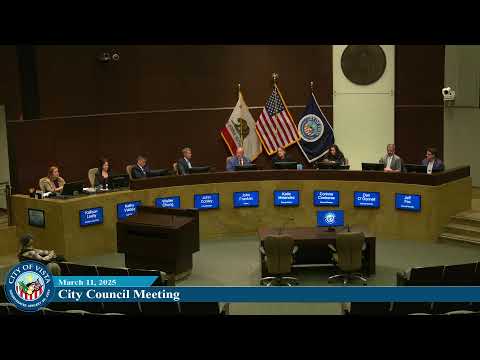
Vista council approves reduced speed limits in Districts 2 and 4 under new state law; 4–1 vote
Summary
The council approved staff-recommended speed-limit reductions for selected roadway segments in Council Districts 2 and 4, citing Assembly Bill 43 and a safe-system approach; the vote passed 4–1 with the mayor opposing.
The Vista City Council voted 4–1 to adopt reduced speed limits on selected street segments in Council Districts 2 and 4, implementing changes recommended under California Assembly Bill 43.
Traffic Engineering Division Manager Sam Hasson told the council the state law (AB 43) gives cities additional authority to lower speed limits after engineering and traffic surveys, including extra reductions for streets designated as safety corridors or adjacent to facilities that generate high pedestrian and bicycle volumes.
Staff said consultants evaluated 99 roadway segments citywide and recommended 95 for speed reductions. For District 2, the segments recommended include portions of Bobier, Foothill, Monte Vista, Santa Fe Avenue, Taylor, Vista Village, East Vista Way and Warmlands. For District 4, the recommended changes include portions of Longhorn, South Melrose Drive, Phillips, Santa Fe Avenue, Sycamore and Thibodaux.
Hasson described the method used to set limits: engineering and traffic surveys based on the 85th percentile (referred to in the meeting as the "80 fifth percentile"), rounded to the nearest 5 mph, with the AB 43 framework allowing additional reductions where warranted. He also noted safety research presented to council showing speed reductions in other cities correlated with fewer crashes.
Staff presented five-year collision data for Vista: roughly 2,849 reported crashes, just over 1,100 injury crashes and 17 fatal crashes. Unsafe speed was identified as the third-largest contributing factor to collisions in the city’s data review.
During public comment, resident Carol Jeffreys described confusing and inconsistent posted speeds on Vail Terrace and requested clearer signing and traffic calming. "There's like five different speeds listed on it," she said, and asked the city to standardize markings and improve signage.
Council Member O'Donnell, who moved approval of the staff recommendation, said the tool provided by AB 43 is an important addition to the city’s safety toolkit and asked staff to return with a data review in one year and a comprehensive safety analysis in five years. Council Member Contreras seconded the motion. Council Member O'Donnell also agreed during debate to a council expectation that staff would analyze five years of comparative data and consider reverting limits if safety had not improved; he added an exception for school zones and high-residential areas.
A council member who opposed the item argued enforcement and additional motor deputies were the better remedy than lowering posted limits and said reducing posted speeds alone would not stop speeders. That member voted against the measure.
The motion passed with four votes in favor and one opposed; the mayor cast the dissenting vote. The council directed staff to carry out field evaluations of signs and markings and to implement the approved speed-limit changes, and asked staff to return with follow-up safety data at intervals specified by council direction.
Staff noted that school-zone regulatory limits for children-present signs remain unchanged (25 mph when children are present) and that the implementation step will include an inventory of signs and pavement markings the city must change to reflect new limits.