Get Full Government Meeting Transcripts, Videos, & Alerts Forever!
Get email alerts on the Weather Radar Gap topic
No spam. Unsubscribe anytime.
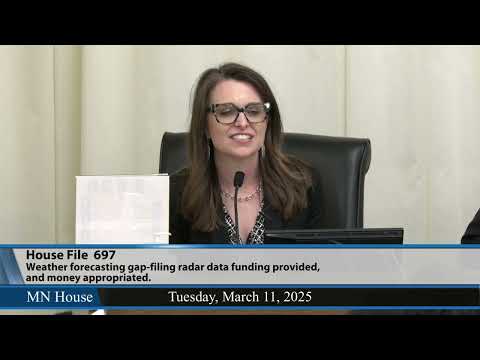
House panel hears bill to fill Minnesotaweather radar gaps; amendment adopted and bill laid over
Summary
Lawmakers heard testimony on House File 697, a bill to accelerate supplemental radar and radar-data sharing to fill coverage gaps across Minnesota. An author's technical amendment was adopted and the bill was laid over for possible inclusion in the committee omnibus.
Representative Baker introduced House File 697 on behalf of the billauthor and moved an authoramendment that replaces a reference to the Minnesota Department of Homeland Security director with the department and adds county and local emergency managers.
The measure aims to accelerate installation of supplemental radar and provide near-real-time radar observations to selected state agencies, county emergency managers and public safety answering points to reduce so-called "radar gaps" where National Weather Service coverage is limited.
"These gaps are a primary reason the National Weather Service requests counties to send out weather spotters to help relay what is happening closer to the ground," Ace Bonnema, emergency management director for Canneuma County, told the committee. Bonnema testified on behalf of the Association of Minnesota Emergency Managers and described local incidents in which radar showed little detail near the ground.
Tara Goode, a vendor representative, said the planned supplemental network would feed state and emergency-management partners; private vendors could also buy data but the state feed to emergency managers would not be the same commercial distribution channel.
Hennepin County Emergency Management Director Eric Waage said gaps can extend thousands of feet above the surface and affect warnings for tornadoes and snow squalls, and that metro-area responders also rely on upstream coverage to prepare.
Members asked about federal funding risks and public access. Committee members including Representative Greenman and Representative Curran pressed how the state contract would interact with National Weather Service data and whether the contract would preserve public access. Bonnema and Goode said the project is intended to make live data available to the public and to emergency managers, though some historical or archived data would remain a commercial contract option.
The author's amendment (A-1) was adopted by voice vote after the amendmentsponsor explained the technical change. House File 697 as amended was laid over for possible inclusion in the committee omnibus.