Get Full Government Meeting Transcripts, Videos, & Alerts Forever!
Get email alerts on the Complaints Intake topic
No spam. Unsubscribe anytime.
Tulsa staff: housing and ADA top complaint types; commissioners urged to help publicize filing options
Summary
City human-rights staff reported housing and ADA grievances are the most common inquiries so far in 2025, described intake options and limits, and asked the Human Rights Commission for help increasing community outreach.
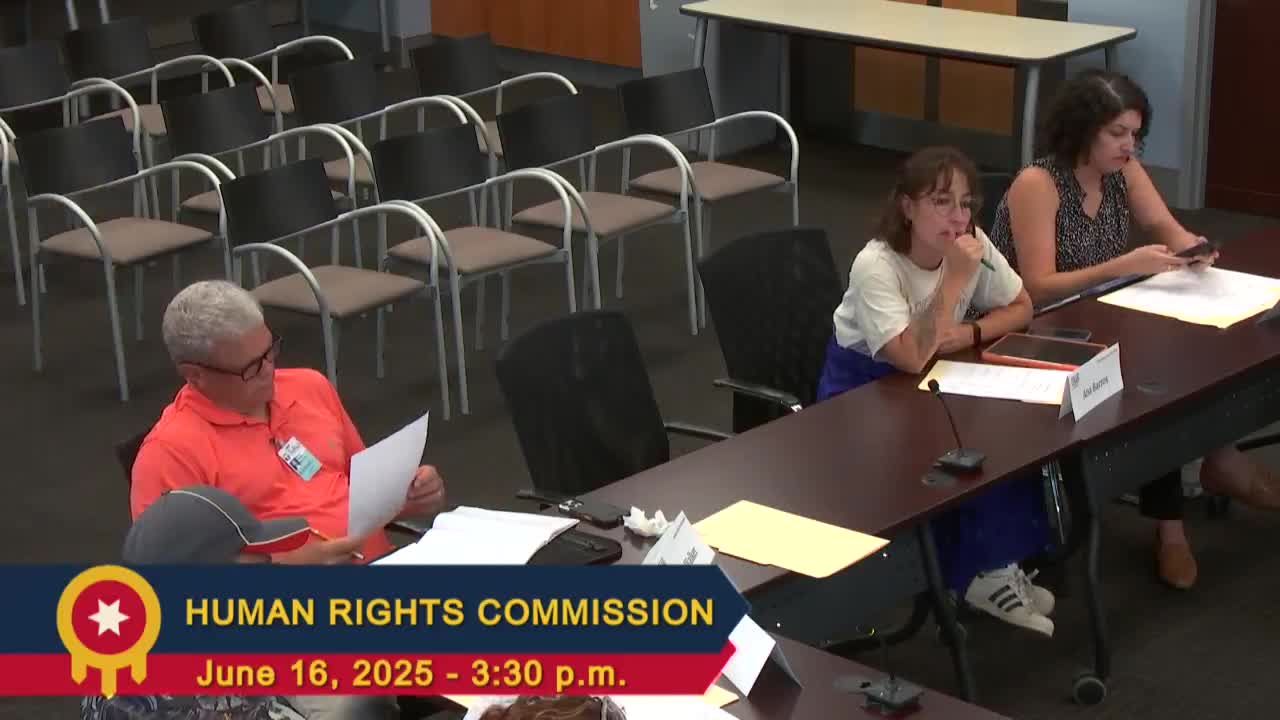
LaKendra, a human-rights staff member with the City of Tulsa, reported to the Human Rights Commission that housing and Americans with Disabilities Act (ADA) grievances are the two most frequent complaint types so far in 2025 and asked commissioners to help spread the word about where and how residents can file.
LaKendra said housing and ADA “run neck and neck” as the most common inquiries and that public-accommodation questions arise often but rarely progress to a formal complaint. She told commissioners the office is tracking case outcomes with a simplified, two-page snapshot and will provide an end-of-year comparison with the previous two years to show seasonal trends.
The report explained how residents can start the process: by calling 311 for a short intake (which the human-rights staff will follow up), by downloading and submitting a printable form to the City Clerk’s Office, or in some cases by calling the human-rights staff directly. LaKendra said the office accepts anonymous intakes online through 311 but that a signed hard copy must still be filed with the City Clerk if the matter becomes a formal investigation. “Once the form is completed, once you bring it up, print it off, it has to be printed off. Once and signed, you bring it into the City Clerk’s Office on the Second Floor,” she said.
Why this matters: access to filing affects whether complaints enter an investigative process and how quickly city departments can respond to ADA and public-accommodation problems. The staff presentation made clear many accessibility fixes require cross-department work — for example, engineering, right of way and parks — and so cases can remain open while staff coordinate solutions.
Key operational points LaKendra outlined
- Top complaint types: housing and ADA grievances are the most frequent. Public-accommodation inquiries occur but seldom become filed complaints. LaKendra said, “housing is our biggest concern.”
- Intake routes: callers can use 311 (online or by phone) for a short intake that will trigger follow-up from the human-rights staff; complainants may also download a PDF form, sign it (a physical wet signature), and deliver or mail it to the City Clerk for formal filing. The staff is able to begin some work from a phone intake, particularly for urgent ADA/public-accommodation items that are clearly within city responsibility.
- Signature requirement and plans for electronic filing: the City Clerk and the city’s legal office currently require a hard wet signature for formal complaints. LaKendra said legal and IT are discussing potential options for an electronic-signature workflow but that implementation would require budget, licenses and an IT project manager.
- Staffing and outreach limits: LaKendra said the unit had 15 staff when she started; after organizational changes it has four staff and a chief resilience officer, which reduced the team’s community outreach capacity. She recommended low-cost outreach such as water-bill inserts, tabling at community events, partnerships with trusted local organizations, and targeted fall-season outreach when contacts rise.
- Partnerships and referrals: LaKendra said she will try to reconnect with the Center for Individuals with Physical Challenges and with the Tulsa Area Chamber’s MOSAIC initiative to identify recurring ADA or accessibility problem sites. She also described routine coordination with the Financial Empowerment Center, Tulsa Response and fair-housing partners for housing-related outreach.
Questions from commissioners highlighted practical barriers. Commissioner Josh Starks asked whether the numbers in the report reflected only submitted forms or included phone inquiries; LaKendra answered that the snapshot includes both calls she personally receives and referrals from 311, but that formal investigations typically require the signed form. Commissioner Anna Burrows suggested distributing materials through trusted “messengers” — pastors, community leaders and partner organizations — and praised previous water-bill inserts as effective.
LaKendra described a recent website/link problem that made the human-rights page difficult to reach when searching on Google; communications staff told her the issue arose after the office moved between departments and that the website links are being corrected. She also said the office’s official name and placement will change again in July 2025, when it moves into the Department of Resilience and Equity (DRE). She pledged to share the presentation slides with commissioners.
Direction and next steps
- Staff asked commissioners for help brainstorming inexpensive outreach and suggested carving time at a commission retreat or holding ad-hoc subcommittee work sessions to develop a water-bill insert and other materials.
- LaKendra said she will contact the chamber/MOSAIC lead and the center for people with physical challenges to explore partnerships and will serve as an internal point of contact for sidewalk/safety reports that belong to streets or right-of-way teams.
- The office is pursuing an internal conversation with City legal and IT about whether an electronic signature option can be implemented; that effort will require budgeting for licenses and a project manager.
Ending
LaKendra said she will provide an updated complaint snapshot later in the year comparing multiple years and welcomed commissioners’ follow-up questions by email. She encouraged commissioners to call the office when they hear a community concern that might be a complaint so staff can take the intake rather than asking residents to navigate multiple city offices.