Get Full Government Meeting Transcripts, Videos, & Alerts Forever!
Get email alerts on the Public Safety topic
No spam. Unsubscribe anytime.
Tulsa police chief details anti-violence tactics, immigration policy and community outreach
Summary
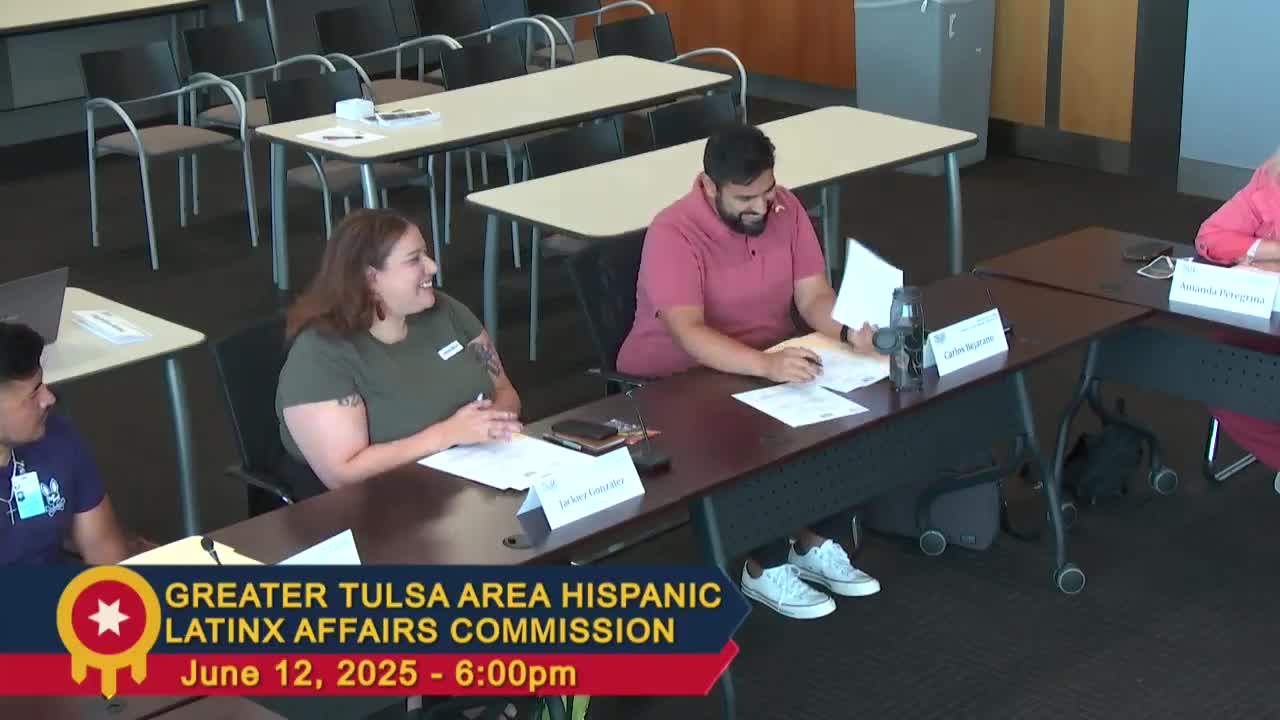
Chief Dennis Larson, Tulsa Police Department chief, told the Tulsa Hispanic Affairs Commission he is prioritizing efforts to remove repeat shooters, increase bilingual recruitment and avoid immigration‑status inquiries in ordinary policing.
Chief Dennis Larson, chief of the Tulsa Police Department, told the Tulsa Hispanic Affairs Commission that reducing gun violence among young people is his top priority and described a string of tactics the department has used to target repeat shooters.
Larson said the department identifies what it calls ‘‘violent impact players’’ — individuals it believes are most likely to pull a trigger — and focuses enforcement and interventions on those people to break up groups that fuel shootings. ‘‘Our SWICs have gone down 50% in the last 3 years,’’ he said, using the department acronym for shootings with intent to kill.
He outlined other department priorities in a roughly 40‑minute presentation and question-and-answer session. Larson said Tulsa Police does not use race, national origin or immigration status as a basis for stops or routine investigations: "Basically, it says we won't use race, gender, national origin, status within the U.S., legal, illegal, as a reason to stop and as a reason to investigate." He added that jails, not the police department, are where immigration status checks typically occur.
Larson described efforts to improve communication with non‑English speakers, including recruitment of bilingual officers (the department pays a stipend for bilingual work) and local partnerships with Tulsa University for translation support. He described new body‑worn camera technology that can detect the language a person is speaking and provide on‑screen or audio translation for officers.
On drugs, Larson said officers and Tulsa Fire Department units carry naloxone (Narcan) to reverse opioid and fentanyl overdoses, and warned that some newer designer combinations can blunt naloxone's effectiveness: "Narcan flips all those switches back on," he said, but added the department must stay ‘‘one step ahead’’ as illicit drug mixtures evolve.
During questions from commissioners and members of the public, Larson said the police department generally does not rely on demographic breakdowns when choosing where to deploy resources; he said maps of shootings and other incident data guide deployment. He also encouraged greater police presence at community events and said the department is willing to attend local gatherings to build relationships and answer residents’ questions. He described a pathway program that can reduce the cost of a four‑year degree for recruits and said he wants more Tulsa‑raised officers.
The commission asked about access to data showing rates of crime by demographic group; Larson said demographic information is not routinely published by his department but that outside groups sometimes compile such analyses. Residents at the meeting raised concerns about misinformation shared on social media, the limits of municipal translation services in courts, and the need for better community education about law enforcement processes.
Larson closed by saying overall crime in many major categories was down and by offering to participate in community events and school activities to help with outreach and recruitment.