Get Full Government Meeting Transcripts, Videos, & Alerts Forever!
Get email alerts on the Digital Equity topic
No spam. Unsubscribe anytime.
Urban League credits Spectrum grant with expanding digital training, device access in Madison
Summary
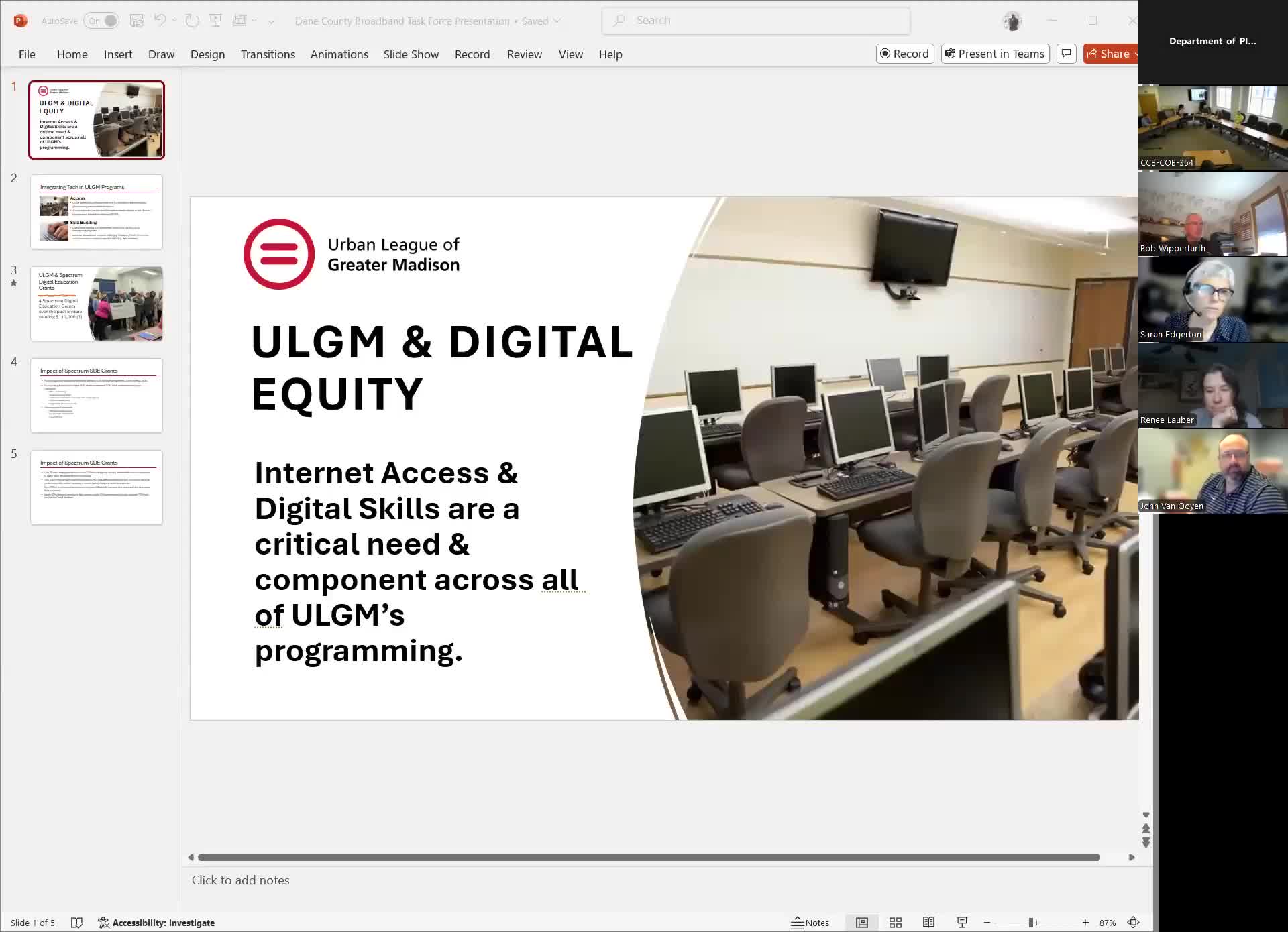
The Urban League of Greater Madison told the Dane County Broadband Task Force that four Spectrum grants totaling about $110,000 over five years have funded computer labs, cohorts and device giveaways that serve primarily low-income residents and people of color.
Ruben Anthony, president and CEO of the Urban League of Greater Madison, told the Dane County Broadband Task Force on June 4 that a series of grants from Charter Spectrum have supported digital-literacy courses, device giveaways and computer labs that serve low-income neighborhoods in Madison.
"If you don't have access to, the Internet or computer, you just can't do a lot of things, in society today," Anthony said, describing how the Urban League uses training and donated devices to help residents with job searches, virtual interviews, medical scheduling and other digital tasks.
The Urban League runs three computer labs with roughly 70 computers across its main office and a Southwest Side site, Anthony said. The nonprofit has used Spectrum funding to provide multiple cohort-based trainings and IT academies aimed at seniors and job seekers; Anthony said the organization has received four Spectrum digital grants totaling "over $110,000 over the last, 5 years." He told the task force the Urban League had given participants Chromebooks during distribution events and has run virtual expungement clinics using the equipment.
Anthony said the program reaches predominantly low-income residents: "over 90% of those who participate in our programs are from low income neighborhoods and 80% are people of color," and that more than 1,000 job seekers have used the Urban League's labs and programs to improve digital skills. He described partnerships with the University of Wisconsin's School of Continuing Education and local churches to expand instruction and technical support.
Representatives of Spectrum and Dane County praised the partnership during the task force discussion. "I mean after Spectrum, I know we really value our partnership and it truly is a partnership with the Urban League," a Spectrum representative said, describing company involvement in device distributions and training events. Todd Violante of the Dane County Planning and Development Department said the end of the federal Affordable Connectivity Program increases the importance of local public–private partnerships to sustain device and connectivity assistance.
Task force members asked for details about technical support and program operations. Anthony said staff and continuing-education instructors provide troubleshooting and refresher sessions when participants encounter problems after devices leave class. He estimated the program has run seven to eight cohorts under the Spectrum grant and additional IT academy cohorts, with one class that week enrolling about 35 seniors.
Task force members and Urban League staff discussed whether county help could expand awareness or capacity for the model. No formal action or county commitment was made during the meeting; members proposed options such as county outreach to raise awareness of existing programs and to inventory anchor institutions that offer public Wi‑Fi and workspace.
Anthony closed by saying the program's combination of devices, training and partnerships "is changing lives and transforming lives," and thanked Spectrum and the task force for prioritizing digital equity.