Get Full Government Meeting Transcripts, Videos, & Alerts Forever!
Get email alerts on the International Security topic
No spam. Unsubscribe anytime.
Israel launched preemptive strikes on Iran—s nuclear and missile sites, ambassador says
Summary
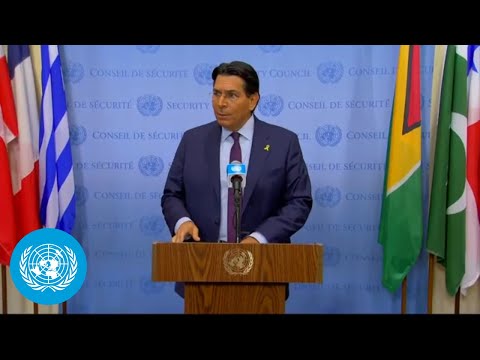
At a United Nations press briefing, Israel's ambassador, Danny Danon, said Israel launched a preemptive military operation overnight against Iran's nuclear and ballistic missile infrastructure, striking dozens of sites and targeting senior figures in the Islamic Revolutionary Guard Corps (IRGC).
At a United Nations press briefing, Israel's ambassador, Danny Danon, said Israel launched a preemptive military operation overnight against Iran's nuclear and ballistic missile infrastructure, striking dozens of sites and targeting senior figures in the Islamic Revolutionary Guard Corps (IRGC).
Danon said the strikes were taken to prevent what Israel assessed as an imminent and existential threat. "This was a calculated and necessary action based on clear intelligence and carried out in response to an escalating existential threat," he said, and added that the action followed what he described as repeated violations and deception by Iran.
Danon framed the operation as a response to what he said were advances in Iran's nuclear program and a secret effort to prepare a weapon and delivery systems. He referred to the International Atomic Energy Agency (IAEA) reports, saying, "According to the latest IAEA reports, Iran now has enough material for multiple nuclear weapons and has moved dangerously close to a provisional capability." He also said Israeli intelligence uncovered planning for a coordinated surprise attack involving proxies.
When asked how long the operation would continue and whether the United States would provide support, Danon said Israeli officials were preparing the population and that they expected further projectiles and attacks. "We will continue to act until we will know that we eliminated the threat," he said. On allied coordination, he said Prime Minister Benjamin Netanyahu had spoken with world leaders and that he expected the U.N. Security Council to meet to discuss the operation.
Danon described the scale of the operation in broad terms: "More than 200 aircraft participated in the operation, more than 100 targets," and said Israel intercepted "more than 100 drones" sent toward Israel during the incident. He told reporters Israel took steps to minimize civilian casualties, saying the strikes were timed "when people were not in the streets," and that Israel had "done everything we can to minimize civilian casualties."
A reporter asked about radiation risk after strikes on facilities such as Natanz. Danon declined to answer technical radiation questions and directed reporters to the Iranian representative for on-the-ground radiation reports, while reiterating that the stated goals were to halt Iran's nuclear and ballistic missile capabilities.
Danon criticized the United Nations secretary-general's response, saying the secretary-general had expressed concern and asking rhetorically where that voice had been "when Iran spent years arming itself while vowing to wipe Israel off the map." He called the operation "not easy" but framed it as necessary to prevent a potentially terminal attack on Israel.
Danon said he would explain Israel's actions if the Security Council met and reiterated Israel's stated intent to continue operations until it was confident the threat was removed. He took additional questions from reporters before concluding his remarks.
Questions about independent verification of the intelligence Danon cited, the precise humanitarian impact inside Iran and any formal Security Council schedule were not specified in his remarks.