Get Full Government Meeting Transcripts, Videos, & Alerts Forever!
Get email alerts on the Behavioral Health Center Residents topic
No spam. Unsubscribe anytime.
Families, staff and residents urge San Francisco Health Commission to halt plan to relocate 82 Behavioral Health Center residents
Summary
Dozens of residents, family members, nurses and staff told the Health Commission that a Department of Public Health plan to repurpose 38 ARF and 44 RCFE beds at the Behavioral Health Center risks destabilizing a vulnerable population and should not proceed without alternatives and clearer staffing plans.
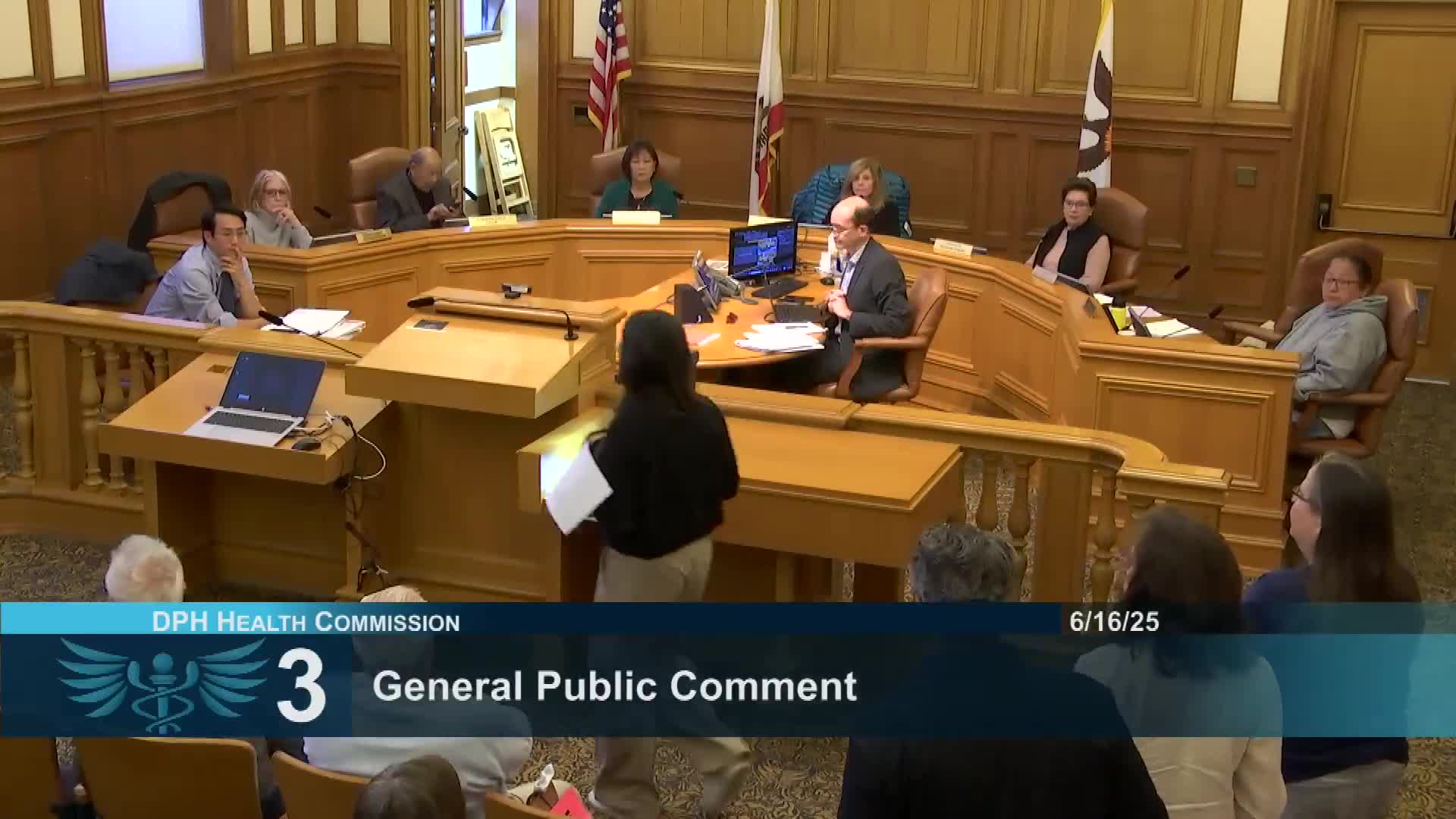
Dozens of residents, family members, nurses and staff told the San Francisco Health Commission on June 16 they oppose a Department of Public Health proposal to repurpose beds at the Behavioral Health Center (BHC) and relocate people who now live in the Adult Residential Facility (ARF) and Residential Care for the Elderly (RCFE).
The public commenters said the ARF and RCFE are therapeutic, staffed settings that have provided long-term stability for people with serious mental illness and long histories of housing instability. Several speakers pressed the commission to halt the relocation plan and find other ways to add locked psychiatric rehabilitation beds without displacing current residents.
Why it matters: Speakers described long-term relationships between residents and staff, language-appropriate care, and clinical skills at the BHC that they said cannot be replicated easily at other boarding care sites. Petition signatures and repeated testimony signaled broad opposition from residents and staff; commissioners were told that moving people risks clinical deterioration, more emergency department visits and homelessness.
Several speakers identified the number of residents at stake. Sarah Clark, a registered nurse at the BHC, said the plan would “displace the 38 residents of the ARF and the 44 residents of the RCFE,” and called the facilities “their home.” Clark added, “This stability is not transferable. The BHC is not just a building. It is their home.”
Jennifer Estine, a registered nurse with the Department of Public Health and vice president of organizing for SEIU Local 1021, said union members and residents want the process slowed: “We are asking for this process to slow down, for you to take another look, just like we did in 2019, and to build these beds somewhere else.” Estine also told commissioners the petition she delivered had signatures from a large share of current residents: “90% of the clients have signed and do not want to move.”
Benson Nadell, the city ombudsman who monitors long‑term care settings, said relocation notices and an unclear options list risked removing residents’ sense of agency: “This had removed their due process rights in terms of being told they have to move,” he said, urging individualized consideration.
Family members and staff described language and cultural access as a key reason to keep residents at the BHC. Connie Truong, a Help Worker III at the BHC who speaks Vietnamese, said some residents are monolingual and asked whether replacement sites would have staff able to communicate with them.
Several resident speakers and staff also described the specialized staffing model. Elizabeth Travelzite, a field representative for SEIU Local 1021, said while “beds are simple to count,” staffing is what makes care effective and that “these beds are nothing without proper adequate staffing.” Darren Page, a BHC employee of 28 years, said the facility’s staffing and structure produce a 90% success rate in getting residents to appointments and avoid higher levels of care.
Department response and context: Director Grant Tsai (Director Tsai) told the commission later in the meeting that the department’s budget and behavioral health strategy include investments for expanded treatment capacity. He said the department is seeking ways to add beds and services while preserving direct care where possible. He also described the broader budget context, including revenue commitments the department has made to preserve services and support its workforce.
What was not decided: The commission heard testimony; no formal vote to repurpose or relocate residents is recorded in the June 16 minutes. Commissioners and staff repeatedly asked for more specifics about alternative placements, staffing plans, and how language access would be preserved. Public commenters urged that any plan should not be implemented until those details are clear.
Ending: Speakers left petitions and written comments for the commission. Commissioners said they would review written submissions and the petition and that public testimony had been received and entered into the record.