Get Full Government Meeting Transcripts, Videos, & Alerts Forever!
Get email alerts on the Urban Forestry Tree Preservation topic
No spam. Unsubscribe anytime.
Committee hears pleas to preserve street trees as city explains limits of reconstruction work
Summary
Committee members, the city forester and engineering staff discussed why many street trees are removed during full street reconstruction, described the design constraints that force removals, and heard alder and resident calls to adopt stronger preservation processes and to reengage experts who helped other cities conserve trees.
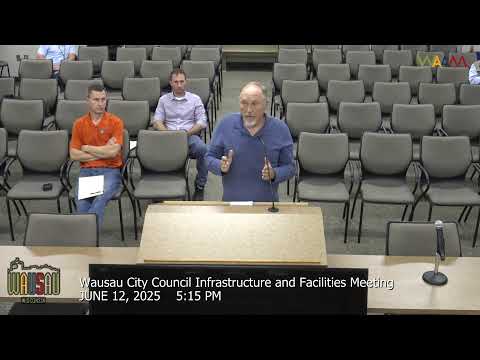
The Infrastructure and Facilities Committee on June 12 held an extended discussion on tree preservation during street reconstruction projects, with alder members and residents urging the city to adopt more rigorous protections and staff explaining engineering and utility constraints that often require tree removal.
TJ (engineering staff) outlined the design process used for reconstruction projects and said decisions about curb-to-curb width (typically 33 to 37 feet) and the need to replace underground utilities drive how much terrace/boulevard remains for trees. He noted water mains are typically about 8 feet deep, sanitary sewers can run 8—2 feet or deeper (and in some locations reach 20 feet), and required separations between utilities and large excavations often leave little unexcavated soil in the terrace for tree roots. The engineering presentation emphasized that "once we do finish our design, we hand that off to the city forester" to evaluate which trees can realistically be saved.
John (city forester) said his evaluation focuses on tree condition and structural stability: species in poor health or ash trees infested by emerald ash borer are typically removed and replaced; trees that would be structurally compromised by the excavation (for example, where remaining rooting area is insufficient) are also removed to avoid later failures. He described a rule-of-thumb that a tree's required structurally stable rooting area is roughly three times the trunk diameter and said deep excavation or cutting on multiple sides can leave a previously stable tree at risk of failure.
Alders and residents described recent projects where many street trees were removed and urged the city to re-examine standards. Alder Neal cited multiple blocks where nearly all trees were cut during reconstruction and asked the city to re-engage outside experts and to bring forward a preservation-focused process. Alder Gisselman and others urged a citywide effort to avoid the look of clear-cut streets and recommended stronger coordination between engineering, parks, and the forester. Speakers recalled a City of Wausau tree-planting and preservation specification manual from previous years and asked staff to locate, update, or reintroduce those specifications.
Staff response and next steps Engineering and parks staff said they already take steps to limit removals where practicable, and the city forester said some trees have survived even after aggressive nearby excavation. Staff acknowledged past plantings and placement of trees were sometimes inappropriate (for example, trees planted too close to utilities or drive approaches) and that newer plantings are placed with longer-term survivability in mind. The committee asked staff to develop a more transparent process in which planned reconstruction projects would show anticipated tree impacts before construction and to coordinate with Parks & Recreation and the Bicycle & Pedestrian Advisory Committee where appropriate. Alder Neal volunteered to work with engineering and staff to draft a proposed process or policy and requested the committee consider inviting a preservation expert (the consultant who previously worked with Milwaukee was suggested) to consult on refinements.
Why it matters Residents said tree canopy and neighborhood character are vital quality-of-life issues and that wholesale removal without visible, documented efforts to reduce loss damages community trust. Staff said public safety and utility access concerns in the short term must be balanced with long-term canopy goals; the city will aim to document impacts earlier in the design timeline and bring proposed preservation procedures back to the committee.