Get Full Government Meeting Transcripts, Videos, & Alerts Forever!
Get email alerts on the 2025 Legislature MN topic
No spam. Unsubscribe anytime.
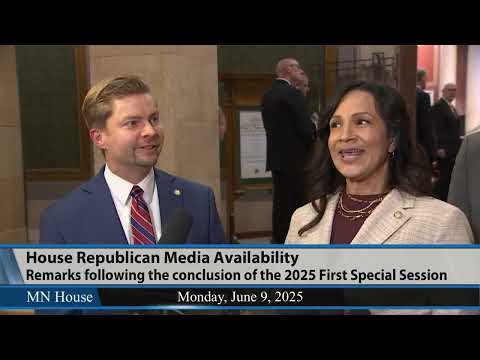
Speaker says closely divided Minnesota Legislature passed budget, bonding bill and measure ending insurance for undocumented adults
Summary
At a Saint Paul press availability, the House speaker said the tied 2025 Minnesota Legislature completed a budget without tax increases, approved a statewide bonding bill and passed a measure ending publicly funded insurance for undocumented adults effective Jan. 1, 2026, while retaining coverage for undocumented children until age 18.
Madam Speaker, Speaker of the Minnesota House, told reporters in Saint Paul that the closely divided 2025 Legislature completed a state budget that avoids tax increases, passed a statewide bonding bill and approved legislation to end publicly funded insurance for undocumented adults effective Jan. 1, 2026, while keeping coverage for undocumented children until age 18.
The speaker said the session began rocky but that co-chairing and a power-sharing arrangement after the chambers were tied produced results the majority wanted, including a bonding bill focused on roads, bridges and wastewater projects and a budget the speaker characterized as reducing spending without raising taxes. “The bill that we passed in the house chamber today was ending that insurance for undocumented people as of January first of 26,” the speaker said, describing a compromise to retain insurance for undocumented children until they reach 18.
Why it matters: the combination of a no-tax-increase budget, a bonding package and changes to coverage for undocumented people alters near-term state spending priorities and affects households, local infrastructure projects and immigrant communities. The speaker repeatedly framed the session as prioritizing affordability for Minnesota families while resisting additional state revenue increases that some Democrats had proposed.
Major actions and outcomes: the speaker described three enacted items during the availability: a state budget that, according to the speaker, reduces spending without raising taxes on Minnesota families; a statewide bonding bill intended for roads, bridges and wastewater projects; and the insurance measure for undocumented adults with a child-coverage exception through age 18. The transcript does not include formal roll-call vote counts for any of those measures.
On why some policies did not pass, the speaker said paid family medical leave changes and earned sick-and-safe-time changes did not find bipartisan agreement and carried a high price tag. “We looked for changes in paid family medical leave and earned sick and safe time, and what was being proposed, was talked about with a very high price tag of additional revenue,” the speaker said. The speaker characterized those items as not included in the final package because they would have required revenue increases.
Transparency and process: reporters asked about the perception that end-of-session work was less transparent after conferring committee work shifted into working groups. The speaker responded that many provisions had been posted and heard in committees for months and urged exploring ways to make public review easier. “Almost all of the provisions that were heard in these bills, as you heard leader Nisga, when we suspended the rules on every bill, talk about how long this language had been posted,” the speaker said.
Federal contingencies and next steps: the speaker said the Legislature completed the state work ahead of July 1 and that any federal action that affects Medicaid could prompt the governor to call lawmakers back. “Depending on what happens at a federal level, if there are implications and effects here in the state of Minnesota, we'll take a look at that and the governor would be able to call us back,” the speaker said.
Other items discussed: the speaker described the passed bonding bill as “probably the best bonding bill that has been passed as far as a statewide impact,” citing core infrastructure priorities. On cannabis taxation, the speaker said the state is setting a tax level comparable to other states with legal markets and noted the legal retail market was still rolling out.
The speaker also referenced past fiscal context, saying the state had a record surplus two years earlier that was subsequently spent and asserting that taxes and fees had previously risen by about $10,000,000,000; the transcript attributes that characterization to the speaker.
The availability did not include formal roll-call vote tallies or bill numbers in the transcript. The speaker and reporters discussed next steps only in general terms: implementing the enacted measures, assessing any federal developments that could affect state funding, and looking for ways to improve public accessibility to legislative language and process.