Get Full Government Meeting Transcripts, Videos, & Alerts Forever!
Get email alerts on the General Government Operations And Appropriations topic
No spam. Unsubscribe anytime.
Guam Fire Department requests $42.6 million for FY2026; seeks $2 increase to E‑911 surcharge to cover NG9‑1‑1 costs
Summary
At a June 8 public budget hearing, Guam Fire Department Chief Darren Berger presented a $42.6 million FY2026 request that would fund new hires, ambulances and paramedic expansion while noting an NG9‑1‑1 maintenance shortfall that the department says likely requires a $2 increase to the E‑911 surcharge and PUC action.
GUAM — The Guam Fire Department told the Legislature on June 8 that its proposed fiscal year 2026 budget of $42,635,007.34 would fund new recruit classes, additional ambulances and steps to expand paramedic services, but would not cover full maintenance costs for the territory's Next Generation 9‑1‑1 (NG9‑1‑1) system without an increase to the E‑911 surcharge.
Darren Berger, fire chief of the Guam Fire Department, presented the department's FY2026 request at a public hearing of the Committee on Finance and Government Operations. Berger said the request includes funding to hire a 20‑person recruit cycle, procure ambulances and continue implementation of the department's paramedic program. "The Guam Fire Department is requesting the total of $42,635,007.34 for the fiscal year 2026," Berger told the committee.
The chief framed the request around staffing and equipment shortfalls and a goal to reduce overtime and improve service. "We'll continue to expand the Guam Fire Department's paramedic program, and we'll be developing blueprints towards a community paramedic program," Berger said. He also described plans to seek updates to the department's fees and fines to improve cost recovery for inspections, emergency medical services and fire suppression responses.
Why it matters: The budget would cover personnel and capital needs linked to emergency medical response island‑wide, including procurement of four ambulances (two funded from the general fund and two from the flame fund/capital outlay) and continued funding for recruit classes. Committee members repeatedly pressed the department on gaps that could affect operations — notably the NG9‑1‑1 contract and an outstanding maintenance shortfall — and on the timing of recruit training and its effect on overtime costs.
Key figures and operational details
- Berger said the FY2026 request represents an overall increase of about $101,640 (0.24%) over the department's FY2025 authorized level from all funding sources and a $337,563 (1.85%) increase in general fund support compared with FY2025 authorized levels. The total requested amount was stated as $42,635,007.34.
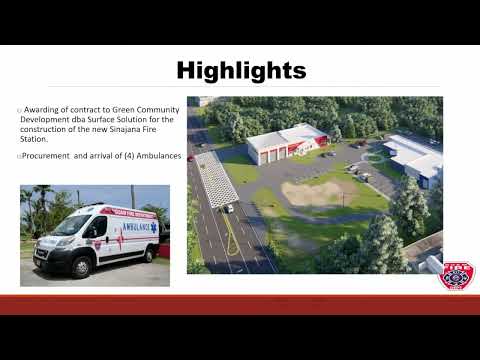
- The department reported newly acquired ambulances and fleet status: four ambulances were procured and placed into service this fiscal year. Berger said there are currently six ambulances operational and nine out of service pending maintenance; he also described rotations to place older units into repair. Committee questioning produced slightly varying counts in the hearing record; the chief repeatedly clarified operational and serviceable totals during questioning.
- Capital outlay: Berger said the FY2026 budget includes $800,000 for ambulances ($400,000 from general fund and $400,000 from the flame fund/capital outlay) and that one fire station contract (Senahani) was awarded in December 2024. Other station projects, fleet maintenance facility and additional construction remain goals and are not fully funded in the FY2026 request.
NG9‑1‑1 surcharge and vendor contract shortfall
Berger told senators the department's E‑911 surcharge has not changed since its inception and does not cover the higher costs of operating the NG9‑1‑1 system. He described a shortfall in the department's special‑funded E‑911 account and said the proposed FY2026 budget from E‑911 special funds covers personnel services only and does not fully address the NG9‑1‑1 yearly maintenance cost. In his testimony he stated the maintenance shortfall was approximately $2,700,000; a later exchange with senators referenced about $2,900,000 as the maintenance magnitude.
On the proposed remedy, Berger said the department is conservatively seeking a $2 increase to the E‑911 surcharge and would petition the Public Utilities Commission (PUC) to examine the adequacy of the surcharge and approve changes. "We're looking at increasing our surcharge by another $2 to meet those demands conservatively," Berger said. He also said the department has not yet filed an effective petition with the PUC and that prior interactions were consultative rather than a formal rate petition.
Budget timing, hires and overtime
The hearing included extended questioning on recruit classes and overtime. Berger said the department graduated 32 recruits in March with another 16 scheduled to graduate in September, and that the FY2026 request would fund a new 20‑person recruit cycle beginning in the new fiscal year. He warned that if the department is not allowed to hire the additional 20 recruits for FY2026, overtime expenditures are expected to rise.
Berger told the committee the 2026 budget assumes decreased overtime compared with the FY2025 authorized level; he quantified the expected decrease at about $600,000 less than the FY2025 authorized overtime allocation, contingent on hiring. Senators pressed for projections if the hires do not proceed and asked when the new cycle would be trained; Berger estimated a six‑month training period after recruitment, with recruits likely operational by March following an October 1 start.
Other operational points raised in questioning
- Prior‑year obligations: Senators asked about roughly $316,000 in prior‑year obligations; Berger said the department has requested payment from the governor's office and BBMR for vendor and personnel obligations but that some personnel payments must await confirmation of available funds near fiscal‑year close. Berger also confirmed a BBMR reservation of $4,468,634 on the department's FY2025 appropriations as of March 31, 2025, but said released funds have been sufficient for current personnel compensation and that the department obtains releases via modification requests when needed.
- Mutual aid and federal runs: The committee requested data on how many ambulance runs were covered primarily by military or other federal resources; Berger said he did not have exact numbers at the hearing but that federal responses were a low percentage and that he would provide the figures.
- Intercept/ALS coverage: Berger described the department's approach to advanced life support (ALS) coverage, saying basic life support units transport patients while paramedic intercept units are dispatched based on triage criteria handled by emergency medical dispatchers. He said the department is growing its paramedic program and has two dedicated intercept/ALS units.
- Fees and fines: Berger said existing inspection fees and EMS charges are well below industry norms (for example, a $35 inspection fee for small storefronts) and that the department intends to pursue a legislative update to increase fees and fines and to seek better Medicare/Medicaid reimbursement rates for EMS.
Committee response and next steps
Committee members signaled support for pursuing a PUC petition and for working with the department on timing and funding of recruit classes and capital needs. Several senators encouraged Berger to engage consultants and work with the PUC early in the rate‑setting process. The committee will continue to accept written testimony on Bill 44‑38 (COR) for seven calendar days following the June 8 hearing.
Ending note: Berger closed by reiterating the department's commitments to training, equipment and community outreach and asked for the committee's assistance on funding and policy changes that would stabilize operations and support paramedic expansion.
Sources: Public hearing testimony to the Committee on Finance and Government Operations on Bill 44‑38 (COR) — Guam Fire Department FY2026 budget, June 8, 2025. Direct quotes and numeric figures are drawn from chief Darren Berger's presentation and subsequent question‑and‑answer exchanges recorded in the public hearing transcript.