Get Full Government Meeting Transcripts, Videos, & Alerts Forever!
Get email alerts on the Child Welfare topic
No spam. Unsubscribe anytime.
Parents, advocates urge City committee to implement child-welfare recommendations, expand cash supports
Summary
Parents and advocates told the Committee of Public Health and Human Services that Philadelphia’s child welfare system removes children unjustly, disproportionately affects Black families and needs immediate policy and cash-assistance changes; the committee recessed until Sept. 15 to continue the hearing.
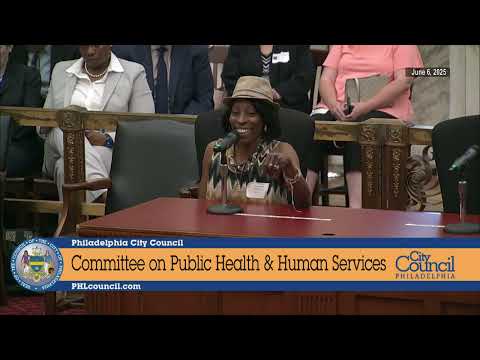
Madam Chair, chair of the Committee of Public Health and Human Services, on behalf of the committee, heard more than an hour of public testimony on concerns about Philadelphia’s Department of Human Services and the city’s foster-care system, with witnesses urging implementation of a special committee’s recommendations and expanded cash supports for families.
Pat Albright, who identified herself as a member of Give Us Back Our Children and Every Mother’s a Working Mother network, told the committee that poverty is treated as neglect and asked the council to add two items to the committee’s recommendations: “no children taken because of disabilities” and “no more termination of parental rights.” She also urged city council to support a federal expansion of the child tax credit, saying an April City Hall press conference “featur[ed] city councilwoman, Bridal Landau and Representative Dwight Evans,” and described several features she said the advocates want: a fully refundable credit available to people without income or with low income, higher monthly payments and inclusion of people with ITINs. She said the group also backs the Worker Relief and Credit Reform Act introduced by Rep. Gwen Moore.
The testimony repeatedly alleged improper removals and poor documentation by caseworkers. Bridget Powell, a registered nurse and longtime parent involved in foster-care proceedings, said she has heard social workers lie in court and wrote that she had been told clearances were “pending” despite never having been asked for required information. Jasmine Banks, a former foster parent who said she raised or fostered roughly 15 children and adopted five, described what she called “false allegations of abuse” and said people who work inside the system can be protected by unions and other institutional safeguards.
Several speakers stressed racial disproportionality. Pat Albright said that “65 percent of children taken are Black,” while Black or African American residents comprise about 38.9% of Philadelphia’s population; she presented that statistic as part of her argument that removals disproportionately affect Black families.
Other policy proposals raised in testimony included increasing Temporary Assistance for Needy Families (TANF) payments (Albright said TANF benefits for a mother with two children remain $403 a month and have not been raised since 1990), establishing a guaranteed monthly care income for caregivers, opposing new work requirements attached to benefits such as SNAP, TANF or Medicaid, and expanding earned-income tax credits to unpaid caregivers and low-income students.
Wanda Walker, who said she served five years as president of CUA 5 and worked with Turning Point, described site visits and said she had seen “incidences where children have been on the line” and urged the committee to hire staff with “compassion and common sense.” Yolanda Taylor said a caseworker turned what she believed should have been a screen-out call into a full investigation, removed her child for three months and later returned the child after the state intervened; Taylor called for better accountability and said parents often lack recourse when court documents or case notes are incorrect.
Committee members acknowledged the testimony and said the panel would continue the work. The chair noted the committee is reconvening work on a special committee that previously examined child separation and that additional hearings would be scheduled to pursue measurable reforms.
The committee took one formal procedural action at the close of the hearing: Vice Chair (name not specified) moved that the committee recess until Monday, Sept. 15, 2025, at 1 p.m. The motion was seconded and the chair announced the committee would recess until that date.
The public comment that day centered on calls for immediate policy changes, expanded monthly cash assistance and improved oversight and accountability in the Department of Human Services; speakers asked that the committee adopt specific guardrails and that the city prioritize getting cash into caregivers’ hands.
The committee indicated it will hold follow-up sessions and other modalities for participation; the chair said the testimony and submitted materials would be taken into account as the committee proceeds.