Get Full Government Meeting Transcripts, Videos, & Alerts Forever!
Get email alerts on the Data Centers topic
No spam. Unsubscribe anytime.
Senate approves data-center bill with new energy, water and community-benefit rules
Summary
The Minnesota Senate passed House File 16, updating environmental and energy oversight for large data centers, creating clean-energy tariff requirements, annual community-benefit fees and strengthened water-permitting authority for the Department of Natural Resources.
The Minnesota Senate voted to pass House File 16, a bill that modifies environmental and energy regulatory requirements for data centers in the state, after extended debate on permitting, water use, clean energy tariffs and community benefits.
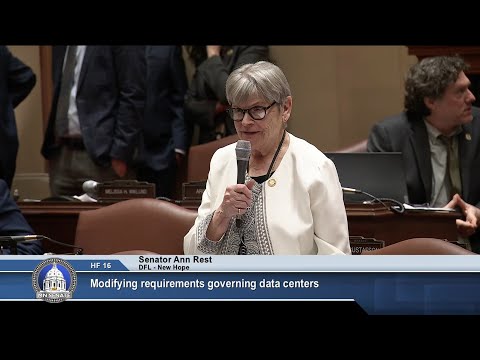
The measure defines large data centers, expands the Department of Natural Resources' ability to review projects that would use more than 100,000,000 gallons of water a year, requires investor-owned utilities to offer clean-energy options and prohibits cost-shifting to residential and commercial ratepayers, and requires data centers to pay annual community-benefit fees of $2,000,000 to $5,000,000 depending on size. Senator Mary Kiffmeyer Rest, the bill’s author, introduced the proposal and described it as a response to a growing “new industrial age” focused on technology.
Proponents said the bill balances economic opportunity with protections. Senator Friends, addressing energy provisions, described three pillars: planning and ratepayer protections, clean-energy tariffs and community benefits. “A data center built in a utility territory cannot, repeat, cannot have a negative effect on the residential or commercial rate payers,” he said. The bill requires utilities to offer clean-energy tariffs and bars cost-shifting so that the data centers shoulder the generation and transmission costs associated with their service.
Senator Anne Johnson Stewart, who worked on the environmental working group, highlighted water and environmental safeguards added to the bill. She said the DNR may request additional information and require aquifer tests for projects proposing to use more than 100,000,000 gallons per year and that the bill authorizes the DNR to ensure an appropriate water-use permit for those centers.
Opponents raised concerns about tax incentives and regulatory burdens. Senator Matthews said rural communities that have already absorbed economic shifts could be harmed by new policy and criticized the bill’s mix of regulatory requirements and long tax-credit extensions. “If that was just the stand-alone piece in this bill, I sure as heck would be supporting that part. But all these other pieces outweigh that in my view,” Matthews said, urging a no vote. Senator McQuaid and others also urged rejection, citing secrecy in some project contracts and long-term tax commitments to very large technology companies.
Supporters argued the bill was needed to mitigate damage from an accompanying tax measure and to preserve Minnesota’s competitiveness for data-center investment. Senator Rasmussen said the bill would help “mitigate the damage” of the tax bill and assist Minnesota-based data companies that would otherwise face large new taxes.
The Senate first suspended its rules to give House File 16 immediate second and third readings; that motion to suspend the rules passed on a roll call of 46 ayes and 19 nays. On final passage the Senate recorded 40 ayes and 26 nays; the bill passed and the title was agreed to.
The bill includes provisions that: expand DNR information and permit authority for very large water users (section 3); define and set eligibility and oversight for large-scale data centers (sections 8 and 17); require clean-energy tariff offerings from investor-owned utilities and prohibit cost-shifting; set annual community-benefit fees of $2 million to $5 million to fund weatherization and low-income energy-efficiency programs; require green building certification and prevailing wages for construction and recommissioning jobs.
Lawmakers said further rulemaking and interagency work will be needed to implement many of the bill’s requirements, particularly on utility tariffs and detailed permitting steps. Senator Rest said the bill is “the beginning” of a framework for the industry in Minnesota.
Votes at a glance: the motion to suspend rules (to fast-track readings) prevailed, 46–19; final passage recorded 40 ayes, 26 nays.
The Senate transmitted its passage and agreed to the bill’s title; next steps include administrative rulemaking by agencies referenced in the bill and any House concurrence steps required for final enactment.