Get Full Government Meeting Transcripts, Videos, & Alerts Forever!
Get email alerts on the Education topic
No spam. Unsubscribe anytime.
Sumter School District asks county council to fund K–3 reading supports, outlines $12.5 million in new expenditures for FY2026
Summary
School district leaders presented a proposal to recruit auxiliary educators for K–3 classrooms and outlined $12.5 million in additional FY2026 expenditures; councilors discussed the plan and a motion was made to approve a renewal increase to fund the initiative.
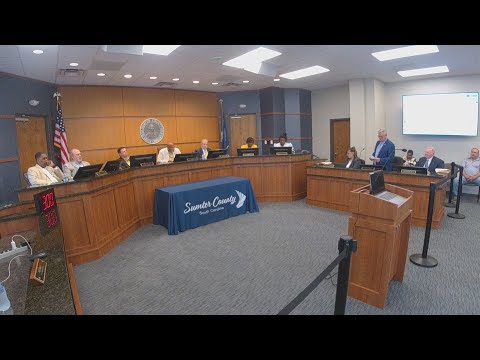
Sumter School District leaders presented a package of proposed spending and a pilot "reading to learn" initiative to the Sumter County Council on Tuesday, June 10, asking the council to consider funding up to 19 auxiliary educators to support K–3 literacy.
The district's presentation, delivered to the council during the regular meeting, said projected additional new expenditures for fiscal year 2026 total $12,505,004.61. That total includes new positions and salary/fringe estimates the district identified as priorities: teacher salary step increases, 15 instructional coach positions ($1,900,000 estimated salary and fringe), six behavior interventionists ($432,500), an assistant principal at Cherryvale ($130,000), an administrative assistant at Radcon Creek ($101,129), a transition specialist for the alternative school ($47,000), virtual-school licenses ($125,000) and a virtual special-education teacher ($77,000). The district also requested funding to employ paraprofessionals (rebranded in the presentation as "auxiliary educators") at a total estimated cost of $639,912 to place additional staff in targeted K–3 classrooms.
The district representative said the starting-teacher salary has increased since 2017 and that the state proposal for a $1,500 increase per certified teacher would add to local costs; the presenter estimated the certified-teacher salary line would increase by about $2,900,000 (salary and fringe). The district described revenue-side expectations — including several possible versions of additional state classroom aid under consideration in the General Assembly — and a projected net gap between new revenues (roughly $4.6 million) and additional expenditures (about $12.5 million). To close that gap, the district said it would reduce its base budget by an estimated 6.6% (about $10.9 million) and rely on the updated base to absorb new spending.
Superintendent of Sumter School District (name not specified) framed the proposed reading initiative as an early-intervention effort, saying, "We should be investing in children to help them learn to read so that they can read to learn." The superintendent said the proposal would target K–3 classrooms and that "most, if not all, schools that serve K–3 students should benefit in some form" from the auxiliary-educator placements.
Shetiva Spearman (presenter, Sumter School District), who walked the council through the expenditure line items and funding assumptions, told the council the district expects enrollment fluctuations and that state aid formulas remain in flux. The district noted it continues to feel effects from federal ESSER-era funding and that some proposed increases (for example, certified-teacher step movement and bus-driver and other staff raises) drive most of the new expenditure requests.
Council discussion included clarifications about the district's terminology and intent. One council member said the district would use the term "auxiliary educators" to clarify that some recruits could be retirees or current employees seeking different roles; the council member added that the title change was meant to broaden the pool of eligible hires. Another council member emphasized support for rural schools and for ensuring paraprofessionals are not overlooked in compensation decisions.
Councilman (name not specified) moved to approve a renewal increase to place two additional staff in selected K–3 classrooms as described by the district. The motion was made on the record; the transcript does not include the mover, seconder, or a roll-call vote for that motion.
Why it matters: District leaders said early reading proficiency is a key predictor of later academic outcomes, and the district framed the proposed hires as targeted early-intervention resources. The presentation also made clear the request interacts with state funding decisions and the district's internal budget reductions.
Next steps and context: The district's presentation accompanied the county's broader budget process. County staff (Mister Nixon) told the council earlier in the meeting that the county's balanced general-fund budget was $65,479,733 and that two readings of the county budget ordinance are scheduled; the school-district request will be considered as council and staff reconcile priorities. The transcript records a motion to fund the auxiliary-educator proposal but does not show a completed vote or final appropriation on the record.
The public comment period that followed included concerns from residents about communication from the council, transportation for students, road repairs and property-tax impacts on fixed-income households. Those concerns were raised separately from the district's formal request and were not recorded as formal council direction tied to the school funding motion.