Get Full Government Meeting Transcripts, Videos, & Alerts Forever!
Get email alerts on the Housing topic
No spam. Unsubscribe anytime.
Planning commission recommends updated moderate‑income housing report required by Utah law
Summary
The Cottonwood Heights Planning Commission on June 4 voted to forward the city’s updated Moderate Income Housing Report (GPA‑25‑002) to the City Council; the report fulfills a Utah state code requirement and recommends five strategies including ADU adjustments, zoning for residential density in commercial zones, PDD incentives, CRA set‑asides, and impact‑fee reductions.
The Cottonwood Heights Planning Commission on June 4 voted to forward the city’s updated Moderate Income Housing Report (GPA‑25‑002) to the City Council. The report is a statutory requirement under Utah state code and must be submitted annually (staff said submissions are due by August 1).
City planning staff summarized the requirement: every Utah municipality must adopt a moderate‑income housing plan and choose from a defined list of options (26 enumerated strategies in state code) describing how the city intends to encourage opportunities for moderate‑income housing. Staff recommended five strategies for Cottonwood Heights to pursue: 1) create or reduce regulatory barriers for internal and detached accessory dwelling units (ADUs), 2) zone or rezone for higher density or moderate‑income residential development in commercial or mixed‑use zones near transit or employment centers, 3) implement zoning incentives for moderate‑income units (for example through the city’s Plan Development District/PDD tools), 4) demonstrate use of a moderate‑income housing set‑aside within community reinvestment areas (CRAs) or similar redevelopment tools, and 5) consider reducing or waiving impact fees for qualifying moderate‑income units.
Staff outlined implementation measures in the packet and work sessions. For ADUs the plan recommends continued public information and review of detached ADU standards to better balance privacy and feasibility; staff also proposed creating a card‑file of pre‑engineered ADU plans to reduce design costs for owners. The staff presentation noted existing tools: the city’s PDD process has previously yielded more than 600 entitled residential units across two projects, with roughly 80 units deed‑restricted for affordability, and the city’s mixed‑use zoning already allows up to 35 units per acre in some commercial areas.
Public comment: Mike Carey, a resident and local general contractor, urged caution. Carey said ADUs alone do not solve affordability and warned of potential negative effects if standards are loosened (for example, conversion toward boarding‑house occupancy or short‑term rentals). Carey also cautioned against relying on impact‑fee waivers as a primary tool, noting that modest fee reductions do not necessarily move market prices and that impact fee policy is complex and constrained by statute and required studies.
Commission discussion covered deed‑restricted affordability levels, PDD incentives, the potential for impact‑fee studies and when and how fees could be reinstated or modified. Staff clarified: the state‑code options do not themselves mandate deed restrictions; deed restrictions come from local PDD agreements and vary (the PDD in use establishes affordability tiers that can require 10%–15% of units be deed‑restricted depending on whether units target 50% AMI or 80% AMI). Staff also noted the city currently charges only transportation and stormwater impact fees and that adding other impact fees would require a formal impact‑fee study and public approval.
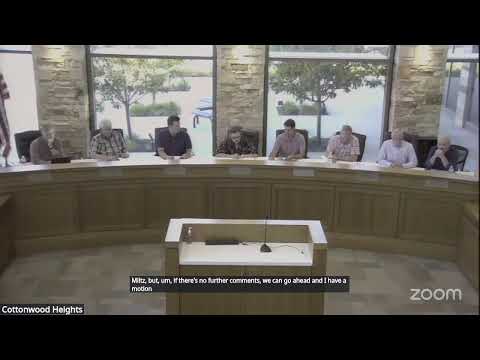
Motion and vote: Commissioner Mills moved to forward GPA‑25‑002 and the updated Moderate Income Housing Report to the City Council; Commissioner Smith seconded. The roll call recorded affirmative votes from Commissioners Smith, Shelton, Barnes, Paulson, Simon, Mills and Anderson; the motion carried.
The report will be transmitted to City Council for their review and possible adoption and will be submitted to the state as required. Staff and commissioners said the measures are not a singular solution to housing affordability but are incremental steps that create eligibility for certain state funding priorities and enable the city to use local tools (PDDs, CRA set‑asides, targeted fee reductions) if council and future developers pursue them.