Get Full Government Meeting Transcripts, Videos, & Alerts Forever!
Get email alerts on the Zoning topic
No spam. Unsubscribe anytime.
Planning commission backs rewrite of neighborhood commercial rules to replace "live‑work" with "neighborhood mixed use"
Summary
Cottonwood Heights Planning Commission recommended approval on June 4 of a city‑initiated zoning text amendment (ZTA‑25‑001) that replaces existing live‑work references in Chapter 19.37 (Neighborhood Commercial) with a new "neighborhood mixed use" category and adds specific development standards.
Cottonwood Heights Planning Commission recommended approval on June 4 of a city‑initiated zoning text amendment (ZTA‑25‑001) that replaces existing live‑work references in Chapter 19.37 (Neighborhood Commercial) with a new "neighborhood mixed use" category and adds specific development standards.
The revision was introduced by city planning staff as a response to a City Council moratorium on live‑work uses imposed in February and is intended to better define how residential uses may be incorporated into neighborhood commercial (NC) properties. Staff said the city has up to 180 days following the moratorium to provide clearer code language.
Under the proposed text amendment, several codified conditional uses in the NC zone would be removed (bed and breakfast, home occupations, home preschools, planned unit developments, residential facilities for elderly persons and live‑work spaces) and replaced or consolidated under the new "neighborhood mixed use" use type. Neighborhood mixed use projects would be permitted to include a residential component only as part of a mixed‑use development and must meet new standards spelled out in the draft ordinance.
Key standards in the draft include: at least 25% of total gross floor area of a neighborhood mixed use project must be nonresidential; at least 50% of the project or unit frontage at ground level along a public right of way must be nonresidential to ensure a public‑facing commercial presence; and existing development standards (height, setbacks, landscaping, parking, buffers and screening) would continue to apply. Staff also proposes removing minimum lot size/width/depth requirements and clarifying height limits by setting a maximum of 35 feet rather than the prior language of "two stories or 35 feet, whichever is less."
During the public comment period, property owner Nathan Anderson said the amendment could diminish development rights for owners who purchased parcels under older expectations. Anderson asked the commission to consider grandfathering, tabling, or offering a variable nonresidential percentage for "off‑prime" sites (for example, lower than 25%) so smaller or less prominent properties could remain viable for small owner‑user commercial uses. He said he has a prospective hairstylist tenant who would rely on the proposed commercial component.
Commissioners discussed staff research and several prior work sessions. Several commissioners praised staff for multiple revisions and research into adjacent communities' approaches; one commissioner expressed sympathy to Anderson for purchasing under unclear expectations and acknowledged potential financial harm from the clarification. The commission did not adopt any special grandfathering language during the hearing; the motion forwarded the staff draft as a recommendation to the City Council.
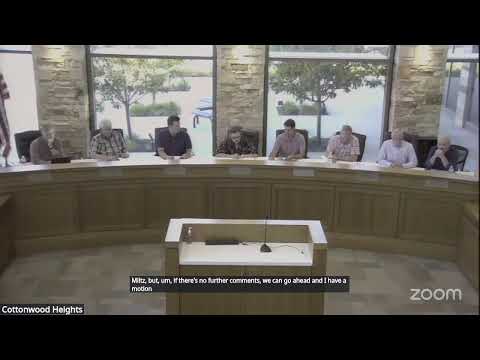
Motion and vote: Commissioner Simon moved to recommend approval of ZTA‑25‑001; Commissioner Mills seconded. The roll call recorded affirmative votes from Commissioners Mills, Steinman, Paulson, Barnes, Shelton, Smith and Anderson. The motion passed and the item will next go to the City Council for its legislative review and decision.
As a legislative recommendation, the planning commission's action does not change zoning until (and unless) the City Council approves an ordinance adopting the amendment. The council will hold its own hearings before any zoning text is adopted.