Get Full Government Meeting Transcripts, Videos, & Alerts Forever!
Get email alerts on the Transit topic
No spam. Unsubscribe anytime.
Lane Transit District details ridership recovery, previews Connect 2045 planning
Summary
Lane Transit District told the Eugene Sustainability Commission it has partially recovered service and ridership since COVID and is launching a long-range mobility plan, Connect 2045, that will consider smaller vehicles, mobility-on-demand pilots and expanded bike-share to rebuild transit use.
Brandon Melton, a senior planner with Lane Transit District, told the Eugene Sustainability Commission that the agency has regained much of its pre‑COVID service capacity but still lags in ridership.
Melton said total annual ridership before the COVID‑19 pandemic was about 10,000,000 boardings and that current totals are about 6.2 million, adding that weekday service hours dropped to roughly 40% of pre‑pandemic levels during COVID and are now about 84% of what they were. "Frequency is king," Melton said, describing frequency as central to convincing choice riders to return to transit.
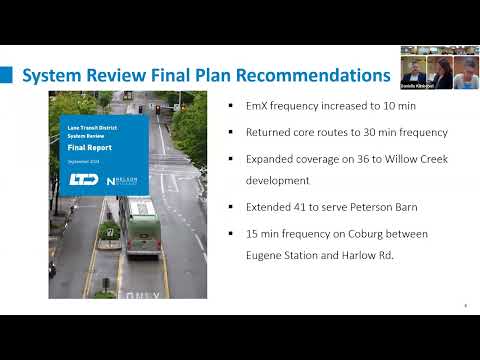
Melton summarized a recent system review — a routine, multi‑year examination of routes and service — that led to short‑term route adjustments and longer‑term recommendations the district adopted in October. Short‑term changes included restoring high‑frequency MX peak service (about 10‑minute headways during peak on some corridors), returning some core routes to 30‑minute frequency and creating a 15‑minute combined frequency on the Coburg corridor between Eugene Station and Harlow Road by consolidating multiple routes. LTD expanded or adjusted coverage in response to development in the Willow Creek area and an extension to Peterson Barn, Melton said.
Commissioners asked about specific recovery patterns and service options. Melton said some peer systems — Salem was cited — are closer to pre‑COVID ridership, and that multiple factors likely shape ridership recovery, including changes in telework, the relative affordability of cars during the pandemic period, and lingering public‑health concerns. He said UO (University of Oregon) student travel strongly affects local ridership patterns, producing pronounced dips during academic breaks.
Commissioners and the public raised alternatives for lower‑ridership areas, including smaller vehicles and mobility‑on‑demand pilots. Melton said LTD lacks many midsize vehicles and typically operates 40‑ and 60‑foot buses; the agency has a Cottage Grove connector (a cutaway vehicle) and recently obtained a federal ATTAIN grant to pilot demand‑responsive service in the Bethel School District area. He also said LTD is exploring expanded bike‑share partnerships to improve first‑/last‑mile access.
Questions addressed paratransit and student access. Melton said RideSource, LTD’s paratransit program for eligible riders within three‑quarters of a mile of fixed routes, remains funded at current levels and is undergoing an operations analysis. He also confirmed K–12 students have free passes (Melton cited about 14,000 student passes) and that LTD is pursuing youth engagement and travel‑training efforts to encourage sustained ridership among younger riders.
Melton described airport service as possible but operationally challenging because some early morning or late‑night flights would require running buses outside normal service hours. LTD will evaluate scenarios and scenarios’ costs before proposing a service change. He told commissioners LTD is also assessing ways to accommodate heavier ebikes on bus bike racks after commissioners reported some current racks do not fit wide‑tire bikes.
Looking ahead, Melton said LTD will launch Connect 2045, a long‑range mobility plan that will revisit the 2014 plan’s recommendations, define a 20‑year vision for transit, and identify specific investments. He emphasized aligning transit service with land‑use decisions in Eugene, Springfield and Coburg, and said the plan will include robust public engagement in the coming months.
Melton closed by inviting commissioners and the public to participate in outreach for Connect 2045 and for LTD pilots.