Get Full Government Meeting Transcripts, Videos, & Alerts Forever!
Get email alerts on the Veteran Services Access topic
No spam. Unsubscribe anytime.
Local groups, providers and county representatives push transport and local care options for veterans
Summary
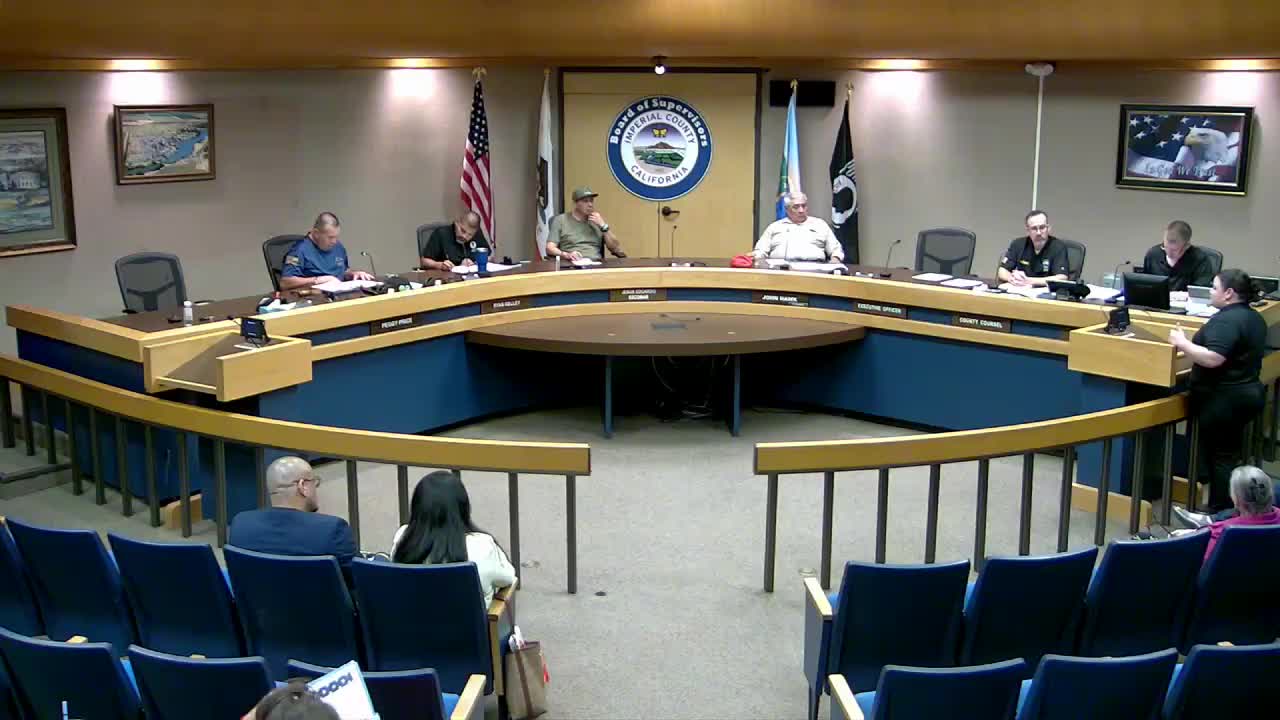
Speakers at the May 29 Imperial County Veterans Advisory Council meeting described persistent transportation gaps to San Diego VA care and outlined local responses: volunteer driver recruitment, coordination with American Red Cross and DAV, HUD VASH voucher advocacy and outreach by local health providers.
Speakers at the Imperial County Veterans Advisory Council meeting on May 29 described ongoing difficulties getting veterans to appointments at the San Diego VA and outlined a mix of short‑term and longer‑term responses, including volunteer driver programs, outreach to federal appropriations staff for HUD VASH vouchers and efforts to expand use of local medical providers.
Sarah Slorzeno, field representative for Congressman Bridal Ruiz, said congressional staff are circulating a letter to the appropriations committee seeking additional HUD VASH vouchers; once the letter has enough cosigners it will move to the committee that sets funding. Slorzeno said the sign‑on letter is a necessary step because “the funds are limited” and local requests must be routed through the appropriations process.
Local organizations and providers described coordinated volunteer and provider efforts. Sarah and other speakers cited Raul Diaz, regional program manager for the American Red Cross, as a potential partner to recruit and process volunteer drivers and to run community preparedness workshops. Council members and public commenters also said Roque Blas, who coordinates DAV driver recruitment out of the VA in La Jolla, has been part of local recruitment discussions.
Esther Frias, representing VetConnect, said the group has engaged more than 60 community organizations on valley‑wide coordination and is pursuing transportation grants through social services. “There’s over, I wanna say, 67, organizations now that are willing to work with, veterans,” she told the council, and the group will present at the continuum‑of‑care meeting planned for June 4.
Health providers offered local capacity that could supplement VA care. Dr. Carlos Ramirez, speaking for a Primary Care Practice affiliated with Imperial Valley Family Care Group, said his practice includes eight providers and that the group already holds a contract enabling them to see VA patients locally. Ramirez urged better communication to make veterans aware of non‑VA provider options and reduce long waits for VA appointments, noting the practice currently sees roughly 200 patients a day across providers.
Araceli Madrigal, vice president of sales for UNICARE, described home health, palliative care and private caregiver services the organization can provide to prevent unnecessary hospitalizations and help veterans age in place.
Other local outreach noted during public comment included Imperial Valley College’s second annual veterans and family resource fair on June 30 from 11 a.m. to 3 p.m., and a proposed volunteer driver schedule of once or twice a month to transport veterans to San Diego while longer‑term solutions develop.
What the council discussed as next steps included connecting volunteer‑driver recruitment between the American Red Cross and DAV, pursuing transportation grant funds identified by VetConnect, and improving public information so veterans know which local providers can accept them under existing contracts.
Quotations in this article come from meeting participants and the public record at the May 29 meeting; details such as counts, dates and grant processes reflect statements made in the public comments and staff updates.