Get Full Government Meeting Transcripts, Videos, & Alerts Forever!
Get email alerts on the Coastal Management topic
No spam. Unsubscribe anytime.
House Natural Resources panel hears bill to redefine Puerto Rico—s maritime-terrestrial zone
Summary
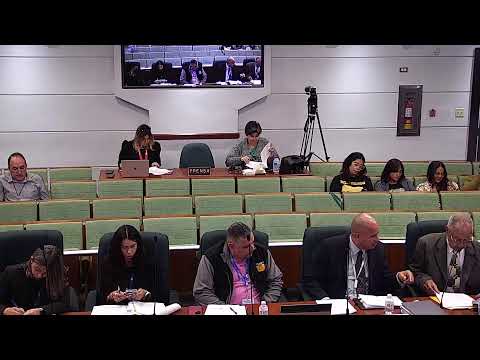
The House Commission on Natural Resources held a public hearing May 19 on Project of the House 25, which would amend statutory definitions of the zona mar—dtimo terrestre in two Puerto Rico laws. Agency witnesses and surveyors urged technical clarifications on tide datums, exceptions for cliffs and statutory alignment with existing regulations.
The House Commission on Natural Resources held a public hearing May 19 on Project of the House 25, a proposal to amend statutory definitions of Puerto Rico—s zona mar—dtimo terrestre in Law 151 (June 28, 1968) and Law 1 (June 29, 1977) as cited in the measure.
The measure would alter how the coastal "maritime-terrestrial zone" is defined for purposes of permits, servitudes and management of the public maritime-terrestrial domain. Department of Natural and Environmental Resources (Departamento de Recursos Naturales y Ambientales, DRNA) officials, the state surveyor and the Association of Surveyors of Puerto Rico testified and recommended technical and drafting changes.
DRNA assistant secretary Eguilveliz Espinoza Lugo and staff described the agency—s statutory responsibilities for the maritime-terrestrial domain and said the draft bill generally moves toward legal clarity but needs technical corrections. "Respetuosamente sugerimos que se añada como —altima oraci—3n en las —1reas del archipi—9lago de Puerto Rico donde se encuentran acantilados si los acantilados tienen una elevaci—3n mayor o superior a la marejada no cicl—3nica en ese caso la servidumbre no es aplicable," Espinoza Lugo said, urging that high cliffs be excluded from the servitude. She also recommended clarifying whether the bill relies on the equinoctial tide and specified that wave run-up after a wave breaks should be excluded from the horizontal displacement used for the boundary.
Marcos Col—3n Mercado, the state surveyor from the Department of Economic Development and Commerce (Departamento de Desarrollo Econ—3mico y de Comercio), presented a memorial explaining the technical implications of the bill. Col—3n Mercado said the bill—s attempt to fix a tide standard is a step forward but urged precision: the draft names the "equinoccial" tide but does not state whether that is the equinoctial in perigee or apogee. He also recommended using mean sea level as the datum for measurements and warned that without clear technical language the bill could create new ambiguities.
"La forma en que se lleva a cabo dicho an—1lisis es extremamente complejo," Col—3n Mercado said, asking the committee to adopt definitions that reflect topographic, geologic and geophysical conditions and to incorporate the department—s technical recommendations.
The Association of Surveyors of Puerto Rico, represented by President Julio Juan Figueroa Carrillo, echoed the call for technical clarity. The association and the state surveyor said the bill—s draft should name the datum (for example, "measured from mean sea level") and refine language about mareas, wave action and the limits of public dominion. The association noted that beaches and coastal formations are geologically unstable and the rules that define the zone should reflect that reality.
Witnesses and presenters also cited existing regulatory and statutory instruments that overlap with the proposed changes, in particular Reglamento 48-60 (regulation on use, surveillance, conservation and sanitation of the maritime-terrestrial zone, waters and submerged lands), subsequent amendments (Reglamentos 52-07 and 78-28) and a more recent joint regulation referenced as the "reglamento conjunto 20-23." DRNA staff said statutory and regulatory definitions differ in places, and that if the bill is enacted the Planning Board (Junta de Planificaci—3n) and the Permits Management Office (Office of the Permit Management Office) would need to align their regulations.
Panel testimony included several technical details regulators and surveyors asked the Legislature to clarify before passage: identify the specific tide datum (e.g., mean sea level or equinoctial and whether perigee/apogee is intended), explicitly exclude wave run-up after breaking from the horizontal displacement measure, provide an exception for cliffs whose elevation exceeds ordinary non-cyclonic storm surge, and adopt precise definitions for the two servitudes referenced in the draft (servidumbre de salvamento: a 20-meter strip counted inland from the maritime-terrestrial zone intended for rescue and deposit of shipwrecked materials; servidumbre de vigilancia litoral: a 6-meter-wide public passage along the high tide line).
Marcos Col—3n Mercado also told the committee the DRNA currently has more than 200 pending maritime-terrestrial delineation (deslinde) cases, and that greater drafting precision in statute could speed case resolution and reduce litigation. Several witnesses urged that the DRNA—s survey division be established as an autonomous technical entity and that any implementing regulations comply with Puerto Rico—s Administrative Procedure law and environmental policy law cited by witnesses.
No formal vote or committee action on the bill was recorded at the hearing. Witnesses from DRNA, the state surveyor and the Association of Surveyors said they would provide further technical recommendations in writing to the commission.
The committee hearing included questions from representatives present and by video; no final disposition was announced at the close of the panel.
Background: Project of the House 25 would amend the definitions of the maritime-terrestrial zone in Law 151 (June 28, 1968) and in provisions cited from Law 1 (June 29, 1977) as referenced in the measure. Testimony at the hearing frequently cited the DRNA—s regulatory framework (Reglamento 48-60) and the law establishing DRNA—s responsibilities (Law 23 of June 20, 1972) and Puerto Rico—s environmental policy law (Law 416 of 2004) as relevant to implementation.
Ending: The commission did not take a final vote. Staff and the panel said they will review written recommendations from the agencies and the Association of Surveyors before any committee report or floor action is scheduled.