Get Full Government Meeting Transcripts, Videos, & Alerts Forever!
Get email alerts on the Dcha Budget topic
No spam. Unsubscribe anytime.
D.C. housing committee warns proposed DCHA budget cuts would shrink repairs and risk displacement
Summary
At a May 30 Committee on Housing hearing, residents, providers and Council members pressed the D.C. Housing Authority (DCHA) and Council staff about Mayor Bowser's FY26 proposal, which holds voucher funding flat, cuts recurring maintenance dollars and reduces public-safety support for public housing.
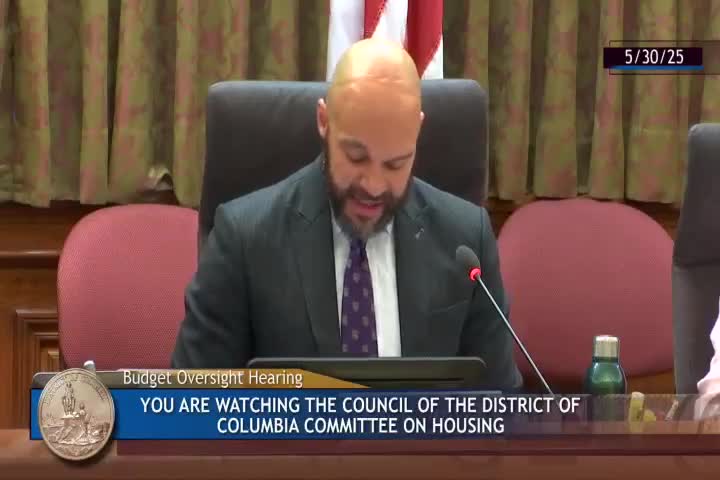
Council Member Robert White, chair of the Committee on Housing, opened the May 30 budget oversight hearing by warning the committee and witnesses that the city is operating on a compressed schedule and that the Mayor’s FY26 budget proposals for the D.C. Housing Authority risk worsening displacement.
“This is a setup for a new wave of displacement, and I'm incredibly concerned,” Council Member White said, summarizing testimony he expected from agencies and providers about the likely local effects of federal funding uncertainty and proposed local cuts.
Advocates and resident leaders told the committee the mayor’s proposal would keep local voucher investments steady but would eliminate a recurring $7 million a year set aside last year for public-housing repairs and maintenance. Several witnesses said the change, combined with a proposed reduction in funding for DCHA’s public-safety activities, would undermine the authority’s ability to preserve aging buildings and protect residents.
Farrah Fassay of Empower DC pressed the committee for a sustained local commitment to repairs and to require DCHA to publish property-level vacancy and offline-unit data. “Over 2,300 deeply affordable homes throughout D.C. are sitting vacant, while tens of thousands of people need affordable housing,” she said, calling for $60 million annually for public-housing repairs — the amount urged by the Fair Budget Coalition and other groups.
DCHA Director Keith Pettigrew told the committee the authority has been rehabbing units and is preparing a more aggressive rehabilitation and redevelopment plan. He said obstacles include aging building systems, supply and labor costs, and delays in federal approvals for Section 18 repositioning requests filed with the U.S. Department of Housing and Urban Development (HUD).
Director Pettigrew said DCHA is committing available local capital funds and HUD capital grants to vacant-unit turns and repairs and is using reserves and prior-year funds to accelerate work, but he warned that some repairs require major infrastructure replacement and are costly. Deputy Director Daniel Denning told the committee the authority has completed 1,164 unit rehabs since January of last year and currently averages roughly 80 unit turns per month.
Council members pressed DCHA on how long it will take to bring offline units back into service, how the authority will prioritize projects given a reduced FY26 capital proposal from the Mayor and what contingency planning DCHA has in case of federal funding cuts. Director Pettigrew said the authority is refining monthly tracking so units coming back into inventory can be prioritized for quick leasing.
Several council members and witnesses urged the committee to ensure the DCHA board’s structure and oversight are adequate to protect residents during repositioning and redevelopment. Witnesses asked the council to codify a guaranteed right to return to redeveloped properties without rescreening; DCHA leaders said they have committed to strong resident protections but that a property-by-property plan and clearer statutory protections would give residents greater certainty.
The Committee left the hearing with multiple outstanding requests for DCHA: a more detailed property-level plan and timeline for returning units to service; an accounting of available capital and repair funds (including prior-year balances and HUD-held reserves); a schedule for implementing a targeted rehabilitation plan; and contingency scenarios in the event of federal funding cuts.
The Committee kept the hearing record open for written testimony through June 6.