Get Full Government Meeting Transcripts, Videos, & Alerts Forever!
Get email alerts on the Palestine Israel Conflict topic
No spam. Unsubscribe anytime.
Fort Wayne activist urges grassroots pressure after recent Palestine trip
Summary
Dr. Michael Smith, of the Indiana Center for Middle East Peace, described conditions he observed in the West Bank and Gaza, highlighted Palestinian and Israeli activists he met and urged local grassroots organizing and partnerships with Palestinian groups.
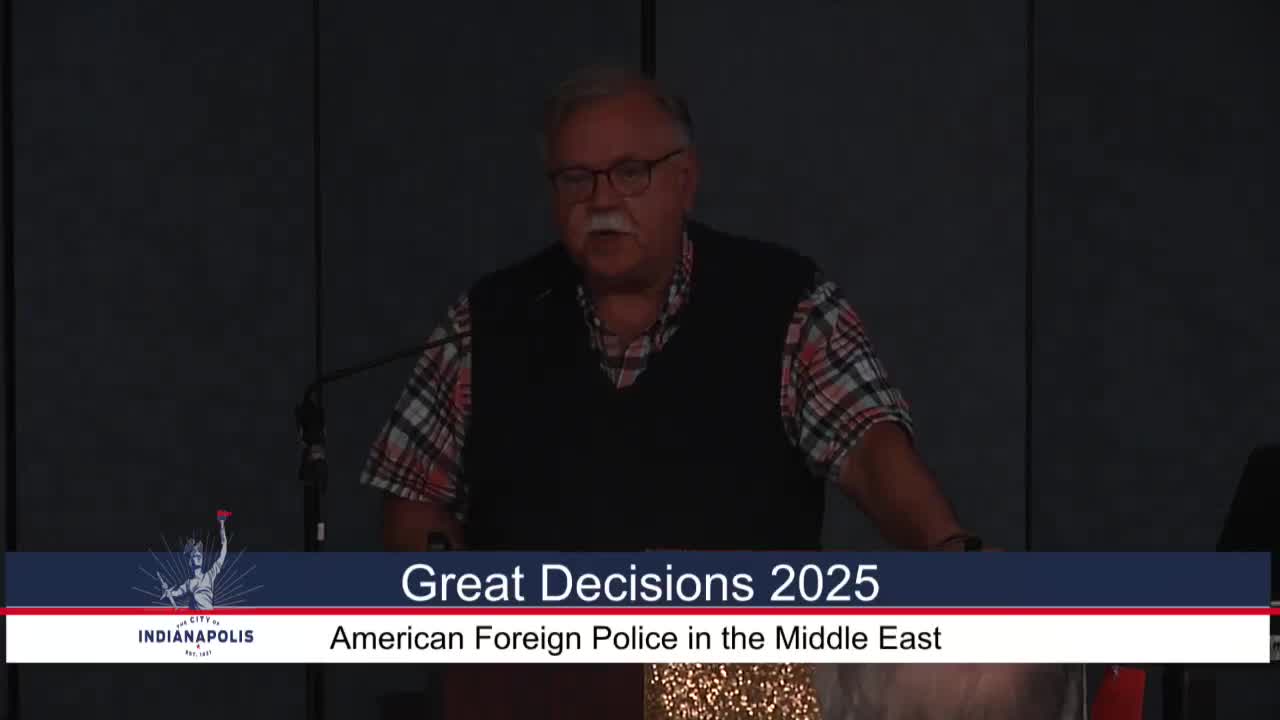
Dr. Michael Smith, who said he represents the Indiana Center for Middle East Peace in Fort Wayne, urged members of an Indiana audience to press for change in U.S. policy toward Israel and to develop grassroots ties with Palestinian organizations after a recent trip to Israel and the occupied Palestinian territories.
Smith said he led a group of 18 U.S. activists and met with religious, political and nongovernmental leaders, including Palestinian activists, journalists and organizers. He described repeated closures of sites in Bethlehem, frequent Israeli military incursions in the West Bank and what he called a slow process of “gauzification” of the West Bank — language he used to explain his view that the West Bank is being turned into a condition like Gaza.
"If genocide isn't your red line, you don't have a red line," Smith said, placing the moral obligation to respond to what he described as largescale civilian harm at the center of his talk. He criticized both U.S. political parties and some U.S. churches for what he called bipartisan and institutionalized support for Israeli military actions and urged attendees to focus on grassroots pressure rather than expecting change from national leaders.
Smith described specific people and sites his group visited. He introduced Mazin, a scientist affiliated with Bethlehem University who helped found a Palestine National History Museum and an Institute for Biodiversity and Sustainability; Issa Amro, a Palestinian activist from Hebron who Smith said had been nominated for the Nobel Peace Prize and who has organized Youth Against Settlements; and Jeff Halper, whom Smith identified as head of the Israel Committee Against House Demolitions and a leader of a campaign for a single democratic state. Smith said Halper and Issa had been nominated together for the Nobel Peace Prize.
Smith recounted the experience of Daoud Nassar and his family at the Tent of Nations farm near Bethlehem. According to Smith, the family holds a deed to property that has been repeatedly challenged in Israeli courts, their trees and terraces have been damaged or destroyed, and the family has faced threats and physical attacks. Smith said the family reports damages exceeding $200,000 over several years and that planned road projects and settlements would result in the loss of more than 60% of their land. He described the family as relying on international volunteers for protection and said the farm's motto is, "we refuse to be enemies." Smith identified a U.S. support group called Friends of Tent of Nations North America.
On Hebron, Smith described a pattern of settlers taking over rooftops, intimidation of Palestinian shopkeepers, and Israeli military checkpoints that limit movement. He said Issa Amro had been assaulted and threatened and that cameras and documentation have become important tools for documenting incidents.
Smith said he and his group met with Sahar Francis, a leader of an organization that supports Palestinian prisoners, and that such meetings have become less frequent during the period he described. He also said Palestinians he met told him they feel betrayed by U.S. policy and perceive no difference between the Biden and Trump administrations on this issue.
Smith discussed the concept of "normalization," quoting Jeff Halper's critique that normalization closes off future strategies for Palestinian self-determination and can entrench an apartheid-like status quo. He told the audience that normalization may be advanced through international agreements that exclude direct Palestinian participation.
Smith recommended steps for local action: build relationships with Palestinian organizations, provide small but steady financial support or purchases of Palestinian goods, host exchanges or virtual meetings, and support arts and education programs that he said sustain Palestinian communities. He highlighted cultural programs such as the Jenin Freedom Theatre and the Arawad Cultural Arts Center as examples of arts-based resilience.
During a brief question-and-answer period, attendee Marcus Case asked about differences between secular and religious visions of Israel. Smith said motivations vary but that, in his view, Zionism unites many political strands and that removing one politician would not necessarily change policy toward Palestinians.
Smith closed by urging attendees of faith and conscience to take small, sustained actions to build ties and pressure policymakers from the ground up rather than relying on federal officials.