Get Full Government Meeting Transcripts, Videos, & Alerts Forever!
Get email alerts on the Parking Policy topic
No spam. Unsubscribe anytime.
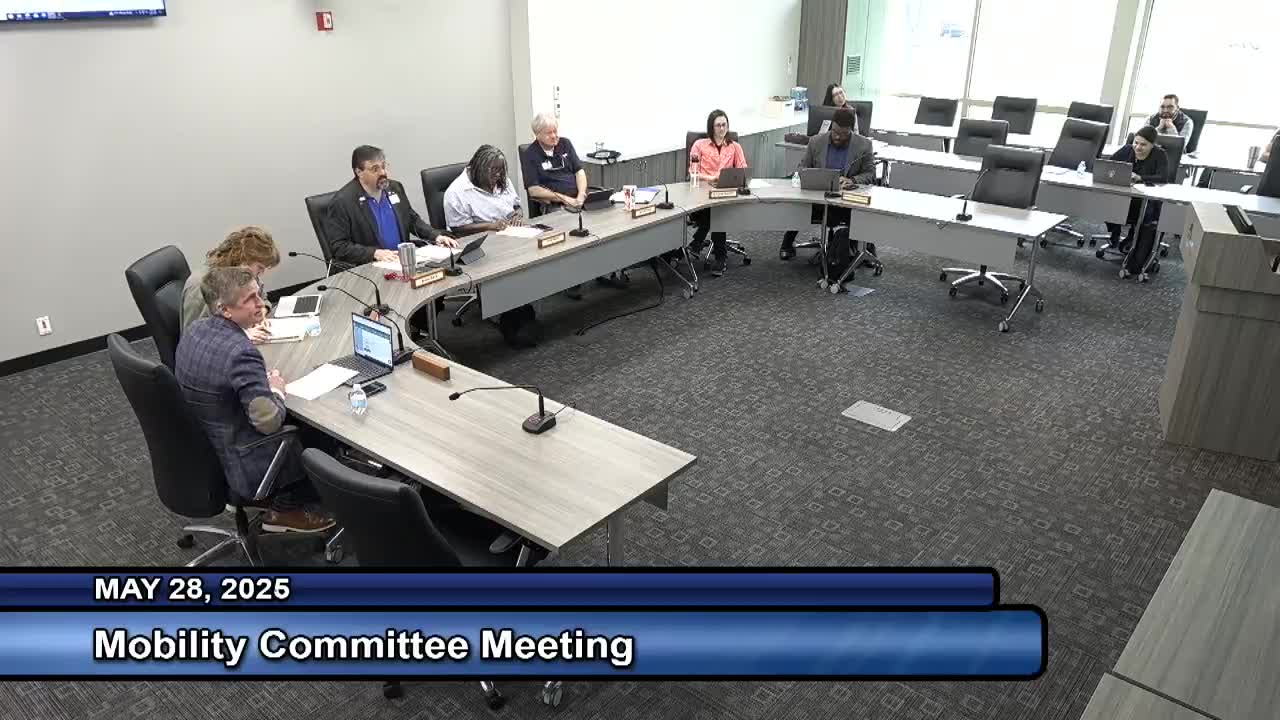
Mobility committee sends East Hickory parking pitch to council after split discussion on costs and safety
Summary
The Mobility Committee voted to forward a two‑minute pitch asking staff to investigate converting East Hickory Street from back‑in (reverse) parking to traditional head‑in parking. Staff told the committee converting the street would carry a substantial price tag and recommended no change absent funding; members were divided on whether the city
The Mobility Committee voted May 20 to forward a petition from a two‑minute pitch asking staff to investigate converting East Hickory Street from back‑in parking to traditional head‑in (front‑in) parking and to send the matter to City Council for further consideration.
Farhan ****, deputy director of Transportation Services, summarized staff analysis and three options developed after a comprehensive traffic operations and safety audit. He told the committee the configuration of back‑in parking on East Hickory was completed as part of a 2014 capital project with an approximate expenditure of $3,200,000. Staff said three options were: (1) pursue aggressive targeted enforcement to reduce violations, (2) convert back‑in spaces to front‑in spaces (a conversion staff estimated would cost significantly more — staff cited a figure "over $3,500,000" for full implementation), or (3) reconfigure traffic to a one‑way street to eliminate conflicting movements. Staff recommended no change at this time because enforcement resources are limited and the redesign options would require substantial budget and planning work.
Council Member Holland moved that the committee send the pitch to council asking staff to investigate returning East Hickory Street to traditional front‑end parking. Holland argued the back‑in configuration had been problematic for merchants and drivers since it was installed and said, "It was a bad idea from the day it was conceived. It's a bad idea today. And mistakes need to be corrected." Another committee member seconded the motion.
Committee deliberations highlighted three recurring concerns: budget impact, the mixed safety evidence presented in an earlier staff review, and the practicality of enforcement as a lower‑cost alternative. Some members said the 2014 redesign had modest safety benefits in the earlier staff review and questioned whether spending millions now would be the best use of limited capital. Staff also described a potential technology option to supplement enforcement — automated detection that could be applied downtown — and said that option might be less costly than a full rebuild and could be used in multiple locations.
After discussion the committee voted in favor of sending the pitch to council for further consideration and a possible work session. The meeting transcript records members raising hands in support and the chair announcing an affirmative result; the transcript does not show a roll‑call vote or named vote tallies.
Ending: The committee’s recommendation will be reported to City Council; staff will be prepared to present enforcement options, cost estimates for conversion and technology alternatives at a subsequent council work session if council requests further review.