Get Full Government Meeting Transcripts, Videos, & Alerts Forever!
Get email alerts on the Active Transportation topic
No spam. Unsubscribe anytime.
Mobility committee backs staff recommendations on bollards, names priority corridors and costs
Summary
City of Denton transportation staff presented final recommendations from a bollard evaluation and proposed flexible plastic posts and concrete block separators for protected bike lanes along several corridors, listing Malone, Georgetown, Ector and South Carroll among initial candidates.
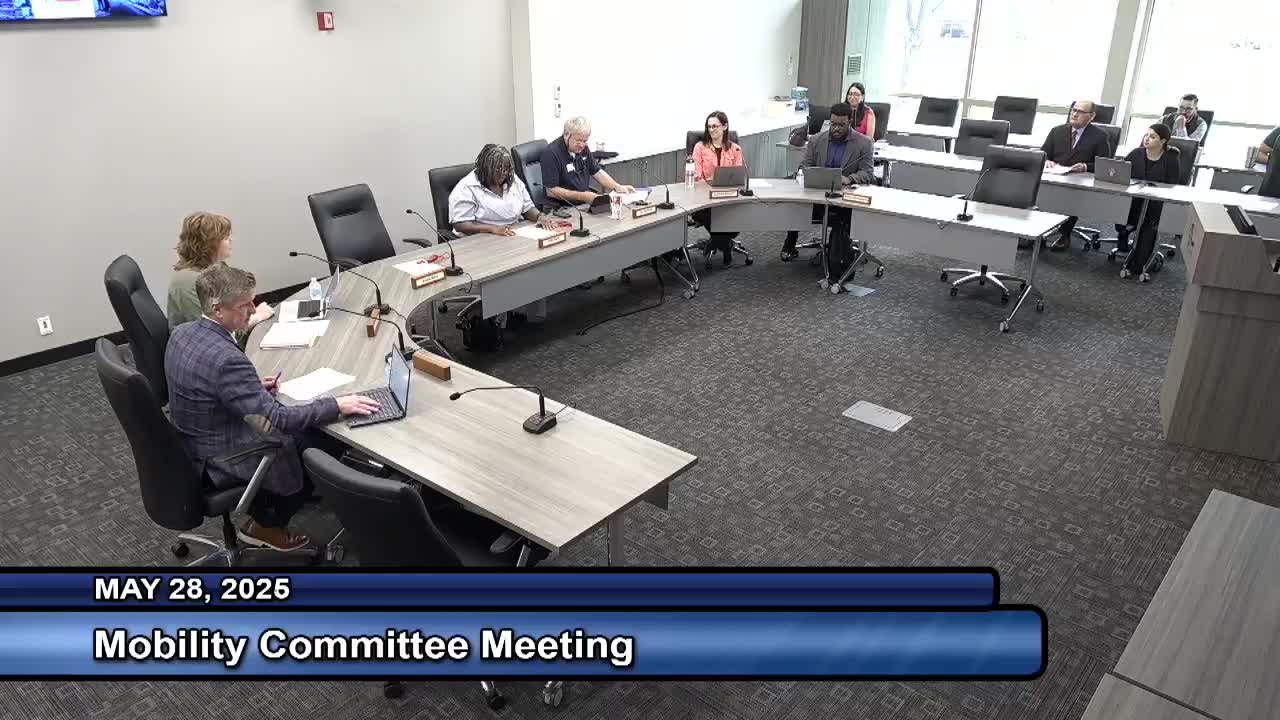
City of Denton transportation staff presented the final installment of a three-part bollard evaluation at the Mobility Committee meeting May 20, recommending two types of treatments for protected bicycle facilities and naming several priority corridors for near-term implementation.
The staff presentation was led by Farhan ****, deputy director of the Transportation Services Division. He said staff recommends two main treatments: flexible plastic posts for lower-speed locations and interlocking concrete block separators for higher-speed arterials. "Bulk cost would be $300 per unit, and installation cost is around $150 to $200 depending on the location," Farhan said of the concrete blocks. He also gave a per-unit figure for plastic posts: "cost would be around $50 per unit, and installation cost would be around additional $25, making it $75 per unit including installation."
The memo and slide deck presented by staff listed selected corridors that audits showed to have frequent bicycle–vehicle conflicts near US 380 and the central activity area. Staff proposed Malone Street (north and south of US 380), Georgetown Drive (north of US 380 to Amherst Drive), Ector Street (US 380 south to Scripture Street), and South Carroll Boulevard (US 380 to Parkway Boulevard) as initial candidates. Staff characterized South Carroll as a six‑lane primary arterial where concrete block separators would be preferred because speed and traffic volumes make a more robust buffer necessary.
Committee members and residents pressed staff on design standards, spacing and community engagement. Farhan said spacing would be context-sensitive: "At high speed locations or relatively higher speed location with a continuous flow, the distance the offset will be higher. And at slower speed locations ... the offset or distance between the bollards would be smaller." He also said some installations could be phased—starting with plastic posts and upgrading to concrete blocks if audits show the treatment is effective.
Committee members raised questions about how the new treatments would interact with existing or older bollard installations and where older posts should be retained, replaced or removed. Farhan said audits are underway at older locations and that in some places staff expects to replace deteriorated posts with striping instead of new bollards. He noted the program would be tied to available budget and that some installations could be advanced sooner if funding is available.
Staff told the committee it is pursuing grant opportunities. Farhan said the US 380 project had been submitted to TxDOT’s Highway Safety Improvement Program (HSIP) and that the corridor will also be part of the city’s SS4A (Safe Streets and Roads for All) application being filed in June.
The presentation concluded with staff describing how the recommended treatments and design guidance will be incorporated into longer‑range updates to the city’s transportation criteria manual and the active transportation element of the mobility plan.
Committee members suggested additional outreach to businesses and residents along candidate corridors, and one resident who said she lives near Razor Ranch pressed staff for temporary or interim improvements while larger designs are developed. Farhan responded that walking audits and targeted corridor audits already take place and that staff will include user origin/destination analysis and public engagement when a corridor moves to design.
No formal vote was taken on implementation funding at the meeting; staff said timing and the number of installations will depend on budget and on the outcome of future audits and grant awards.
Ending: Staff will continue corridor audits, seek grant funding and fold the recommended design elements into the transportation criteria manual and future mobility plan updates. Specific project schedules will depend on available capital or grant funding and subsequent design work.