Get Full Government Meeting Transcripts, Videos, & Alerts Forever!
Get email alerts on the University Housing topic
No spam. Unsubscribe anytime.
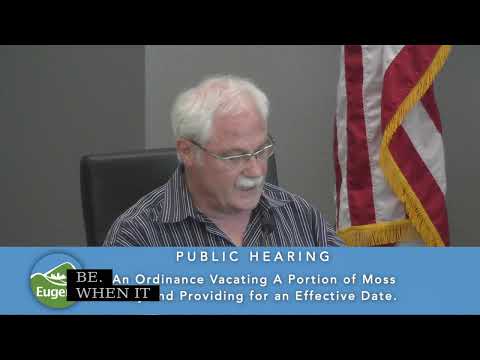
Eugene council holds hearing on vacating Moss Alley for proposed UO residence hall
Summary
The Eugene City Council held a public hearing May 19 on a University of Oregon request to vacate part of Moss Alley to create a site for a student residence hall; the record was closed and deliberations were scheduled for June 23.
Eugene City Council held a public hearing Monday to consider a request to vacate a portion of Moss Alley south of 17th Avenue, near the edge of the University of Oregon campus, to create a development site for a proposed UO student residence hall. The council closed the public record at the end of testimony and scheduled deliberations and possible action for June 23, 2025.
The council will consider the vacation under the public-interest standard in Eugene Code section 9.8725. The university’s representatives told the council the alley vacation would enable a residence-hall design that supports first-year student success, expands on-campus housing supply and frees up off-campus housing for nonstudents. The applicant also proposes retaining public utility easements over the vacated area to preserve access to underground infrastructure.
Dr. Michael Bridal, Associate Vice President for Enrollment and Student Services and Director for University Housing, told the council "The new residence hall is about student success," and said first-year students who live in University of Oregon residence halls have higher grades, higher retention rates and graduate faster than those who live off campus. Colin MacArthur, applicant representative with Cameron McCarthy Landscape Architecture and Planning, said the findings submitted with the ordinance show the vacation is in the public interest, that affected utility providers have concurred and that plans are in place to relocate utilities into easements.
Bob Choquette, chair of the campus planning committee, testified in support and said the East Campus area has long been identified for student housing, describing proximity to transit and Franklin Boulevard as reasons the site is appropriate. "The 2 new residence halls will increase the housing supply on campus and within the community," Choquette said, noting the project is informed by the Next Generation Housing Development Plan and recent campus planning meetings and open houses.
A University of Oregon student, Daisy O'Hearn, director of the Residence Hall Association, described personal benefits of living on campus: "I felt safe in the residence hall, and I felt like I had a community... Living on campus created an environment I needed to succeed." She said the halls provide social and academic support for first-generation students.
Councilors disclosed multiple ex parte contacts with Matt Roberts of the University of Oregon; several said their conversations were brief and informational. The city attorney reminded councilors that, because this is a quasi-judicial proceeding, decisions must be based on the evidence and argument in the record and on the applicable approval criteria. The city attorney also noted councilors and the public may rebut the substance of any disclosed communications during the hearing.
Council discussion included questions about current uses of Moss Alley and how deliveries and emergency access would be handled if the alley is vacated. Planning staff said they would provide a diagram of current and proposed delivery routes. Jeff Gupper, principal planner, said staff would try to include information about the total number of students planned for the area in the Administrative Information Sheet for the upcoming deliberation if that figure is already in the record; he said he was not aware of that number at the hearing.
Councilor Zelenka, speaking about broader planning issues tied to the university’s East Campus plan, raised neighborhood livability concerns, including potential traffic and noise impacts on the Fairmont neighborhood if larger campus boundary changes proceed without additional studies and mitigation. The city attorney clarified that Zelenka’s remarks address potential future land-use applications and that the record for the Moss Alley vacation itself was closed prior to those comments.
No decision was made at the May 19 hearing. The council closed the record on this application and set deliberations and possible action for June 23, 2025. Staff and the applicant indicated they will provide follow-up materials in the record before that date, including utility relocation plans and delivery-route diagrams.
Deliberations on the Moss Alley vacation will be limited to whether vacating the portion of the alley is in the public interest under Eugene Code section 9.8725 and to evidence in the record when council takes up the item on June 23.