Get Full Government Meeting Transcripts, Videos, & Alerts Forever!
Get email alerts on the Economic Development topic
No spam. Unsubscribe anytime.
Witness tells Michigan House subcommittee SOAR 'critical industry' deals pay companies up front rather than for jobs
Summary
At a House Oversight Subcommittee hearing, James Homan of the Mackinac Center testified that Michigan's SOAR critical industry program structures payments around capital expenditures and milestones rather than verified job creation, leaving the state exposed if promised jobs never materialize.
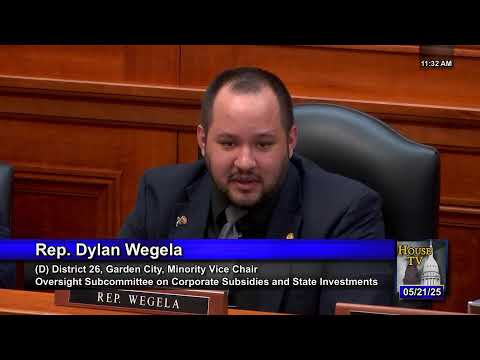
At a hearing of the House Oversight Subcommittee on Corporate Subsidies and State Investments, James Homan of the Mackinac Center urged lawmakers to require that SOAR critical industry payments be tied more to verified job creation and less to companies' capital expenditures.
Homan told the committee the critical industry program is “unstructured,” gives administrators broad discretion to tailor deals and typically pays companies for capital costs or milestone benchmarks rather than for employees’ wages or verified hires. He said that approach leaves the state with limited and delayed recourse if companies fail to deliver the jobs promoted in press statements.
Homan said the state has authorized roughly $1.45 billion through the program and that about $720 million has been spent so far. “Weve spent $720,000,000 and no jobs have been created,” he said, summarizing the outcomes reported to date. He also summarized nine large deals that, taken together, proposed roughly $1.46 billion in assistance to create about 14,779 jobs, and he used those cases to illustrate common contract features.
Homan reviewed several named projects and how their contracts trigger payments. He said the states agreement with the company publicly tied to the GM/Altium announcement obligates 3,200 jobs even though some headlines cited 4,000; payments to the company, he said, are largely tied to capital spending rather than to payroll. He said the state has paid about $660 million related to that effort but reported no jobs at the recipient facility.
Homan told lawmakers the June 2022 Ford proposal offered about $100.8 million to create 3,030 jobs but that the critical-industry portion of the deal was never finalized. He said a 2022 deal with battery producer Our Next Energy (OneX) was for $200 million and 2,112 jobs, but only about $70 million had been paid and “only 10% of the deal is based on job-creation milestones,” with the bulk of payments tied to capital or other non‑payroll milestones. He said the Goshen deal requires 2,350 jobs but allows companies to receive a large portion of awards before job targets are met. He cited other projects including a Ford proposal in Marshall (critical-industry portion not finalized; $150 million in site-preparation funds transferred), a February 2024 solar project (Homan said roughly $68 million offered), a July 2024 Dow retention deal (Homan said $120 million to retain 5,000 jobs), and a December 2024 Detroit Diesel proposal (about $27.7 million for 436 jobs, with a final $7.7 million tranche tied to job goals).
Homan contrasted those terms with other Michigan programs such as MEGA and Good Jobs for Michigan, which he said generally base payments on job creation and require companies to maintain jobs for longer periods. He argued that if the policy goal is creating and sustaining payrolls, lawmakers should expect deals to pay primarily when jobs are added and sustained rather than primarily when buildings are completed.
Committee members asked Homan questions about the programs transparency, reporting lags, how administrators verify hires, the risk of companies filing for bankruptcy and the practical prospects for clawbacks, and whether states other than Michigan use similarly structured short-term cash programs. Homan said the states annual report meets a basic transparency standard but is slow, often lagging actual status by many months, and he recommended faster, clearer reporting. He also said the states position in bankruptcy would depend on the companys finances and the legal priority of state claims.
The subcommittee took no policy votes at the hearing. Representative Bierlein moved to approve the minutes of the committees May 14 meeting at the outset of the session; with no objection the minutes were approved.
Homan concluded by urging lawmakers to change expectations rather than the programs statutory language: he said legislators can stop approving deals that pay primarily on capital expenditures and instead insist payments be tied more strongly to verified job creation.