Get Full Government Meeting Transcripts, Videos, & Alerts Forever!
Get email alerts on the Bateman Island Causeway Removal topic
No spam. Unsubscribe anytime.
Richland Council backs application to remove Bateman Island from city lease, citing management concerns
Summary
The Richland City Council on Tuesday voted 7-0 to authorize the city manager to apply to the U.S. Army Corps of Engineers to remove Bateman Island from the city's recreational lease, a step city staff said would limit the city's land-management obligations if the Corps proceeds with causeway removal.
The Richland City Council on Tuesday voted 7-0 to authorize the city manager to submit an application to the U.S. Army Corps of Engineers to remove Bateman Island from the city's recreational lease, a move city staff and conservation partners said would reduce the city's management obligations if the Corps proceeds with causeway removal.
The resolution asks the Corps to consider amending the city's lease so Bateman Island would revert to Corps management; the motion passed by unanimous consent. Council discussion and public comment during the meeting focused on the environmental effects of removing a roughly 550-foot rock-and-earthen causeway, public access and how land management responsibilities would change.
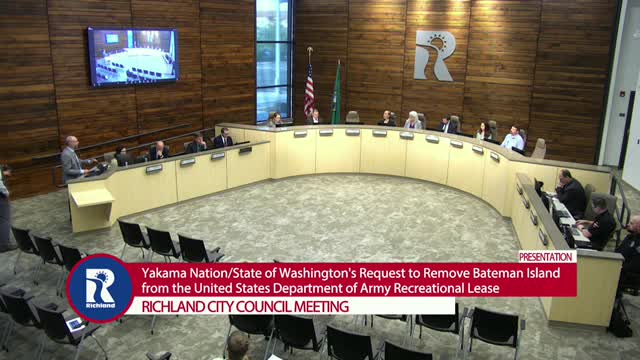
During a nearly hour-long presentation, Mike Livingston, South Central Washington regional director for the Washington Department of Fish and Wildlife, and Joe Blodgett, project manager with the Yakama Klickitat Fisheries Project, described the Bateman Island causeway removal as an ecosystem restoration project that partners have worked on since about 2016 and formally pursued with the U.S. Army Corps of Engineers beginning in 2017. Livingston told council the Corps completed a feasibility study in October 2024 and the project is now in design and permitting, with a targeted work window of December through February to minimize fish impacts.
Blodgett described the causeway's effects on fish habitat: "It reduces the mixing that once used to exist between the Columbia River and the Yakima River," he said, and explained how stagnant slack water has allowed sediment and plant growth that raise temperatures, reduce oxygen and create prime predation habitat for bass and birds. "The salmon are our first foods," Blodgett said, adding that restoration work aims to return self-sustaining, harvestable runs for culture and economy.
City staff have a separate, management-focused concern. Chris Waite, speaking for the city, said the current recreational lease with the Corps assigns the city property-management and safety obligations. He read part of the lease: the lessee must exercise "due diligence in protection of all property located on the premises against fire or damage from any and all other causes." Waite told council that removing the pedestrian causeway would make it logistically difficult for the city to meet those obligations, for example to respond quickly to hazard trees or other safety incidents without direct land access.
"Our primary concern with the obligation is removing that land access is our primary source of how we manage the property," Waite said. He recommended submitting the Corps form asking the agency to remove Bateman Island from the city's lease, which Waite said would return management to the Corps and limit the city's liability and operational responsibilities.
Council members who spoke during the item acknowledged the long timeline and the number of partner agencies involved. Council member Van Dyke asked about changes to current flow and shoreline erosion if the causeway is removed; Livingston said hydrodynamic modeling did not predict significant increased risk to the adjacent marina under modeled conditions and that armoring on the main shoreline is planned to protect the shore.
Public commenters at the meeting largely supported the ecological rationale for removal. Megan Bromley, a Richland resident, told the council she supported removal to reduce harmful algal blooms and low-oxygen conditions she said had been linked to warmer, stagnant water: "I support the city council's movements towards making the water safer for fish and also for people," she said.
The staff-recommended resolution (Resolution No. 2025-82) directs the city manager to submit the application to the U.S. Army Corps of Engineers. Waite said Corps review of a lease modification application can take up to six months, though timing varies. If the Corps accepts the application and amends the lease, Corps staff would determine the future management approach, which could emphasize habitat management over pedestrian recreation.
The presentation also noted project timing: Corps feasibility finished October 2024; design and permitting and a draft SEPA (State Environmental Policy Act) process were under way, with permitting and SEPA expected through the summer. Presenters said the removal work window with the least fish impact is December through February and that project partners include the Corps, Yakama Nation, WDFW and Mid-Columbia Fisheries.
The council motion was adopted by unanimous consent. The council also heard that partners had studied sediment contaminants and did not identify concentrations that would preclude deconstruction work, though additional confirmation work was described as ongoing.
The City will submit the application as directed; any future operational or access decisions will depend on the Corps' review and final project permits.