Get Full Government Meeting Transcripts, Videos, & Alerts Forever!
Get email alerts on the Budget And Staffing topic
No spam. Unsubscribe anytime.
OHA COO outlines $1.4 million biennium budget, highlights staffing, beneficiary metrics and rebuilding trust
Summary
Office of Hawaiian Affairs Chief Operating Officer Kapunui Kehau presented a proposed biennium budget for the COO office that emphasizes personnel, leadership training and performance systems; a public commenter urged clearer metrics tying budget lines to beneficiary impacts.
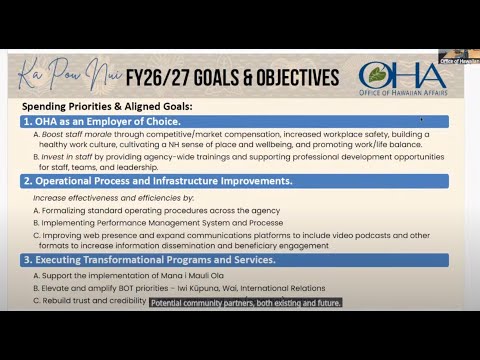
Chief Operating Officer Kapunui Kehau presented the Office of Hawaiian Affairs' proposed biennium budget for the COO office on Oct. 27, 2025, saying the office's spending priorities emphasize personnel, leadership development and systems to measure organizational performance.
Kehau said the COO operational budget totals about $1.4 million for the two-year biennium, with personnel representing the largest share. The presentation listed personnel costs at just over $1.2 million, contracts budgeted at $75,000, programs at about $13,000 and travel at roughly $41,040. Kehau described the budget as focused on “aligning our goals and objectives to our spending priorities” and on implementing a performance management system across OHA divisions.
The proposal includes funding for leadership training intended for the executive leadership team and a cohort of senior managers (referred to as Kaaha) and a $75,000 contracts line for outside facilitators. Kehau said the training will cover leadership practices rooted in Hawaiian values, emotional intelligence and “cognitive coaching” — an approach she described as coaching staff to think through problems rather than having supervisors supply solutions.
Kehau also explained organizational changes: the COO now oversees six divisions, and two administrative assistant positions are shown in the COO budget as permanent shared roles (one already filled, one offered but declined). She told trustees temporary and interim workers have been used during the reorganization and that the agency maintains a separate program code that has paid Remedy Intelligent Staffing for contracted temporary workers.
Kehau said her strategy is to provide temporary workers the opportunity to compete for permanent OHA positions where they meet minimum qualifications. “My strategy is to give all of our temporary staff the opportunity to compete for these vacancies,” she said.
Public testimony and trustee questions focused on measures tying budget items to beneficiary outcomes. Germaine Myers, who gave public testimony, said she reviewed the packet of presentations and “failed to see anything related to beneficiary, including objectives and goals” that show how budgeted programs will affect beneficiaries. “I don't see the programs that are going to be paid for with the budget, and it was not outlined in today's presentation,” Myers added.
Kehau acknowledged gaps in public understanding of OHA’s role and said rebuilding trust and visibility in communities is a priority that is cascading from the CEO through the executive leadership team: “I think there's…a feeling like OHA has not necessarily addressed some of the issues that are important to community,” she said, adding that improving web presence, community engagement and communications are part of the approach.
Trustees asked for more specificity on several items, including leadership training cadence and the proposal's temporary staff strategy. Kehau told the trustees the training line was estimated as two cohort trainings per quarter in year one and a reduced allocation in year two, and reiterated that vacancies and hiring processes will be managed by HR, with temporary staff evaluated competitively for permanent roles.
The COO presentation covered process and infrastructure improvements (standard operating procedures, a one-stop repository for SOPs and an agency-wide performance system), an emphasis on staff morale and workplace safety, and program-level goals that Kehau said will be translated into performance measures as the agency finalizes its performance-management system.
No formal votes or budget decisions were recorded at this meeting; the session was a briefing and question-and-answer period on the proposed budgets.
Kehau and trustees indicated follow-up briefings and documents would be provided that list page-and-line references in the line-by-line budget and that staff would return with more detailed measures tying program activities to beneficiary outcomes.