Get Full Government Meeting Transcripts, Videos, & Alerts Forever!
Get email alerts on the Planning Housing topic
No spam. Unsubscribe anytime.
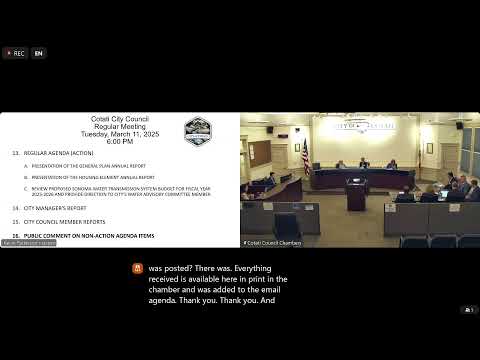
Cotati council reviews and accepts 2024 General Plan and Housing Element annual progress reports
Summary
City planning staff presented the General Plan Annual Progress Report and the Housing Element Annual Progress Report; the council reviewed implementation status, RHNA progress and state law changes affecting fees and extensions, and accepted the reports for submittal to the state.
Planning staff presented the City of Cotati’s 2024 General Plan Annual Progress Report (APR) and the Housing Element APR to the council on March 11, and council accepted the documents for submittal to the state by April 1.
Planning technician Eli Arriola summarized the reports and told the council the general plan APR tracks progress on actions across most elements, while the housing APR reports progress toward the city’s Regional Housing Needs Allocation (RHNA) and implementation of housing-element programs. The housing presentation noted that the city has entitled or processed applications for several hundred units across multiple projects but that only projects with issued building permits count toward RHNA credit; staff said only 16 units in the table were yet eligible to be counted toward the city’s then-current RHNA because most entitled units had not reached the building-permit stage.
Why it matters: State law requires annual APR submissions. The housing APR in particular signals where a jurisdiction stands on RHNA goals for critical lower-income categories. Staff highlighted recent state bills that affect local practice: SB 937 (limits when certain impact fees can be collected), AB 2729 (18‑month extensions for entitlements issued prior to 2024 under certain conditions), and AB 3093 (state definitions and implementation details related to income categories). The reports also describe the city’s local program work—ADU permitting, density bonus adjustments, cottage housing code changes and proposed parking-management planning—aimed at facilitating housing production.
Council discussion and staff response: Council members asked about SCTA transit planning noted in the general-plan APR, the status of the Rhonda Fleddy Ranch partnerships, and how recent state laws affect collection of impact fees and RHNA accounting. Planning staff said some items listed "on hold" in the APR (for example, regional transit coordination) are actively under discussion at SCTA and other regional forums, and that staff will correct timing language in the APR where appropriate. On SB 937, staff noted the state law changes the timing of certain fee collections (now often at certificate of occupancy rather than at building permit issuance) and that the city must build internal processes to ensure fees are not waived inadvertently when occupancy is granted.
Housing pipeline and RHNA: The housing APR reports the city has multiple projects in the pipeline, including a 36-unit duplex subdivision (65 Lasker Lane), a roughly 44-unit affordable project at 120 East Cotati Avenue, and a 68-unit project on Redwood Road. Staff noted that while many entitlements exist, the city only receives RHNA credit for units with issued building permits; council members and staff discussed preservation, entitlement-to-permit timing and state-level consequences for persistent RHNA shortfalls such as streamlined review (SB 423/SB 305-type ministerial pathways) for qualifying affordable projects.
Outcome: Council reviewed and accepted the two APRs for submission to state agencies; staff will file the documents by the April 1 deadline and continue work on items flagged in the reports, including targeted community engagement, parking assessment planning and housing program implementation.
Evidence: Presentations and council questions are recorded in the meeting transcript; staff noted the APR packages and tables included mandated templates from the state.