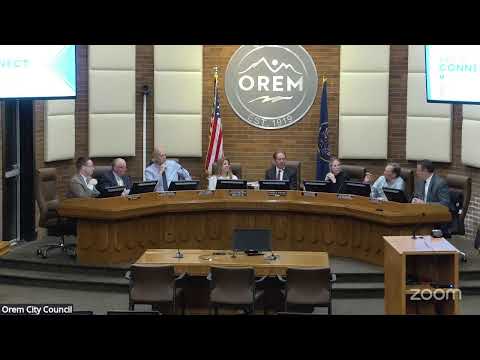
Orem council begins public debate on short‑term rental rules after state law changes; work session continued
Loading...
Summary
Orem city staff presented a draft short‑term rental ordinance and three regulatory approaches—ban, regulated licensing, or free allowance—after state law clarified municipalities’ authority to regulate listings and use online advertisements as evidence.
City staff presented a draft ordinance and policy options for regulating short‑term rentals after recent changes to state law clarified municipal authority to license and use online listings for enforcement.
City Attorney and staff walked the council through three broad policy approaches: retain the current prohibition; adopt a city licensing and regulatory program that restricts location, occupancy and advertising; or allow unrestricted short‑term rentals without local regulation. Staff said the draft ordinance aimed for the middle path—a licensing program designed to preserve residential character while allowing limited rentals under conditions.
Key elements discussed in the draft - Occupancy and owner‑occupancy: Staff explained the draft does not require owner occupancy but said the council could adopt an owner‑occupancy requirement (e.g., primary-residence rule) to reduce commercial conversions. Council members noted that an owner‑occupancy requirement affects county tax classification (primary vs. secondary residence) and could shift property‑tax revenues to other taxing entities. - Maximum occupancy: Staff proposed a simple, enforceable rule keyed to bedrooms (two people per bedroom, up to an initial cap of eight occupants) and said that large-event or multi‑dozen occupancies cause neighborhood impacts; council members asked whether larger homes used for family gatherings should be permitted under exceptions or specific tiers. - Geographic or density controls: Staff reviewed options used elsewhere—zoning-based controls that nominate areas for rentals, density caps, or tiered license systems for larger homes. Council members differed on whether to permit rentals across the city or restrict them to special zones. - Enforcement: City staff emphasized a complaint‑driven enforcement model, higher fines for violations, a mechanism to revoke licenses for repeat violations, and requiring licensed listings to display the city-issued license number in online ads so the city could identify noncompliant advertisements. Staff also said House Bill 256 (recent state legislation) clarifies that municipalities may use online advertisements as evidence in enforcement when combined with other proof.
Public comment More than a dozen residents and short‑term rental hosts spoke. A number of hosts urged the council to preserve short‑term rental activity in many neighborhoods, saying hosts largely prevent parties, enforce quiet hours and point guests to local businesses. Several residents who live near the Ken Garff car dealership block said a new proposed entrance and expanded commercial activity were already creating traffic and safety issues on 1200 South and urged neighborhood buffers and no new vehicle access; others at the meeting addressed short‑term rentals separately and urged stricter limits or a ban, citing a high‑impact “party house” example elsewhere in the city.
Next steps Staff recommended gathering more council feedback and returning the draft ordinance to a subsequent work session for more detailed decisions on each “lever” (occupancy limits, owner occupancy, geographic caps, tiered licensing, fines and advertising requirements). The council did not adopt a final ordinance; staff and the city attorney said they will solicit additional feedback from council members and the public and bring back a revised draft at a later work session. The city manager encouraged public comment and said staff will circulate materials to the council for incremental feedback between meetings.