Get Full Government Meeting Transcripts, Videos, & Alerts Forever!
Get email alerts on the Historic Preservation topic
No spam. Unsubscribe anytime.
Board upholds Tulsa Preservation Commission denial of retroactive parking pad at Swan Lake; applicant given time to revise plans
Summary
The Board of Adjustment declined to overturn a Tulsa Preservation Commission denial of a retroactive front-yard parking pad at 1519 E. 20th Street in the Swan Lake Historic District, citing the TPC’s finding that the unpermitted hardscape altered the property’s historic setting; the homeowner argued the pad was needed for on-site turnaround and safety due to a retaining wall that creates a sight-line hazard.
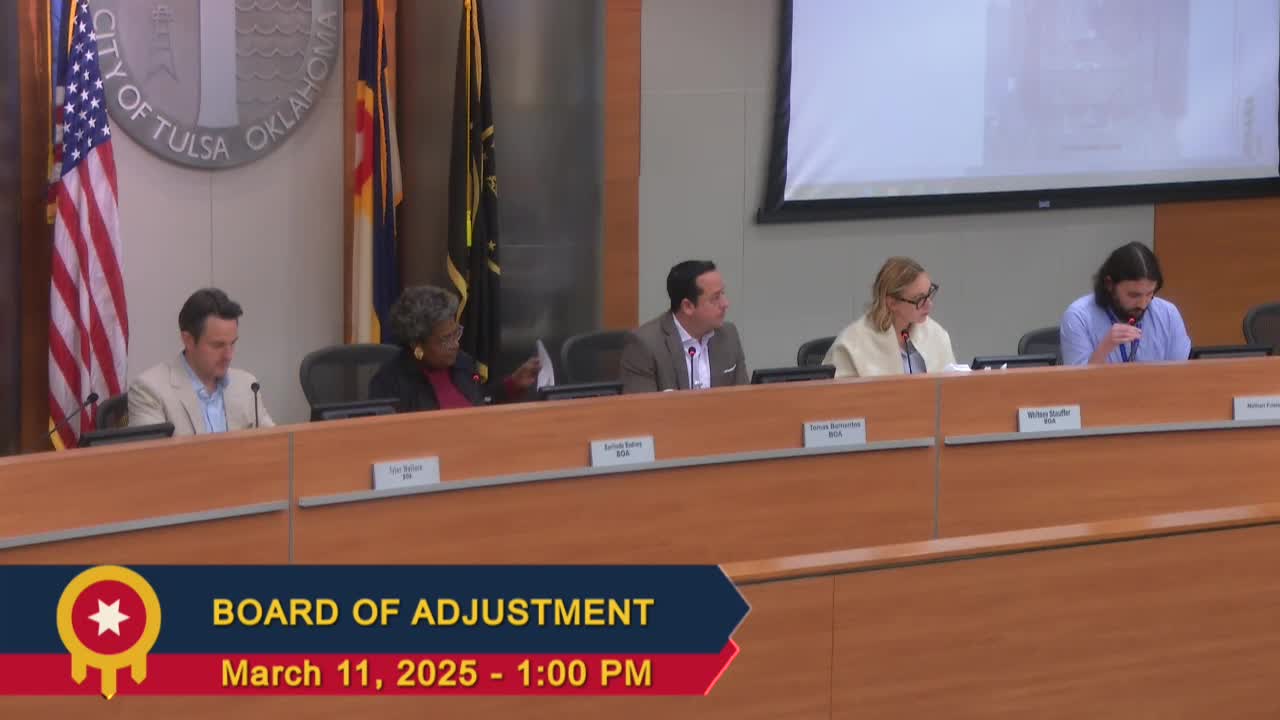
The Board of Adjustment on March 11, 2025, declined to overturn a denial by the Tulsa Preservation Commission (TPC) of a historic-preservation permit for a front-yard parking pad at 1519 East 20th Street in the Swan Lake Historic District.
Why the case was before the board
The property owner installed a paved parking pad in the front yard without first securing an HP permit. The Tulsa Preservation Commission reviewed a retroactive HP permit application and denied it at its January meeting, concluding the work “introduced a large expanse of hardscape in the street-facing yard of a 1920s Tudor Revival home, permanently altering the property’s historic setting,” and that it violated multiple provisions of the unified residential design guidelines (cited in discussion as G0.2, G0.2.1, G0.2.2 and G0.2.4).
What the preservation commission said
Shane Hood, chair of the Tulsa Preservation Commission, said the commission’s statutory role is to “determine whether a proposal conforms to the adopted unified residential design guidelines for historic preservation districts.” He told the board the TPC found the parking pad “inconsistent with these provisions in the guidelines as it introduced a large expanse of hardscape in the street facing yard of a 1920s Tudor Revival home permanently altering the property's historic setting.” Hood said commissioners had no standard under their guidelines to approve the retroactive pad and that the commission “faithfully followed our established procedures, reviewed the specific guidelines in detail, and voted per the evidence presented. We do not believe we have erred in our process or decision.”
What the homeowner said
Homeowner Brent Wilkes said he purchased the house in October 2024 and said the parking pad had been installed before he bought the property. Wilkes described a safety concern: a tall retaining wall at the edge of the property limits sight lines when a vehicle backs onto East 20th Street. He told the board, “There is a retaining wall that causes a blind spot for my wife and children that would definitely not have a safe area to leave without this L extension parking pad.” Wilkes said he and his representative had discussed other remedies but that, in his view, the L-shaped pad provided the only practical on-site turnaround and reduced the risk of reversing into the arterial street.
Board discussion and vote
Board members and staff discussed two separate legal questions: whether the preservation commission had correctly applied its design guidelines and whether the board should overturn that administrative decision. The city’s legal standard requires the Board of Adjustment, when hearing an appeal of an administrative official, to give the official’s decision a presumption of correctness and to identify specific error in that decision in order to reverse it.
After hearing both sides, the board voted on a motion to reverse the Tulsa Preservation Commission’s denial. The roll call on the motion was: Board member Wallace — no; Board member Barrientos — abstain; Board member Stauffer — yes; Chair — yes. The motion failed because it did not receive the required three affirmative votes to reverse the administrative decision; the commission’s denial therefore remains in effect.
Next steps: continuance for revised plans
Immediately after, the applicant requested a continuance on the related special-exception and driveway-variance matters so the homeowner could seek a revised design and additional guidance from the Tulsa Preservation Commission. The board granted the continuance and set the special-exception and variance matters for the board’s April 8, 2025 meeting to allow the applicant time to pursue a revised TPC submittal. City staff advised the applicant that even if the board were to grant zoning relief, the TPC approval would still be required to permit the specific design as built; if the TPC approves a revised design, the applicant should return to BOA with design exhibits that align with requested zoning relief.
Why this matters
The TPC framed its decision as an application of adopted design guidelines intended to preserve the district’s historic character. The homeowner and some board members framed their concerns around immediate safety risks posed by the site’s steep grade and a retaining wall that limits sight lines. The board’s ruling preserves the TPC’s application of the design guidelines in this instance, while giving the applicant a defined path — a revised TPC application and return to BOA — to seek an acceptable compromise.
Selected quotes
- Shane Hood, chair, Tulsa Preservation Commission: “The newly installed parking pad was inconsistent with these provisions in the guidelines as it introduced a large expanse of hardscape in the street facing yard of a 1920s Tudor Revival home permanently altering the property's historic setting.”
- Brent Wilkes, homeowner: “There is a retaining wall that causes a blind spot for my wife and children that would definitely not have a safe area to leave without this L extension parking pad.”
What the applicant can do now
The Board of Adjustment advised the applicant to revise the design and return to the Tulsa Preservation Commission for review; if the TPC approves a revised design that addresses the guidelines (or proposes mitigations such as different paving materials, landscaping treatments or other design measures), the applicant can then return to the Board of Adjustment seeking any necessary dimensional relief that matches the approved design. If the applicant is dissatisfied with the board’s action, the applicant retains the right to appeal the board’s decision to district court.
Speakers quoted above are identified in the meeting record and are included in the article’s speaker list. This summary is based on the public hearing record for BOA Case 23857 (HP06442025).