Get Full Government Meeting Transcripts, Videos, & Alerts Forever!
Get email alerts on the Flooding Drainage topic
No spam. Unsubscribe anytime.
Venice hears urgent calls to fix Flamingo Ditch as consultant updates study
Summary
A consultant presented a mid-project update Tuesday on the Flamingo Ditch feasibility study after residents described repeated flooding that destroyed homes and property in the Golden Beach neighborhood.
A consultant presented a mid-project update Tuesday on the Flamingo Ditch feasibility study after residents described repeated flooding that destroyed homes and property in the Golden Beach neighborhood.
The study, led by Coastal Protection Engineering (CPE), aims to identify options that would reduce or prevent flooding in a low-lying bowl of land that drains to the Gulf. "It's a low‑lying depression in the earth that the water is flowing into and it's very hard to get the water out at least on natural drainage by gravity," CPE principal engineer Tom Piero said.
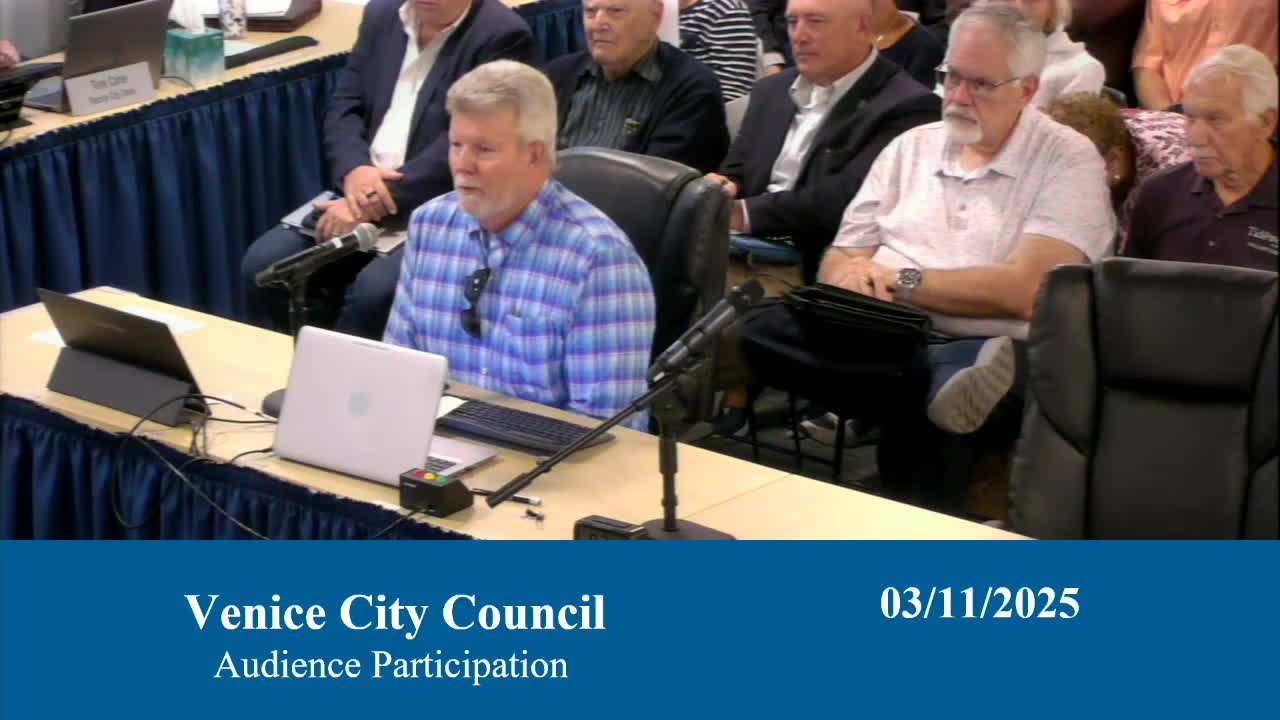
The update came after months of public reporting from residents who said flooding worsened during recent storms. Residents pushed the council and staff to apply quickly for federal and state resiliency grants. "If we had proper drainage and infrastructure, many homes would still be standing today," resident Christopher Durback told council during audience participation.
Why the study is needed: consultants said Flamingo Ditch differs from other local drainage channels because the surrounding topography forms a low bowl that limits gravity-driven drainage, and because episodic storm surge from the Gulf can push water back into the ditch. "It is the stormwater drainage getting the water out and storm surge inundation keeping the water out," Piero said. That compound flooding makes a single, simple fix unlikely.
What consultants said they need: CPE engineers said the hydraulic model available to them was originally built for water‑quality analysis, not high‑resolution flooding analysis. "There are some data gaps and we needed to update this model," CPE engineer Joe Morrow said, and the team has solicited survey quotes to correct elevations, pipe inverts and other field details. Consultants said the corrected model is necessary to evaluate alternatives such as conveyance/channel work, one‑way devices, pumps, or more structural solutions.
Short‑term steps considered: CPE and city staff identified immediate, operational steps that could reduce near‑term risk while the study continues — updating emergency operating procedures, standing emergency contracts for maintenance or outfall clearing before storms, targeted maintenance of culverts, and short‑term backflow prevention devices at vulnerable pipe outfalls. CPE emphasized these are mitigation steps, not permanent solutions.
Grant support and timing: Council members and residents asked whether the study’s timeline puts the city at risk of missing major federal funding announcements. CPE said a fuller grant‑writing scope was not in the current contract but could be added and the firm said it would help the city with grant narratives and high‑level budget estimates if requested. "Grants don't require a whole lot of detail. They just need a narrative and some general budget numbers," Piero said. CPE said it expects to deliver the study results this summer once updated field data are collected and the model is validated, but added permitting and implementation timelines could extend significantly beyond that.
Public reaction and next steps: Residents reiterated urgency and repeated pleas for immediate action and for the city to pursue available federal recovery and resilience dollars. Several speakers urged the council to seek funding now. City staff said they would continue short‑term maintenance actions and coordinate with CPE on the expedited collection of survey and infrastructure data so alternatives can be modeled and grant applications prepared.