Get Full Government Meeting Transcripts, Videos, & Alerts Forever!
Get email alerts on the Land Use Policy topic
No spam. Unsubscribe anytime.
Commission backs UDC amendments to align McKinney Town Center rules with the UDC; forwards to council
Summary
The commission voted 7-0 to recommend a package of non‑substantive and substantive amendments to the McKinney Town Center (MTC) rules in the Unified Development Code, including creation of a new ‘craft consumables’ use and changes to how commercial amusement/entertainment is allowed.
The Planning and Zoning Commission voted 7‑0 to recommend approval of amendments to the City of McKinney Unified Development Code (UDC) affecting the McKinney Town Center (MTC) zoning appendix, forwarding the package to City Council for final action in May 2025.
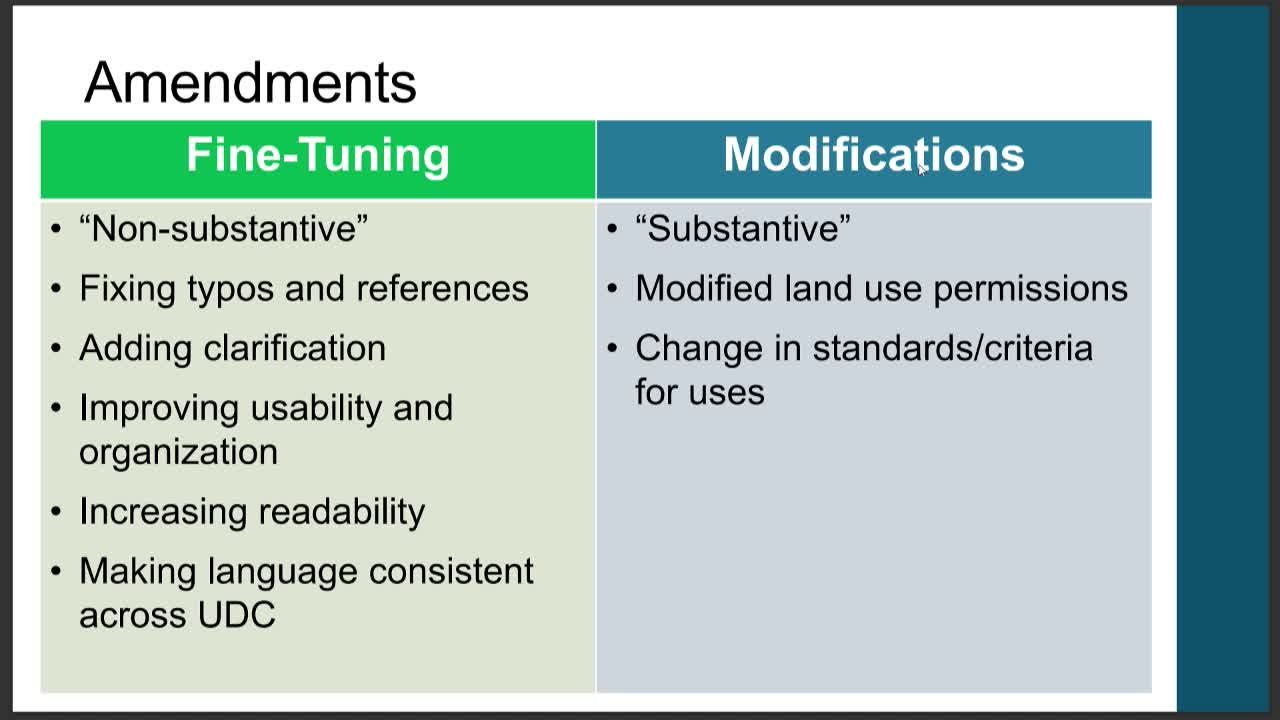
City planner Cameron Christie described the amendments as a mix of editorial “fine tuning” (typo corrections and clarifications) and substantive changes intended to make the MTC’s form‑based code work more consistently with the rest of the UDC. Christie said the changes replace several MTC‑specific land‑use names and consolidate or convert uses so the MTC use table aligns with the UDC’s main table of uses.
The substantive changes include adding community gardens, allowing temporary warming stations, permitting electric vehicle charging stations as accessory uses, creating a new, broader “craft consumables” use to replace existing microbrewery/distillery/winery/cidery entries, and splitting the existing commercial amusement category into commercial entertainment and reception/event center uses. The craft consumables use would allow small‑scale production and on‑site sales of alcoholic and non‑alcoholic beverages and food products (examples cited included chocolatiers and coffee roasteries). The code language carried forward an existing size restriction: craft consumable uses would be limited to buildings under 20,000 square feet but could be permitted up to 50,000 square feet when paired with an appropriately sized restaurant frontage, consistent with analogous UDC text.
The amendments also change how entertainment uses are regulated: in the MTC’s historic core and downtown core, commercial entertainment and certain reception/event uses would move from requiring a specific‑use permit to being allowed by right; in transition/edge districts the amendments would allow these uses with criteria (including a 300‑foot minimum separation from residential uses or zones unless modified by a specific‑use permit). The change for outdoor entertainment in the downtown edge is to permit it via specific‑use permit where it had been not allowed.
Christie and other staff said they had taken feedback from a December Planning & Zoning work session and a City Council work session and revised the draft accordingly. Commissioners asked clarifying questions about the temporary nature of warming stations and whether the restaurant that unlocks a larger square footage allowance for craft consumables must be the same legal occupant; staff said the code does not explicitly require the same user and that unique cases would be evaluated based on intent and code standards.
No public speakers addressed the item in the commission hearing. Commissioner Hammock moved approval and Commissioner Woodard seconded; the motion passed 7–0 and will go to City Council for final action in May 2025.
Staff said the amendments are not intended to create new nonconformities and that they aim to make the MTC easier to use and clearer for applicants and staff.