Get Full Government Meeting Transcripts, Videos, & Alerts Forever!
Get email alerts on the Blight Demolition Landbank topic
No spam. Unsubscribe anytime.
CRA advisory urges code changes, demolition funding and developer vetting to fight blight
Summary
The Fort Pierce CRA advisory committee recommended drafting a law to require owners to demolish commercial or residential structures vacant five years or longer, adding FPRA demolition funding and offering CRA vetting of developers; staff said unsafe‑structure and nuisance abatement codes exist and recommended a workshop.
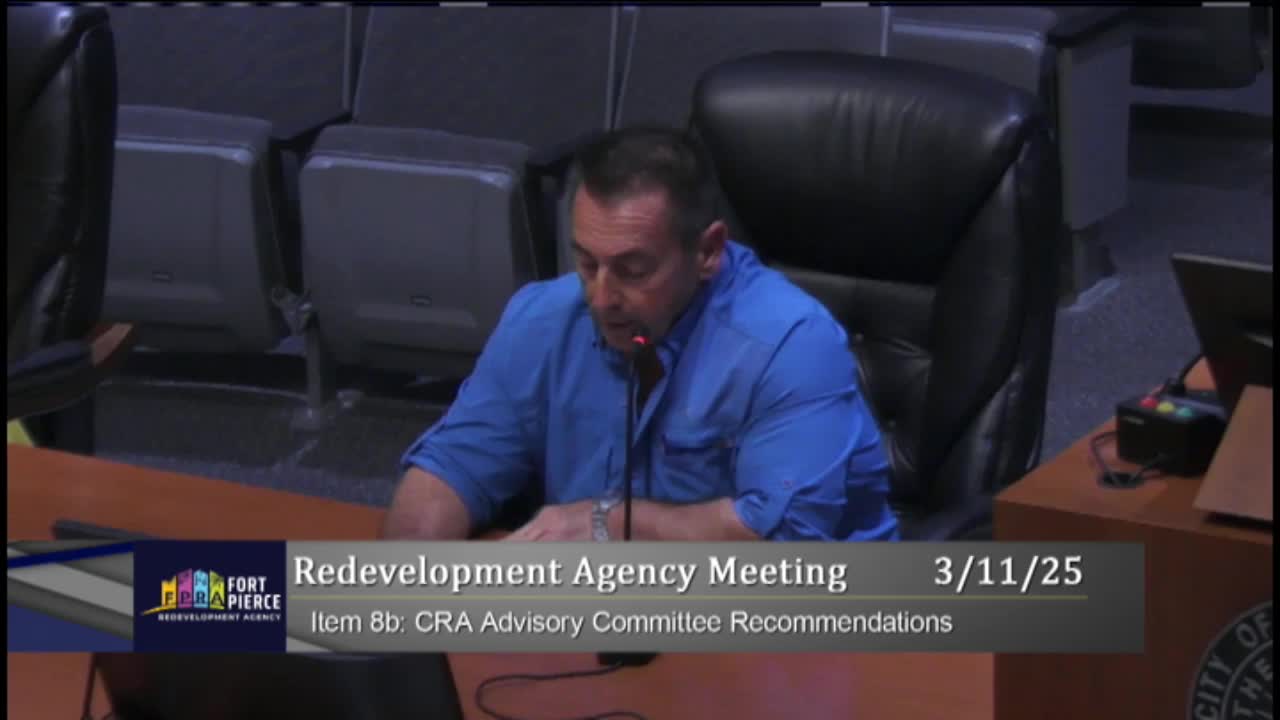
Members of Fort Pierce’s CRA advisory committee told the Fort Pierce Redevelopment Agency on March 11 they want a more aggressive city policy to remove long‑vacant, blighted properties.
Phil Thompson, chair of the CRA advisory committee, asked the FPRA to request city legislation that would mandate owners of commercial or residential properties vacant for at least five years to demolish unsafe or blighted structures at their own expense and to empower code enforcement, the special magistrate, building department and the St. Lucie County Fire District to hold owners accountable. The committee also recommended the FPRA budget a line item for demolition of abandoned properties and offered the CRA advisory committee’s services to vet developers for FPRA projects.
Thompson cited a recent example where a single property that had been vacant for about 20 years required nearly three years to move through enforcement and demolition processes; with coordinated action among code enforcement, building department and the fire district, the owner ultimately pulled demolition permits and removed the structure at no cost to the city, Thompson said.
City staff told the board a nuisance‑abatement and unsafe‑structure process already exists in city code (cited as code section 24‑107). Staff and the board agreed that the current process can be long because of required due process protections and magistrate hearings; staff suggested the item would benefit from a workshop that lays out existing law, points where enforcement can be tightened, and what legislative changes — if any — would be required to impose a five‑year demolition requirement.
Why it matters: Commissioners and advisory committee members said long‑standing derelict properties reduce nearby property values, attract trespassers and impede neighborhood reinvestment. The CRA suggested a land bank approach — acquiring cleared lots for affordable housing or resale — but acknowledged it would require budget and administrative setup.
Next steps: Staff recommended a workshop to compare the CRA’s proposals with existing code (including code section 24‑107) and to explore funding options, potential land‑bank models and whether CRA funds can be used for demolition. Commissioners asked staff to prepare a work plan and bring this back as a workshop topic for a future meeting.