Get Full Government Meeting Transcripts, Videos, & Alerts Forever!
Get email alerts on the Disaster Recovery topic
No spam. Unsubscribe anytime.
Committee approves first reading of ordinance to accept $1.6 billion in CDBG‑DR recovery funds
Summary
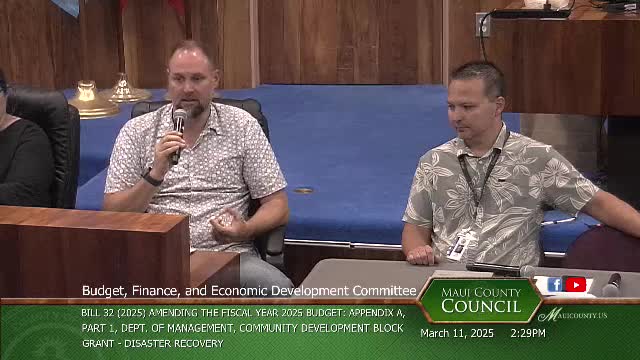
The Maui County Budget, Finance & Economic Development Committee voted to pass on first reading Bill 32, an ordinance to amend the FY25 budget so the county can accept $1.6 billion in Community Development Block Grant — Disaster Recovery (CDBG‑DR) funds and set up program staffing and reporting requirements.
Chair Lee opened the Budget, Finance & Economic Development (BFED) committee meeting by framing Bill 32 as a turning point for the county’s long‑term wildfire recovery efforts and asked the committee to consider accepting federal Community Development Block Grant — Disaster Recovery (CDBG‑DR) funds.
John Smith, administrator of the Office of Recovery, presented how the CDBG‑DR award will be used alongside insurance settlements, nonprofit assistance and other federal programs. “CDBG‑DR is that funding of last resort that comes in and fills the bucket the rest of the way,” Smith said, describing the grant as one piece of a multi‑source recovery funding strategy.
The draft action plan described in the presentation divides the CDBG‑DR allocation into program “pots,” with the largest share proposed for housing and other amounts for infrastructure, public services and hazard mitigation. The administration told the committee the draft action plan earmarks roughly $903 million for housing, about $350 million for infrastructure and about $90 million for public services; HUD has already approved an administrative set‑aside (about 5% of the grant, roughly $82 million) to stand up program management and hire staff.
Committee members asked about staffing and procurement. The administration described an organizational structure that includes about 56 limited‑term county positions to run CDBG‑DR programs and an implementation contractor to provide large‑scale technical support; the county said it will require contractors to include local subcontractors and will prioritize hiring locally where legally possible. The Office of Recovery said some positions are already posted and about 10 staff had been hired at the time of the meeting.
Speakers warned the committee that HUD requirements limit how funds can be used. The Office of Recovery and the managing director emphasized that the county must pursue other federal funding streams (for example, FEMA public assistance, hazard mitigation and EPA SRF programs) before using CDBG‑DR for projects that those other programs would cover. The administration also described the program’s compliance and reporting obligations to HUD and noted the action plan must tie proposed programs and projects to wildfire recovery.
Committee members pressed for clarity on timing and cash flow. County staff said CDBG‑DR operates differently from many federal reimbursement programs and that HUD has processes that allow relatively fast drawdowns when the action plan and agreements are in place. Staff said the draft action plan was scheduled for public comment and that the administration planned to submit the action plan to HUD on April 21; HUD then has 45 days to review the submission.
Before taking the vote, Chair Lee described the urgency behind accepting the funds. The committee then voted to pass Bill 32 on first reading. The ordinance — described at the meeting as amending the FY25 budget, Appendix A part 1 (Department of Management — CDBG‑DR) — authorizes acceptance of the CDBG‑DR award and includes conditional language to create limited‑term appointed equivalents (56 positions) and a requirement that quarterly HUD grant reports also be transmitted to the council.
The administration committed to continued public outreach (multiple action‑plan hearings were underway) and to provide regular reports to the council as the action plan is developed and implementation proceeds.
Ending: The ordinance passed on first reading; the administration and Office of Recovery will continue community engagement on the draft action plan and return with required documentation, policy details and periodic reports as the county moves into implementation.