Get Full Government Meeting Transcripts, Videos, & Alerts Forever!
Get email alerts on the Affordable Housing Napili topic
No spam. Unsubscribe anytime.
Committee advances $650,000 predevelopment grant for 120-unit affordable housing proposal in Napili
Summary
BFED recommended first reading of a budget amendment to reallocate lapsed affordable‑housing fund dollars and award a $650,000 predevelopment grant to Ikaika Ohana (limited partner) for a 120-unit multifamily rental project on 14.99 acres of county land in Napili.
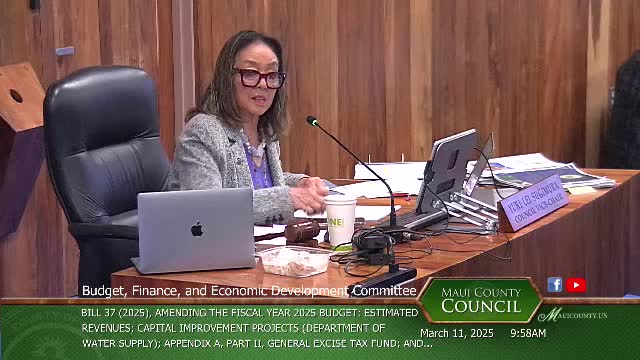
The Budget, Finance and Economic Development Committee on March 11 recommended first reading of a budget amendment to recognize $11,892,259 in lapsed funds in the affordable housing fund and to grant $650,000 in predevelopment funds to Ikaika Ohana LP for a proposed affordable housing development on county-owned land in Napili.
Deputy Director Samalu Mataafa of the Department of Housing presented the request and said the $650,000 is intended to cover predevelopment work including a traffic impact analysis, cultural impact assessment, archaeological studies and monitoring, civil engineering and a district boundary amendment (DBA) process. "The total cost could range," Mataafa said; he and Budget Director Leslie Milner provided a line-item breakdown in committee: a traffic study (~$40,000), cultural assessment (~$40,000), archaeological inventory and monitoring ($35,000–$57,000 range), flora and fauna survey (~$15,000), civil engineering (~$150,000), and DBA/2.01H processing (~$300,000), totaling roughly $650,000.
Developer representatives (Tom Fisher and Doug Bigley) described a conceptual plan for 120 multifamily rental units on a 14.99‑acre portion of roughly 50 county acres. The project team said units are currently targeted for households at up to 60% of area median income (AMI) but noted changes in state rules and financing mechanisms could allow a broader mix, including some units above 60–80% AMI; they described options such as some combination of tax-credit-funded affordable units and market-rate or higher-AMI units to achieve project feasibility. Fisher and Bigley emphasized parallel and concurrent workstreams—entitlements, engineering and financing—are needed to keep schedules from stretching multi‑year.
Committee members pressed staff and developers on water availability and infrastructure connections, project timelines and procurement. Deputy Director Mataafa said the project does not yet have a commitment from the Department of Water Supply and that the county will work with DWS because the parcel is county‑owned; Water staff were asked to provide a written response on water availability. Members also asked for copies of the market study and further documentation; developers and staff agreed to provide the market study and study materials to the committee in writing.
The committee moved the bill on a voice/hand vote; the motion carried and the committee recommended first reading. Members said they expect additional follow-up on water commitments, procurement history for the developer relationship to county land, and the county plan for reimbursement to the Open Space fund if the county-owned land is repurposed.