Get Full Government Meeting Transcripts, Videos, & Alerts Forever!
Get email alerts on the Transit Multimodal topic
No spam. Unsubscribe anytime.
Board reviews transit and multimodal language for comprehensive plan; staff to clarify funding and coverage
Summary
Consultants reorganized transit policies to emphasize transit-supportive development, multimodal connectivity and paratransit; commissioners sought clarification about scope, funding and whether objectives should be aspirational or mandatory.
Marion County planners and consultants reorganized the comprehensive plan—s transit section to group policies on future transit service, transit-supportive development patterns, and transit design standards, and the board discussed how those policies should be framed and implemented.
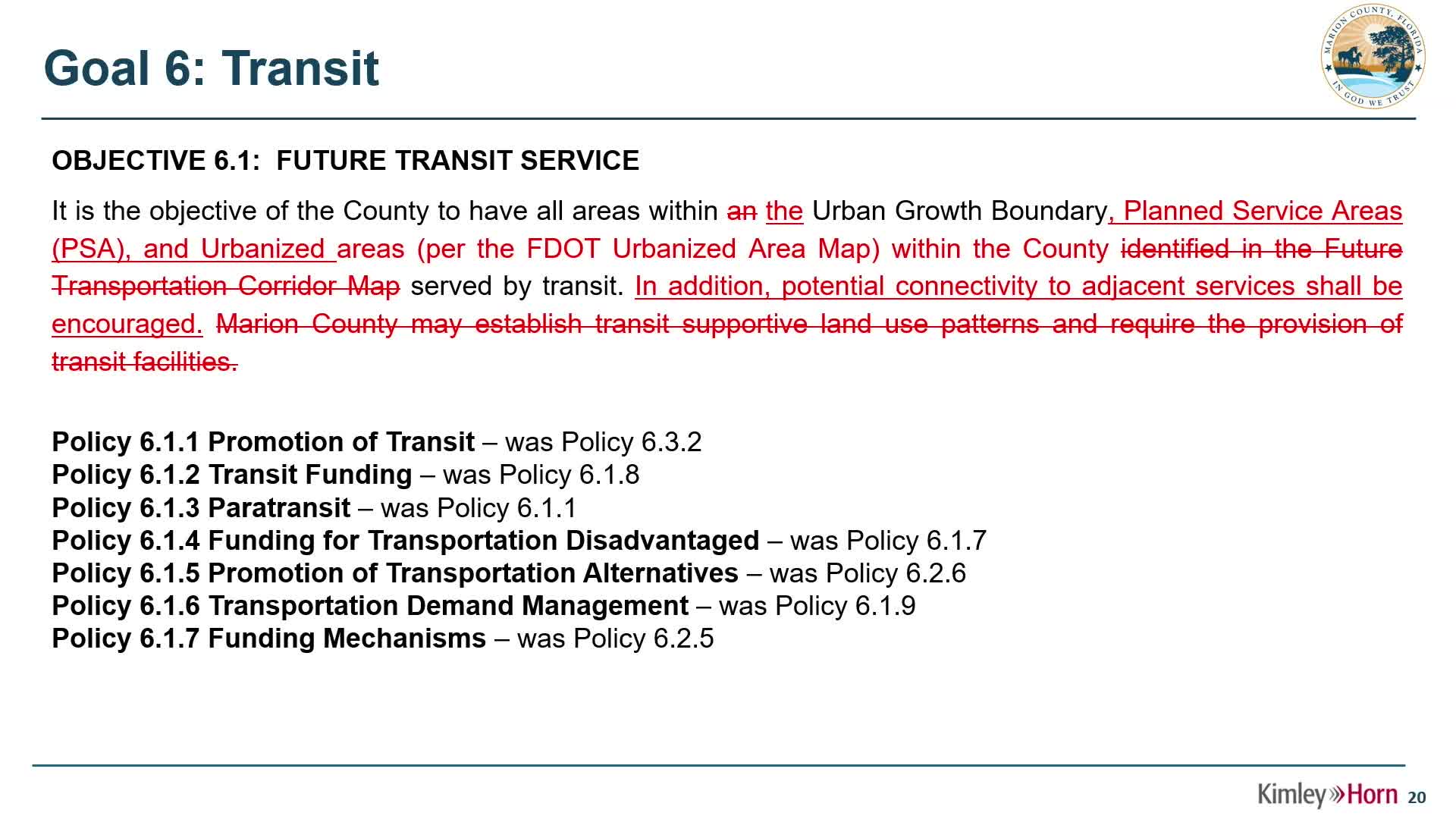
Amber Gardner and Blair Knight explained the restructuring: objective 6.1 addresses future transit service (including plan-service areas and FDOT—s urbanized-area map), 6.2 addresses transit-supportive development patterns (density, mixed-use, and connectivity to transit), and 6.3 covers design standards (on-road and site-level elements such as park-and-ride accommodations and bus-stop facilities). The consultants moved language about bicycle and pedestrian facilities into the LOS section as part of multimodal connectivity and suggested the county may rely on FDOT—s quality of service guidance while retaining the option to adopt corridor-specific service volumes based on detailed studies.
Commissioners asked several clarifying questions. Some expressed concern that the draft objective language could be read as a county mandate to provide fixed-route transit across the entire urban growth boundary; consultants and staff said the intent is aspirational and to encourage transit-supportive land uses and connectivity where funding and service availability permit. Commissioners and staff agreed the plan should avoid mandating specific transit providers or routes; board members suggested adding language that recognizes transit-supportive measures are pursued "within available financial resources." Commissioners also discussed demand-response services, the county—s paratransit arrangements (Marion Senior Services provides contracted mobility for transportation-disadvantaged persons under the current arrangement), and other strategies to reduce vehicle trips (vanpools, employer subsidies, park-and-ride facilities, telecommuting and microtransit).
On mitigation, consultants proposed that where corridors are capacity-constrained (for example, scenic or physically constrained roads that the county does not want to widen), development could be allowed to mitigate impacts with non-auto improvements when appropriate (bus shelters, stop improvements, or other transit-supportive facilities). Commissioners asked staff to consider softening mandatory wording (changing "shall" to "may") in places where requiring specific transit infrastructure would be impractical without funding or operational agreements.
What was decided: the board asked staff to preserve an aspirational but realistic objective for transit (recognizing financial constraints), to avoid naming specific providers in comp-plan policies, and to bring back revised language that clarifies when the county "may" encourage or require transit-supportive elements versus when policies are advisory. The board also requested staff confirm where existing transit service (SunTran routes, paratransit) currently reaches urbanized areas and to coordinate policy language with the TPO and FDOT.