Get Full Government Meeting Transcripts, Videos, & Alerts Forever!
Get email alerts on the Water Resources topic
No spam. Unsubscribe anytime.
Boerne staff frame water supply, reclaimed water and conservation amid resident concerns
Summary
City staff presented citizen survey results and a detailed overview of the city's water supply, reclaimed water use and drought planning; staff said the utility currently has water for projected near‑term growth but emphasized conservation, reclaimed water expansion and policy choices about future regional purchases.
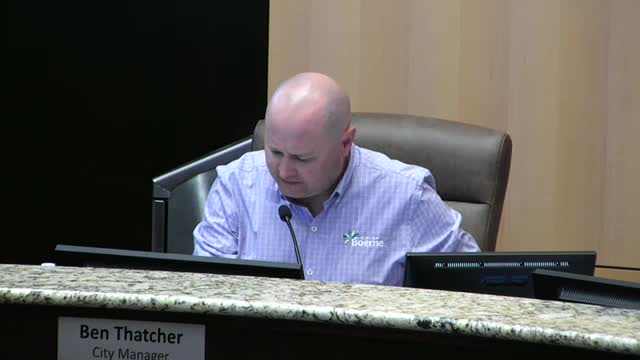
City staff used the March 11 council meeting to present results from a December 2024 citizen survey and to give a detailed update on water supply, reclaimed water use, drought status and conservation measures.
Staff and council read representative survey comments raising concerns about growth and water availability. Mayor Pro Tem Willison read a district comment noting Shoreline Park residents' desire that the city supply Boerne Lake; other comments requested publicized contingency plans for running out of water, questioned approval of new plats where utilities are limited and urged removal of fluoride from the city's water. City staff clarified that fluoride in the city's water is naturally occurring and is not added by the city.
Director of Utilities Michael Mann described the city's water service territory versus the city limits, explained that some areas inside city limits are served by Texas Water Corporation or by water control and improvement districts (for example Esperanza), and reviewed supply sources and recent usage statistics. He said that in 2024 the city's water supply mix was about 72% surface water, 15% groundwater and 13% reclaimed water and that reclaimed water usage provided the largest conservation benefit by removing irrigation demand from potable supplies.
Mann described operational details and trends: service population in the water service territory has grown in the last decade (staff cited increases from roughly 13,000 to about 20,000 over ten years), per‑capita consumption has declined since 2017 (from about 162 to 115 gallons per person per day), and reclaimed water production amounted to roughly 480 acre‑feet (staff presentation equated that to 156,000,000 gallons of potable supply offset). He said average annual water use in 2024 rose only about 0.6% compared with a 6.8% growth in service population because of summer rain and conservation.
Staff acknowledged the community perception that the city may be short on water and explained several drivers of that perception: private wells outside city limits, visible development approvals in areas not served by the city's utility, and regional headlines about statewide projections. Mann said the city's permitting for Boerne City Lake has not changed (the city's permitted withdrawal from the lake has remained the same since its construction) and that evaporation, not consumption alone, accounts for a large share of summer drawdown. He also discussed GBRA supplies and noted GBRA's staged curtailments when reservoir levels fall.
On planning horizons, staff said internal modeling that accounts for reclaimed water expansion and conservation shows the city has adequate supply under a range of growth and use scenarios through mid‑century; staff noted the Texas Water Development Board uses a methodology the city believes over‑allocates regional growth to Boerne and therefore projects earlier shortfalls for the city than staff's modeling. Mann and council discussed the cost tradeoffs for acquiring regional supply: staff said locally produced surface water costs roughly $1.50 per thousand gallons, GBRA purchases are approximately $3 per thousand, and regional projects could cost materially more (staff cited estimates as high as $12–$15 per thousand for some proposed regional supplies). Mann and others cautioned that acquiring expensive regional supply would raise customer bills significantly and that reclaimed water expansion and conservation are lower‑cost ways to extend existing supplies.
Council members asked staff to return with additional information and options. Staff identified potential next steps including updating the reclaimed water expansion plan, examining incentives or programs (for example irrigation audits, rainwater catchment promotion and HVAC condensate capture pilots), and assessing whether developer contributions or other funding mechanisms should be part of long‑term water planning. No formal council action was taken on policy changes at this meeting.
Representative quotes from the meeting:
- "The average demand that's about 1 and a half times what it historically has," Michael Mann said when explaining higher peak demand related to modern appliances.
- "We do not add fluoride. It's naturally occurring," Mann said in response to a resident comment asking to remove fluoride.
- "Reclaimed water instead of potable water for 156,000,000 gallons," Mann said as an example of reclaimed water's conservation value.
Next steps: staff will continue modeling, refine reclaimed water expansion options, return with any recommendations on rate structure or developer participation as appropriate and produce informational materials about contingency planning and conservation programs for the public.