Get Full Government Meeting Transcripts, Videos, & Alerts Forever!
Get email alerts on the Market Match Calfood topic
No spam. Unsubscribe anytime.
Market Match and CalFood funding face strain as demand for fresh food incentives grows
Summary
Farmers-market incentive advocates and food-bank representatives told the committee that Market Match (CNIP) and CalFood purchases boost local farm economies and healthy food access, but both programs face funding uncertainty and recent federal administrative freezes disrupted emergency food programs.
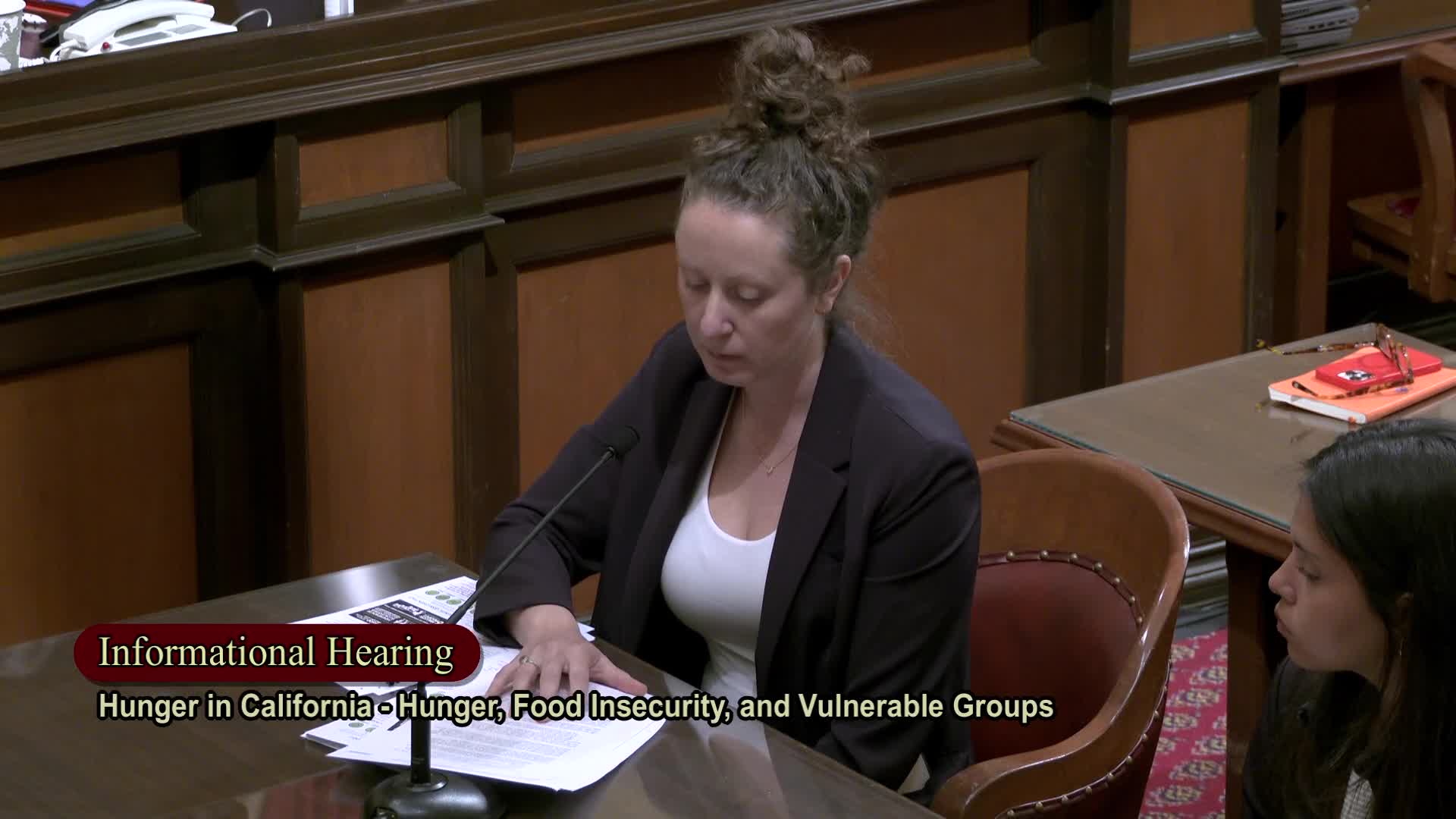
Representatives for farmers-market incentive programs and food banks told the Senate Committee on Human Services that California's nutrition incentive programs—Market Match (CNIP) and the CalFood state purchasing program—have measurable benefits for local farmers and households but face funding and administrative disruptions.
Sam Greenlee, executive director of Alchemist Community Development Cooperative and a CNIP steering-committee member, described Market Match as a "win-win-win" program that doubles CalFresh purchasing power at participating farmers markets and draws federal matching dollars. He said Market Match helped generate about $19.4 million in combined spending at farmers markets in 2023 and facilitated an estimated $15.6 million in local economic stimulus in California.
Becky Silva, director of government relations for the California Association of Food Banks (CAFB), told the committee that CalFood enabled the food-bank network to purchase 80 million pounds of food in 2024, representing roughly 37% of the network's food purchasing budget. Silva warned that CalFood funding will drop to $8,000,000 per year at the end of the fiscal year — a roughly 90% reduction from the recent three‑year average of about $60,000,000 annually — and that many food banks would have to cut food amounts, paid staff, or distribution sites if funding is not sustained.
Witnesses also described federal administrative disruptions: CAFB said the Emergency Food and Shelter Program funding was paused and that other federal programs, including the Local Food Purchase Assistance program and parts of The Emergency Food Assistance Program, experienced temporary freezes or funding uncertainty that disrupted operations for small farmers and food banks.
Why it matters: Market Match and CalFood both increase fruit and vegetable purchases and sustain local supply chains. Multiple panelists said higher CalFresh or local incentive benefits lead to healthier purchases and local economic activity, and multiple speakers urged the legislature to secure ongoing state funding for these programs.
Ending
Advocates asked lawmakers to sustain CalFood funding at $60,000,000 ongoing, to stabilize Market Match/CNIP, and to coordinate with federal partners to minimize administrative disruptions that hamper emergency and local purchase programs.