Get Full Government Meeting Transcripts, Videos, & Alerts Forever!
Get email alerts on the Learning Recovery Testimony topic
No spam. Unsubscribe anytime.
State Board President Linda Darling Hammond urges continued investment in TK, community schools, tutoring and teacher preparation
Summary
State Board of Education President Linda Darling Hammond testified to the Assembly budget subcommittee that California has made modest recovery gains but faces growing student needs; she urged continued investments in universal TK, expanded learning, community schools, tutoring, and teacher recruitment and retention programs.
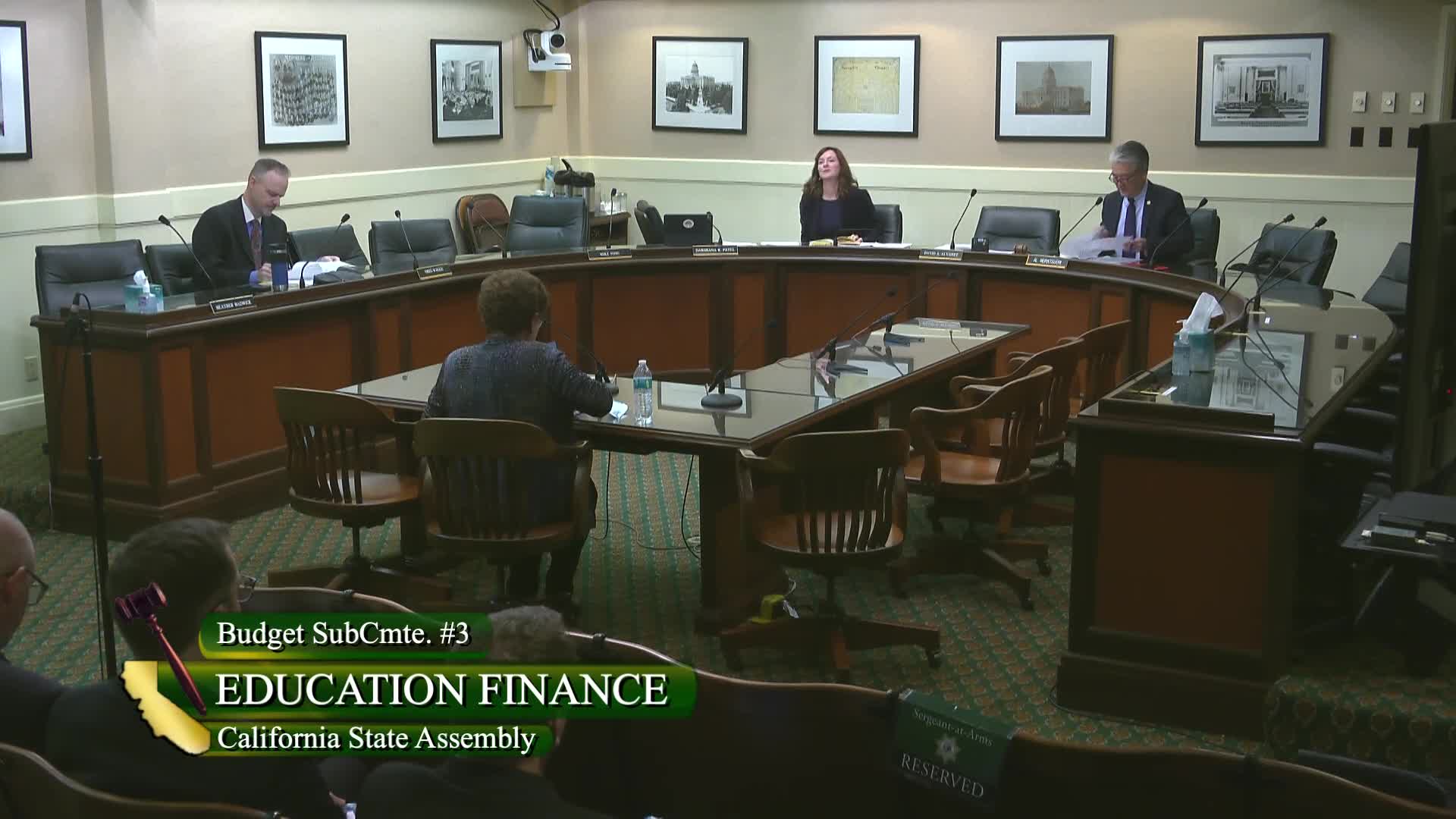
Linda Darling Hammond, president of the California State Board of Education, testified to the Assembly Budget Subcommittee No. 3 on student needs, learning recovery trends and budget priorities. Hammond summarized statewide assessment trends, demographic changes and recommended priorities for sustaining and improving recovery efforts.
Hammond told the committee that California’s student population shows increasing needs: 65% of recent NAEP test takers in 2023–24 were from low-income families (up from 63%), the number of students experiencing homelessness rose nearly 10% year-over-year, and the population of students with disabilities expanded. She said the state-wide NAEP and state test data show mixed results but noted that California’s declines were in some measures smaller than national declines and that fourth-grade math showed gains. Hammond said there were localized examples of recovery: “For the first time gains were larger than the state average for Black students and foster care students in many grades, beginning to close achievement gaps.”
Hammond linked observed improvements to targeted interventions and the use of recovery funds, saying districts that invested in tutoring, summer programs and community schools often demonstrated larger gains. She noted that a large portion of initial federal pandemic relief was used for one-time needs — devices, connectivity, HVAC and safety — and that other recurring pressures such as increased pension and health-care costs drain local budgets.
Hammond recommended continued and sustained support for several priorities: (1) full implementation of universal transitional kindergarten (TK) with attention to class length and staffing ratios; (2) expanded learning opportunities including summer and after-school programming; (3) community schools and braided funding strategies to reduce duplication and improve efficiency; (4) tutoring and targeted interventions shown to support recovery; and (5) teacher recruitment and retention, including debt-free preparation, loan-repayment incentives and support for National Board Certification. She said coaching and professional development that stay in districts are more effective than short-term workshops.
Hammond also urged attention to climate-driven school closures and chronic absenteeism, noting that natural disasters and fires have disrupted schooling and raised costs for districts. She emphasized screening and early literacy interventions for K–2 and support for high-need schools through programs that reduce turnover, improve teacher experience and reduce class size.
The committee thanked Hammond and indicated they would follow up on items including community schools, TK integration and workforce incentives.
Less-critical details: Hammond cited studies (Education Recovery Scorecard, Learning Policy Institute) and state assessment trends; she noted California’s higher-than-average poverty and English-learner shares compared with other states and referenced community-school cost-benefit evidence in other jurisdictions.