Get Full Government Meeting Transcripts, Videos, & Alerts Forever!
Get email alerts on the Elop Expansion topic
No spam. Unsubscribe anytime.
Subcommittee weighs expansion of Expanded Learning Opportunities Program to 55% threshold; LAO and stakeholders urge delay and rate stability for Tier 2
Summary
The governor's budget would expand Tier 1 ELOP eligibility from 75% to 55% unduplicated pupil percentage and add $435 million; LAO and multiple stakeholders recommended delaying implementation one year, stabilizing Tier 2 rates and considering alignment with ACES to reduce overlap.
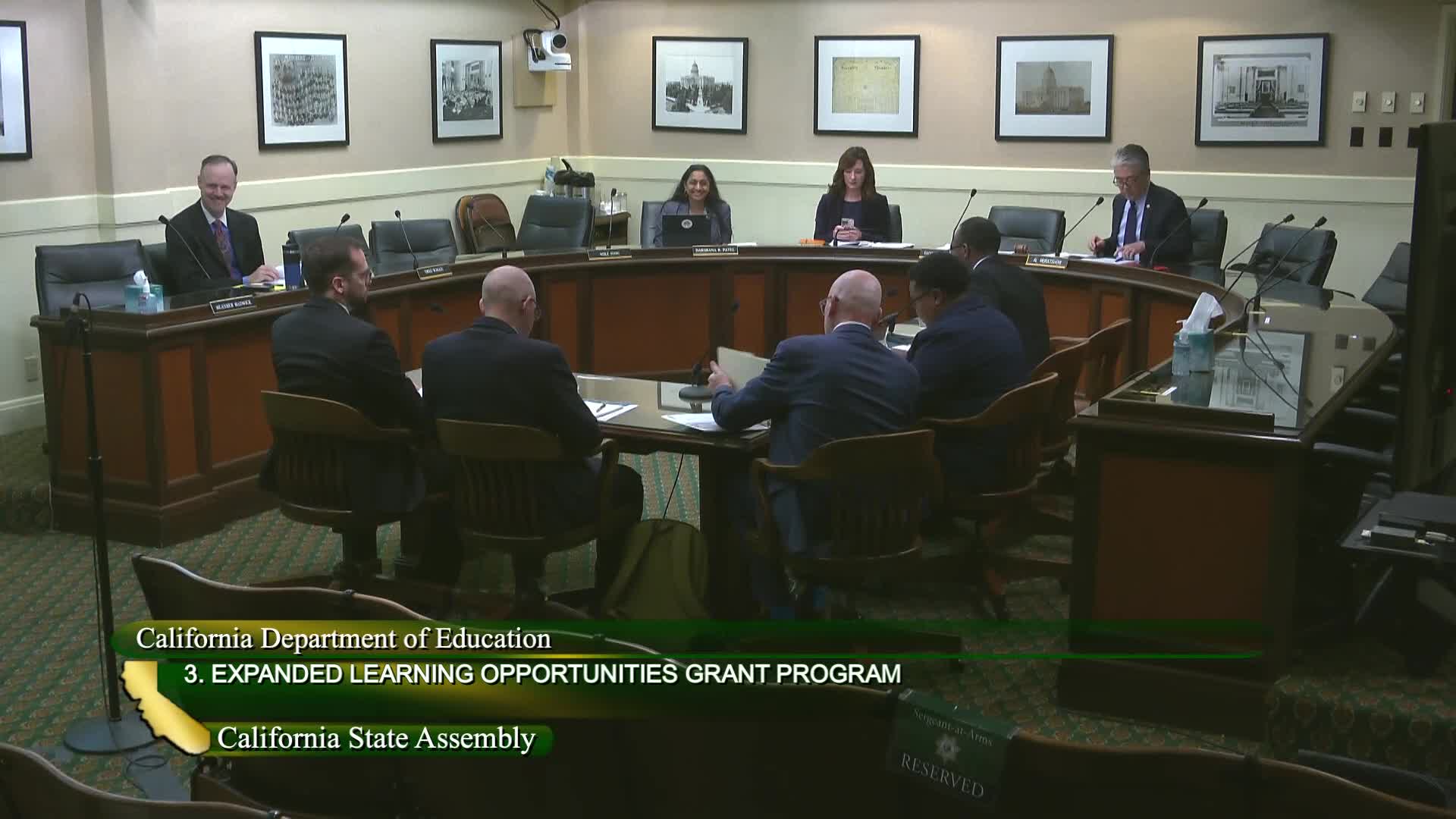
The Assembly Budget Subcommittee No. 3 examined the Governor’s proposal to expand the Expanded Learning Opportunities Program (ELOP), which funds before-, after- and summer-school programming for TK–6 students. The Department of Finance, Legislative Analyst’s Office and California Department of Education presented the proposal and related implementation questions.
George Harris of the Department of Finance summarized ELOP and the administration’s request to lower the Tier 1 threshold from 75% unduplicated pupil percentage to 55%, widening eligibility for the higher Tier 1 rate and aligning that threshold with the concentration grant. “The governor’s budget moves forward with the plan from the budget act of 2021 with full implementation of ELOP by increasing the number of local education agencies that offer universal access to students,” Harris said, and the budget includes a $435 million increase to bring total ELOP funding to about $4.4 billion ongoing Proposition 98 general fund.
The LAO said the $435 million estimate is reasonable for an expansion to 55% but recommended delaying implementation for at least one year to allow districts time to staff and establish programming. LAO analyst Dylan Ocziplozzo recommended three structural changes for consideration: (1) delay implementation and allow districts time to hire staff and build capacity; (2) consider aligning ELOP with the After School Education and Safety (ACES) program to reduce duplication and free funds for other priorities; and (3) transition ELOP funding over time from an enrollment-based allocation to a participation-based allocation (enrollment or an ADA/attendance metric) after the state collects participation data required under AB 1113.
Department of Education representatives noted both challenges and progress in local implementation. Michael Funk (CDE) and other department staff said districts with prior expanded-learning funding ramped up quickly, while districts that historically lacked after-school infrastructure were slower to begin programs and accounted for much of the unspent funds reported in early years. CDE staff also highlighted attempts to support inclusion of students with disabilities in expanded-learning programming and statewide trainings to improve practices.
Stakeholders who testified publicly echoed LAO recommendations. Several groups asked the Legislature to stabilize Tier 2 rates (which have declined year to year) and to increase minimum grants for small districts (stakeholders recommended increasing the $50,000 minimum to $100,000 so small districts can operate programs). Multiple witnesses warned against simply deducting ACES funding from ELOP allocations, saying that would penalize districts that invested to expand offerings.
Committee members asked about participation, summer-program access, and federal funding uncertainty for high-school after-school programs. Panelists cautioned that switching to a participation-based allocation could make local planning more difficult unless the state uses prior-year participation counts or other predictable measures; LAO and CDE recommended delaying any such transition until participation data collection is mature.
The committee held the ELOP item open for further follow-up and asked staff to consider LAO and stakeholder proposals aimed at stabilizing Tier 2 and ensuring predictable funding for smaller districts.
Less-critical details: witnesses referenced unspent funds from the initial roll-out; CDE said many districts accelerated spending in later years; LAO supplied a table showing tier-rate changes in staff materials.