Get Full Government Meeting Transcripts, Videos, & Alerts Forever!
Get email alerts on the Learning Recovery topic
No spam. Unsubscribe anytime.
Panel backs partial restoration of Learning Recovery Block Grant; LAO urges deadline extension to account for local planning
Summary
Committee heard that the governor’s budget proposes the first of three delayed payments to restore a $1.1 billion reduction to the Learning Recovery Emergency Block Grant; LAO said districts have spent most federal COVID funds only recently and recommended extending the expenditure deadline at least a year.
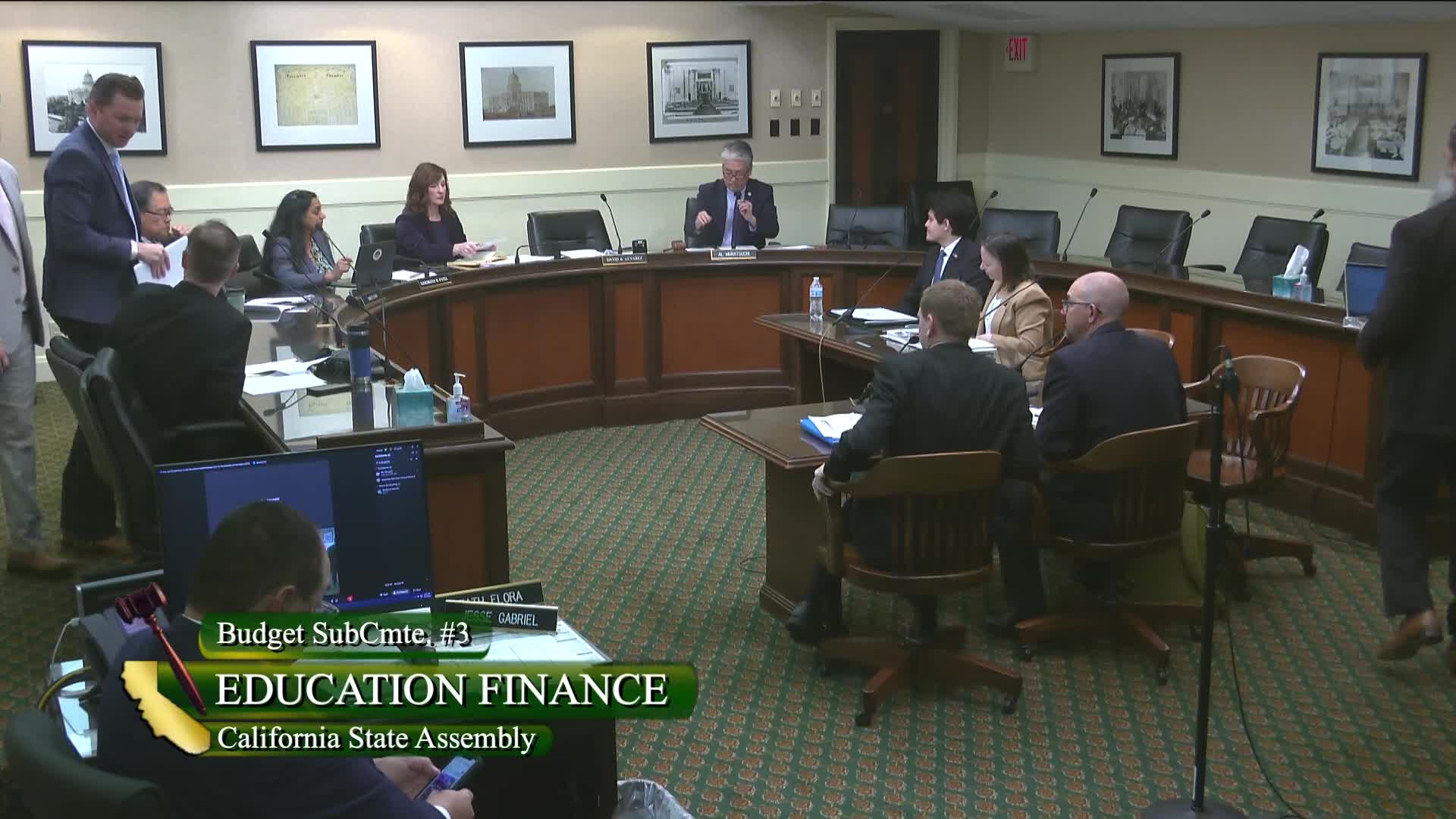
The Assembly Budget Subcommittee No. 3 on Education Finance considered the Governor’s proposal to restore previously delayed payments to the Learning Recovery Emergency Block Grant. The Department of Finance, Legislative Analyst’s Office and California Department of Education described the proposal, district spending patterns and how the funds are being used at the local level.
Hugo Solis Galena of the Department of Finance said the governor’s budget includes a one-time Proposition 98 appropriation of $378.6 million as the first of three delayed payments that together would repay a $1.1 billion reduction taken in 2023–24. He said the payment will be subject to the needs-assessment and LCAP reporting requirements added in the 2024 education omnibus trailer bill. “The proposed $378,600,000 is the first of 3 delayed payments,” Solis Galena said, and those funds are subject to the needs-assessment and reporting requirements specified by statute and trailer- bill language.
The Legislative Analyst’s Office reported interim spending data showing that of $6.8 billion allocated previously to districts from the block grant program, districts reported spending $1.6 billion through the 2023–24 school year; LAO staff said districts accelerated spending in 2024–25 and that the majority of the $6.8 billion has likely been spent. LAO analyst Ken Kipan called the governor’s restoration proposal reasonable but recommended extending the current June 30, 2028 expenditure deadline by at least one year, reasoning that local planning and the timing of installments make the existing deadline difficult for districts to meet.
The Department of Education’s William McGee said the department supports programmatic implementation and local technical assistance for the grant. Committee members pressed panelists on outcomes: LAO noted there are promising district-level reports (early literacy efforts, tutoring and counseling), but said broad statewide student-outcome measures will be limited until more funds have been spent and more local needs-assessment documentation is available. Finance and LAO witnesses said much of the initial federal pandemic funding was spent first (federal ESSER deadlines influenced local spending order), which contributed to the timing of local block-grant outlays.
Committee members held the item open for further follow-up and asked staff to continue monitoring district spending data and implementation outcomes. LAO’s formal recommendation—endorsed at the hearing—was to consider extending the expenditure deadline for the restored payments to accommodate local planning and the delayed receipt of funds.
Less critical details: the block grant supports activities including additional instructional time, tutoring, teacher training, and counseling; the allocation is targeted through existing needs-assessment and LCAP reporting structures enacted in 2024.