Get Full Government Meeting Transcripts, Videos, & Alerts Forever!
Get email alerts on the Lcff Cola topic
No spam. Unsubscribe anytime.
Assembly panel reviews LCFF funding, COLA assumptions and proposal to penalize districts that miss LCAP deadline
Summary
The California Assembly Budget Subcommittee No. 3 on Education Finance reviewed the Governor’s budget proposals for the Local Control Funding Formula (LCFF) and related policies, hearing presentations from the Department of Finance, the Legislative Analyst’s Office (LAO) and the California Department of Education.
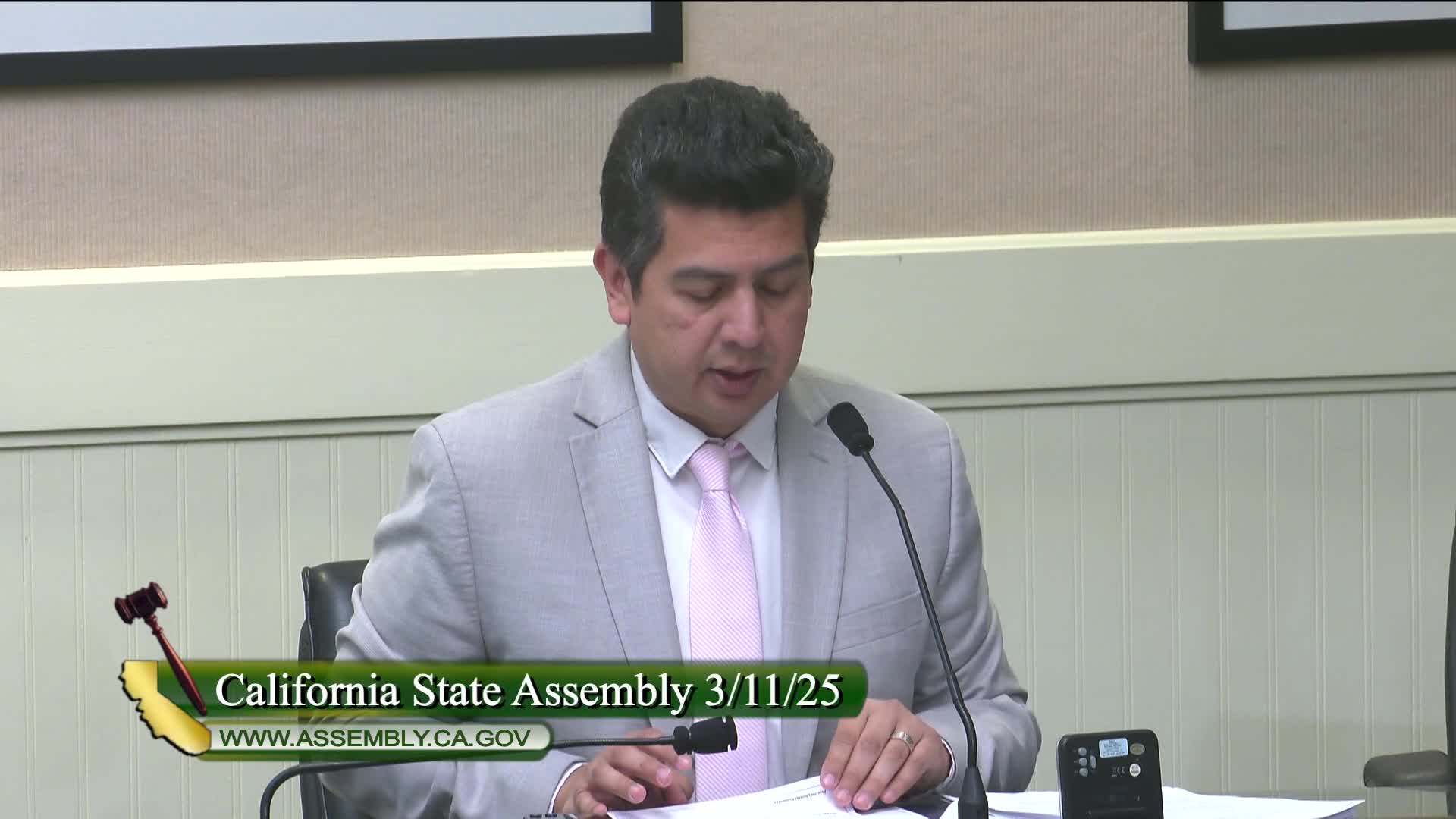
The California Assembly Budget Subcommittee No. 3 on Education Finance reviewed the Governor’s budget proposals for the Local Control Funding Formula (LCFF) and related policies, hearing presentations from the Department of Finance, the Legislative Analyst’s Office (LAO) and the California Department of Education. Committee Chair Alvarez opened the hearing and asked panelists to explain LCFF mechanics, cost-of-living adjustments and a proposed trailer-bill penalty tied to Local Control and Accountability Plan deadlines.
The Department of Finance’s Katie Lagomarcino described LCFF as the main source of unrestricted funding for local educational agencies, distributed on a per-student basis and weighted for low-income students, English learners and foster youth. “The bulk of unrestricted funding for local educational agencies is provided through the local control funding formula and is distributed based on the number of students served,” Lagomarcino said. The department said the budget assumes a 2.43% statutory cost-of-living adjustment (COLA) and projects total LCFF funding of roughly $83.4 billion in 2025–26, including adjustments for transitional kindergarten implementation and transportation.
Hugo Solis Galena of the Department of Finance described a trailer-bill proposal that would withhold state and federal apportionments from school districts and county offices of education that do not adopt an LCAP by the July 1 statutory deadline. Solis Galena said the proposal would also assess a penalty equal to 20% of a district’s second principal apportionment, increasing by 1 percentage point for each year the LCAP remains unadopted, up to an 80% cap, and would not reduce the final apportionment below constitutionally required levels. “The governor’s budget proposes the creation of a penalty for LEAs and COEs that do not adopt an LCAP by the July 1 deadline by withholding state and federal apportionments until they do adopt an LCAP,” he said.
The Legislative Analyst’s Office questioned parts of the budget’s assumptions. LAO analyst Michael Alfeteros said LAO’s current estimate for the statutory COLA calculation is 2.26%, lower than the administration’s 2.43% assumption, which would reduce LCFF costs by about $130 million if that estimate holds. LAO staff recommended the state consider alternative indices that better reflect labor and compensation cost pressures facing school districts rather than the current state-and-local government price index used to set the statutory COLA.
Committee members pressed panelists on regional cost differences and whether the COLA base should be recalibrated to California-specific or employee-compensation measures. LAO staff described a past recommendation to tie COLA to the state and local deflator focused on employee compensation, arguing school districts’ primary cost drivers are salaries and benefits rather than components such as volatile energy prices. Amber Alexander of the Department of Finance said the administration is aware of LAO’s recommendations and that the governor’s budget fully funds the statutory COLA.
Members also discussed how transitional kindergarten (TK) is treated in LCFF calculations. Finance staff said Ed. Code §48000 already includes TK in the K–3 grade-span adjustment and that LCFF should cover TK costs; LAO staff noted potential technical issues: because TK now carries a statutory TK class-size cap of 24, districts could theoretically raise class sizes in K–3 while still meeting the cap for TK, creating a planning tension. The panel and committee asked staff to analyze whether the K–3 grade-span adjustment and TK statutory caps should be restructured to avoid unintended consequences for K–3 class sizes.
Committee members repeatedly distinguished two separate pressures on district budgets: (1) inflationary cost increases for salaries, benefits and utilities, and (2) declining average daily attendance (ADA) and enrollment that change LCFF entitlement calculations. LAO and Finance explained that Prop 98 funding is rebenchable for newly eligible TK students but not automatically rebenched downward for statewide enrollment declines. The LAO noted that because LCFF cost growth depends on both COLA and ADA, declines in ADA have moderated LCFF cost pressures in recent years.
The committee asked staff to work with LAO on potential COLA alternatives and to examine how TK integration into K–3 adjustments should be handled to avoid unintended class-size impacts. Chair Alvarez held the issue open for future follow-up and directed staff to continue coordinating with LAO on technical options identified during the hearing.
Less-critical details: panelists repeatedly noted the statutory COLA calculation and that final COLA figures are typically set after federal/state data updates in April. Panelists also discussed the role of one-time funds and the state’s equity goals in distributing discretionary grants.