Get Full Government Meeting Transcripts, Videos, & Alerts Forever!
Get email alerts on the Caregiver Engagement topic
No spam. Unsubscribe anytime.
Austin ISD outlines plan to lift caregiver-engagement goals after November self-assessments
Summary
District staff reported that most campuses set caregiver-engagement goals aligned with the dual capacity building framework but few reached the "master's" level by November 2024; the department plans trainings, KPIs and targeted outreach to 21 campuses that had no goal.
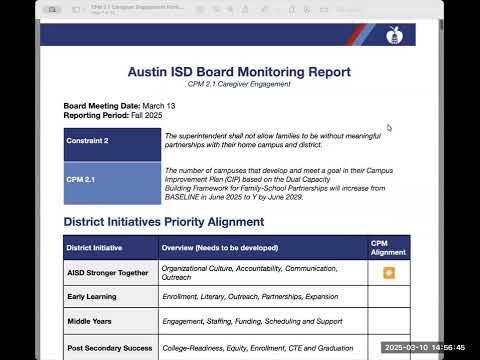
Ally Ghilarducci, chief of communications and community engagement for Austin Independent School District, told the board that a district performance measure (CPM 2.1) will track how many campuses develop and meet caregiver-engagement goals aligned with the dual capacity building framework.
Ghilarducci said the district used campus improvement plan data collected in November 2024 to establish a baseline and that the formal summative self-assessment in June 2025 will set the official baseline for multi-year targets. "The superintendent shall not allow families to be without meaningful partnerships with their home campus and district," she said, reading the CPM constraint that guides the measure.
The presentation found that 72.4% of campuses developed caregiver-engagement goals that landed in the "approaches" category of a locally created rubric and that 7.8% developed goals that demonstrated "master's" level alignment. Ghilarducci said nine campuses set master's-level goals; none of those campuses had achieved the goals as of the November self-assessment.
Ghilarducci described variation across school performance bands: Band 1 campuses had the highest share at the approaches level and the largest number achieving master's-level goals. She said 21 campuses reported no caregiver-engagement goal in their CIP; of those, six were band 1, six band 2, five band 3 and four band 4.
Ghilarducci identified training gaps and inconsistent goal articulation as primary root causes. "Limited training on the dual capacity building framework is likely a strong cause," she said, and added that some principals frame engagement as participation or service provision rather than partnership. She recommended training principals on how to craft goals that align with the framework and consistent norms for the formative and summative self assessments.
District staff highlighted campuses the presentation labeled outliers. Oak Springs Elementary, which the presenter said has 96.94% of students classified as economically disadvantaged and 73.3% emergent bilingual, used a summer block walk and monthly family workshops to inform and sustain caregiver activities; the campus reported increases in attendance. Principal Senegal described sponsor-supported initiatives including a rent rewards and educator rewards program sponsored by Dream Together 2030 aimed at addressing family economic hardship.
Navarro Early College High School set a caregiver-engagement goal and was reported as the district's first high school to adopt the "Families as Partners" program; Principal Kovan said Navarro aims to double its parent champions from three to six by May 2025 to help families understand literacy and CCMR (College, Career and Military Readiness) opportunities. Kovan said 78% of Navarro's 2025 cohort is currently on track to meet CCMR criteria and staff expect parental engagement to support future cohorts.
Webb Middle School, which the presentation listed as 97.23% economically disadvantaged and 78.6% emergent bilingual, reported tripling participation in "coffees with the principal" and adding student members to its campus advisory council. Principal Michael Coyle credited a strong parent support specialist, multilingual communications and offering each engagement opportunity twice (a morning and an evening session) for improving participation.
To support campuses, district staff said they will develop training materials about the dual capacity building framework and the rubric, offer mini-trainings at principals' meetings, provide summer training sessions, and schedule touchpoints during the 2025–26 school year. Ghilarducci described a district initiative called ASD Stronger Together, organized around four scopes—front office experience, family engagement aligned by vertical team, streamlined communications and central office responsiveness—that staff intend to use to reinforce campus efforts.
Other central actions described in the presentation include using a regional parent support team funded by a City of Austin parent support grant to assist 45 campuses without an assigned parent support professional; bringing volunteer coordination in-house for 2024–25 (previously managed by Austin Partners in Education); transitioning to a new district communications platform for alerts and newsletters; and planning a pilot to improve vertical-team alignment in the northeast vertical for 2025–26.
Ghilarducci said the district is developing key performance indicators (KPIs) tied to each dual capacity standard—examples included quarterly audits of campus websites and tracking volunteer platform usage—and will prioritize outreach to band 1 and 2 campuses. She described plans to create a real-time tracking tool for campus advisory council (CAC) compliance and quality; currently, the district conducts annual spot checks and has 100% compliance on roster submission, she said.
The presentation emphasized that the November data represent formative, self-reported progress and that the district will use the June 2025 summative self-assessment to establish the official baseline and multi-year targets. Ghilarducci said the department will contact the 21 campuses without a goal to encourage development of a goal this spring even if the campus's effort will not count toward the first-year baseline. No formal board vote was reported during the presentation.
Ghilarducci closed by saying the district will provide additional training for principals, parent support staff and other campus support roles and will continue to refine KPIs to support campus caregiver-engagement goals.