Get Full Government Meeting Transcripts, Videos, & Alerts Forever!
Get email alerts on the School Finance topic
No spam. Unsubscribe anytime.
Sumner County school board urges county commission to consider repaying booster-club debts after Westmoreland field‑house loan
Summary
The Sumner County Board of Education voted unanimously Feb. 18 to approve a nonbinding resolution encouraging the Sumner County Commission to pay off outstanding athletic booster‑club debt across the county.
The Sumner County Board of Education voted unanimously Feb. 18 to approve a nonbinding resolution encouraging the Sumner County Commission to pay off outstanding athletic booster‑club debt across the county.
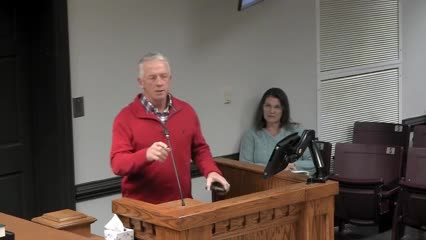
The board’s action follows a public comment from Rick Duffer, principal of Westmoreland High School, who described how parents and community members personally guaranteed loans so the school could replace a condemned field house and add lights. “Ten people at $36,000 each … some of which did HELOCs, home equity line of credit, so that we could build a facility for our kids,” Duffer said, and later summarized that Westmoreland’s boosters still carry roughly $325,000 in debt related to those projects and that the boosters still owe about $49,000 on the baseball‑field lights.
Board members spent more than an hour discussing the scope and language of the resolution, including whether to add a paragraph urging the commission to allocate payments to other booster groups that had not taken on debt but had contributed privately to facility improvements. That proposed amendment to broaden the ask was debated and voted down. Several board members argued for a narrower, phased approach; others said the board should show broad support for all booster groups.
Director of Schools Dr. Langford placed the measure in a broader context of capital funding and past practice, describing a shift in approach under current leadership. “I would also recommend that we consider a policy as a school board to say that we don't let SSOs take on debt anymore,” Langford said, urging a review of policy to prevent future reliance on private debt for district facilities.
Several board members emphasized the nonbinding nature of the resolution and that the commission makes final fiscal decisions. Board member Charles Evans, who presented the resolution, said the intent was to put a comprehensive request before the commission so commissioners could “dissect, discuss, and debate” it.
The board rejected two amendments offered during debate: one to remove language asking the commission to allocate payments to groups that had not incurred debt (the motion to remove that paragraph failed), and another amendment that would have narrowed the request to a single, specified reimbursement for Westmoreland (that narrower amendment also failed). The final, unamended resolution as approved asks the Sumner County Commission to pay off outstanding booster‑club debt and to consider countywide approaches to support athletic facilities.
Board members and the director repeatedly noted the county commission’s limited undesignated funds, and several members urged a phased approach to avoid overburdening county reserves; others argued that paying booster debts would correct an inequity left by past practice.
The resolution is advisory: it asks the county commission to act but does not obligate the Board of Education to provide funds. The board also asked its education committee to consider and make recommendations about how remaining booster club debts might be handled going forward.
The discussion brought more than an hour of public and board attention to how Sumner County schools have historically funded athletic facilities, the role of school support organizations in raising private funds, and whether district policy should be changed to prevent private debt for facilities in the future.
The board’s vote on the resolution was recorded by roll call and passed unanimously.