Get Full Government Meeting Transcripts, Videos, & Alerts Forever!
Get email alerts on the Disability Employment Minimum Wage topic
No spam. Unsubscribe anytime.
Labor committee hears DLI bill to phase out subminimum wages for people with disabilities; refers measure to Human Services
Summary
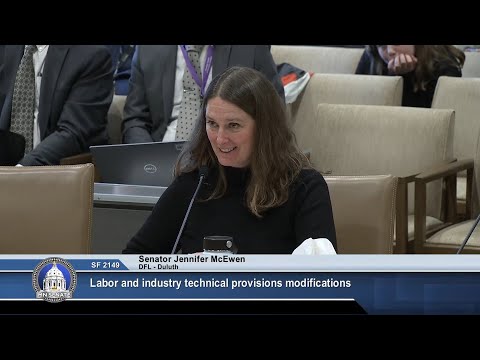
The Minnesota Senate Labor Committee on March 11, 2025 heard Senate File 2149, the Department of Labor and Industry's policy and technical bill, which would phase out use of Section 14(c) subminimum wages for people with disabilities, expand DLI authority to seek temporary restraining orders in urgent labor-law cases, and make construction-code technical fixes.
ST. PAUL, Minn. — The Minnesota Senate Labor Committee on March 11, 2025 heard Senate File 2149, the Department of Labor and Industry’s policy and technical bill, which includes a phased elimination of subminimum wages for people with disabilities and new authority for the department to seek temporary restraining orders in certain labor-law cases. After hours of testimony from disability advocates, providers and families, the committee laid over the bill and voted to refer it to the Senate Human Services Committee without recommendation.
The proposal would prohibit hiring workers under subminimum wage rules for new positions beginning Aug. 1, 2026, and prohibit paying any employee less than the highest applicable minimum wage by Aug. 1, 2028. It also would permit the Department of Labor and Industry (DLI) to seek court orders to enjoin urgent violations of employment law beyond its current authority under the Child Labor Act, and would make technical updates to electrical licensing code references.
Supporters said the bill completes work already begun in Minnesota to remove exceptions that permit employers to pay people with disabilities less than minimum wage. Josiah Moore, legislative director at the Department of Labor and Industry, told the committee that the changes would “remove the subminimum wage for people with disabilities, ensuring that workers with disabilities are entitled to the same minimum wage as other workers in the state.” Jonah Kesey, legal advocate at the Minnesota Disability Law Center, urged a phase-out by Aug. 1, 2028, calling the 14(c) program “a story of lawmakers’ good intentions gone awry.” Several providers and unions, including representatives from ARC Minnesota, LifeWorks Services, the Minnesota AFL-CIO and AFSCME Council 5, testified in favor of the phase-out and of the temporary restraining order authority.
Opponents — including some family members and providers — warned that eliminating Section 14(c) without adequate, ongoing funding and transition supports could leave people with severe disabilities without paid work or appropriate day services. Martie Silery, a former job development specialist and parent, told the committee that “for many who are unable to work in competitive employment due to severe cognitive impairment, a better choice is available” under current 14(c) arrangements and that forcing minimum-wage requirements could lead to fewer providers offering work opportunities. Parent Jim Clapper said existing transition efforts have produced limited gains for some participants and urged caution and further review of outcomes from other states.
Committee members pressed both sides on implementation details, including whether current Medicaid-funded employment and day services would remain available and how technical-assistance grants already in place would be used. Christie Grama of the Minnesota Department of Human Services told the committee that federal- and state-funded employment services (including employment exploration, development, and support) and day support services remain available under current Medicaid rules and that recent reforms and rate increases were intended to strengthen those services.
The committee considered an amendment (A-1) offered by Senator Liske that would have removed the bill’s language phasing out Section 14(c) and retained 14(c) as an option. The amendment failed on a 5–5 roll call (tie fails). Later, after motions and brief procedural pauses, the committee voted 10–0 to refer SF 2149 to the Senate Human Services Committee without recommendation and laid the bill over for possible inclusion in future action.
Votes at a glance: - A-1 amendment (retain 14(c) option): 5 ayes, 5 noes — amendment failed. - Motion to refer SF 2149 to Senate Human Services Committee without recommendation: 10 ayes, 0 noes — motion adopted; bill referred.
What happened next: The committee laid the bill over for possible inclusion and referred it to Human Services without recommendation. No final enactment or appropriation was made by the Labor Committee; proponents and opponents asked Human Services and other committees to continue vetting implementation details, funding and timelines.
Why this matters: The bill touches on employment, wages and human-services funding for people with disabilities. Committee testimony highlighted a policy tension: advocates say a phase-out corrects a discriminatory exception and expands employment options through “customized employment,” while some families and providers say transition risks and local service capacity must be addressed first. The bill’s phase-out dates (Aug. 1, 2026, and Aug. 1, 2028) set a legal timeline that would require programmatic and contracting changes at the provider, local and state levels if enacted.
Provenance: Excerpts of committee testimony and the roll-call result were used as the primary source. Evidence spans include Senator McKeown’s introduction of the bill and the committee’s final referral announcement (see provenance segment references).